## What changed

- Add `[skills].max_context_tokens` to override the token budget used to render the available-skills catalog.
- Require a positive value and cap configured budgets at 10,000 tokens.
- Preserve the existing default of 2% of the model context window when the option is unset.

## Testing

- Cover configuration parsing, override behavior, the 10,000-token cap, and catalog rendering within the configured budget.

GitOrigin-RevId: f29ddcb57fc2d800c0006d03e1c33cbe3ab6272d
## What changed

- Treat workload identity environment markers as an explicit authentication selection, even when another process credential is present.
- Return initialization errors from `AuthManager` and propagate them through commands and services instead of continuing with an unusable authentication state.
- Make `codex login status` validate workload identity, keep the TUI on an embedded app server for local workload identity, and reject workload identity in `codex mcp-server`, where it is unsupported.

## Testing

- Cover workload identity precedence and partial configuration errors.
- Verify login status reports an unreadable identity assertion and app-server routing enforces the supported workload identity topology.

GitOrigin-RevId: efc6b6b4cd4d61652617de82aaa3d7ffc75d6618
## What changed

- Add `TurnInputRequest` and typed submission results for atomically starting a turn, steering the active turn, or declining input with a specific reason.
- Expose `start_or_steer_turn`, `start_turn_if_idle`, and `steer_turn` on `CodexThread`, and migrate Core consumers to these APIs.
- Make app-server `turn/start` steer an active regular turn and return that turn's ID. Reject incompatible output schemas and non-steerable turns without applying settings or enqueueing input.

## Testing

- Cover concurrent start-or-steer submissions, accepted and rejected settings updates, output-schema compatibility, idle-start rejection, and app-server steering.

GitOrigin-RevId: dd9b5528d76ec650c019e97af420bc13190ea86a
## Why

`parent_turn_id` identifies the immediate caller of a nested request, but not the
top-level turn that initiated a multi-level chain of work.

## What changed

- Add `root_turn_id` to turn state, submissions, and Responses API metadata.
- Propagate the root through spawned agents, delegated work, review sessions, and
  turn-triggering inter-agent messages.
- Omit the root when background work has no user turn or combined input makes the
  root ambiguous.

## Testing

Added coverage for nested agent resumes, reviews, mailbox delivery, steered input,
and reserved metadata handling.

GitOrigin-RevId: 60057db2ee81f4efefa946a9f63c74ff98b93929
## What changed

- Add a storage-neutral queue extension for listing, adding, editing, reordering, deleting, and explicitly starting queued user messages.
- Dispatch queued messages in FIFO order when a thread becomes idle after a completed turn, while leaving them queued after interruptions or failures.
- Wait for user input to be persisted before removing its queue item, and report hook rejection, task termination, and persistence failures distinctly.
- Snapshot local image and audio attachments into validated data URLs before storing them, enforce input limits, and emit `ThreadQueueChanged` events after mutations.

## Testing

- Cover queue mutations, automatic and explicit dispatch, interruption and failure behavior, hook rejection, invalid records, input limits, and local attachment snapshotting.

GitOrigin-RevId: 14f39d7c8cbaccb767a6da84b82cced0edfcb4b9
## Why

Authentication restrictions must apply before stored or environment-provided credentials can be used, including during bootstrap before cloud requirements are fetched.

## What changed

- Add local `requirements.toml` allowlists for login methods and ChatGPT workspaces. Ignore these fields in cloud-provided requirements.
- Combine managed workspace allowlists with existing workspace restrictions by intersection, and fail closed when the resulting policy permits no usable login method.
- Centralize policy checks in the authentication manager so CLI, TUI, app-server, external-auth, and credential-loading paths consistently reject disallowed authentication before token hydration or network requests.

## Testing

- Cover policy composition, workspace intersection, invalid stored and external credentials, bootstrap enforcement, and login endpoint restrictions.

GitOrigin-RevId: efef22b248f3c3333e9aa55423e539efa2d2dd48
## What changed

- Update the required pull request attribution to `Generated with [Codex](https://openai.com/codex/).`.
- Recognize the previous unlinked attribution when restoring saved context so it can be replaced without duplicating the attribution instructions.

## Testing

- Cover cold resume with both commit-only legacy instructions and the previous unlinked pull request attribution.
- Update app-server and MCP server assertions for the linked attribution.

GitOrigin-RevId: 8773546a6a59dab146905e50cf4434d53b9335cf
## What changed

- Install the skills extension for MCP Codex tool sessions so host skills are
  included in the developer instructions.
- Route extension warnings to the matching active MCP turn as `codex/event`
  notifications, preserving request and thread metadata and ordering warnings
  before the final tool response.
- Track reply turns independently and bound forwarded warning messages to 256
  UTF-8 bytes.

## Testing

- Add unit coverage for active-turn routing, request ID collisions, warning
  ordering, filtering, and truncation.
- Add an MCP integration test for host skill instructions and skills context
  budget warnings.

GitOrigin-RevId: 9e5c699665f6889bf1103e78c3d6ca53824a10a0
## What changed

- Propagate the initiating turn ID through agent spawns, follow-up tasks, reviews, and delegated Codex sessions.
- Add `parent_turn_id` to Responses client and turn metadata while keeping it out of external MCP metadata.
- Preserve parent-turn provenance across queued agent messages when their triggering parent is unambiguous.

## Testing

- Cover spawned, resumed, nested, reviewed, delegated, and WebSocket request metadata.
- Verify queued messages do not claim ambiguous or queue-only parent turns.

GitOrigin-RevId: 481fdebbe7df2031880fe259509273cce50b20a8
## What changed

- Update the `rmcp` model and transport integrations for `3.0.0-beta.3`.
- Preserve legacy `elicitation/create` form requests, schema defaults, metadata, and wire-format compatibility while adopting the new elicitation types.
- Harden OAuth discovery by using GET-first discovery without starting an MCP session, preventing cross-origin header redirects, validating authorization-server and callback issuers, and retaining compatibility with metadata that omits an issuer.
- Keep stored OAuth credentials readable and avoid requiring reauthorization after transient refresh failures.

## Testing

- Add coverage for legacy elicitation round trips, OAuth discovery variants, callback issuer validation, credential migration, and refresh failures.

GitOrigin-RevId: 756197d26f3fd347c28c400228f6b3d06ed493b7
## What changed

- Set the Rust recursion limit to 256 for both the MCP server library and binary crates.
- Populate `started_at_ms` in the thread-fork test's completed-item fixture.

GitOrigin-RevId: b25eeaeecaf94265fe3be8f23cb3c395595afc2a
## What changed

- Add optional `plugin_id` and `script_path` fields to execution approval and guardian assessment events.
- Propagate validated plugin attribution through delegated approvals, guardian-reviewed command items, app-server notifications, thread history, and rollout traces.
- Preserve attribution on both started and completed command items, including declined commands.

## Testing

- Extend core, app-server, thread-history, and rollout-trace tests to cover plugin attribution propagation and serialization.

GitOrigin-RevId: 723684d010cab04142918d7a95e06ed95d008da1
## Why

The TUI must inspect the default execution environment before loading its final
configuration. Initializing the environment manager at that point can give
startup services the bootstrap HTTP policy instead of the effective policy after
managed requirements are applied.

## What changed

- Split environment discovery from manager construction so callers can inspect
  the default environment without starting remote connections.
- Build the environment manager after final configuration loading and pass its
  resolved `HttpClientFactory` through all construction paths.
- Add shared test support for managers that use the legacy default HTTP policy.

## Testing

- Cover connection-free environment discovery and explicit HTTP policy
  propagation.
- Verify TUI startup services use the final managed `respect_system_proxy` value.

GitOrigin-RevId: 928fa31e6b4bcfbe1a121cade2f351427fdfa0f4
## What changed

- Install the git attribution extension in the app server, MCP server, and `codex debug prompt-input` so authenticated workspace policy controls the commit and pull request attribution instructions sent to the model.
- Resolve attribution settings from the process-level ChatGPT base URL, independent of per-thread or per-tool configuration overrides.
- Treat git attribution as contextual developer content when mapping model events.

## Testing

- Cover policy fetch retries, workspace switches, rollbacks, cold thread resumes with legacy instructions, MCP tool calls, and prompt-debug output.

GitOrigin-RevId: 57d182c432c20d7c1c6c429057b6163c9f32088d
## What changed

- Add `StartThreadOptions::new` to provide the standard configuration for a new thread.
- Make `ThreadManager::start_thread` the single thread-start entry point and migrate callers from the previous convenience methods.
- Derive default environment selections when `environments` is `None`, while preserving explicit selections, including an empty list.

GitOrigin-RevId: 8977dc11aed54c5e1215a81eaed2b2cf5fc6087a
## What changed

- Change `ReviewDecision::Denied` to carry a rejection string and update the generated protocol schemas.
- Preserve specific rejection reasons through command, patch, network, MCP, delegated, and automatic approval flows so tool results can return them to the model.
- Distinguish invalid approval responses from user declines and truncate oversized rejection messages before adding them to model context.

## Testing

- Add coverage for denial serialization, invalid app-server approval responses, dropped automatic reviews, network rejection propagation, and rejection-message truncation.

GitOrigin-RevId: d48a55643aa03c7ecfa08a8e4b669913eec5464a
## What changed

- Remove unused APIs and test helpers across the Rust workspace.
- Route Linux sandbox test setup through the shared exec request path.
- Drop dependencies that became unnecessary after the cleanup.

GitOrigin-RevId: 48fd9b2b1575bad7add0819786b4d8ec88d8486f
## What changed

- Track connected and disconnected states across initial remote exec-server connections and reconnection attempts.
- Emit experimental `thread/environment/connected` and `thread/environment/disconnected` app-server notifications for each thread selecting the environment. Each payload identifies the thread and environment; current state is not replayed when a thread starts.
- Stop forwarding connection events when an environment selection is removed or replaced.

## Testing

- Cover connection, disconnection, reconnection, shared-environment notifications, and replacement of a selected environment.

GitOrigin-RevId: 5dd767372363c4a2a8319fc16164be117d5bd20c
## What changed

- Accept a caller-provided `CodexAppsToolsCache` when constructing a `ThreadManager` and pass it through to the MCP manager.
- Add `ConnectorRuntimeManager::new_without_cache()` for an in-memory runtime that neither loads nor persists connector state on disk.
- Re-export `CodexAppsToolsCache` from `codex-core` and `codex-core-api` for embedders.

## Testing

- Verify that a cache-disabled connector runtime ignores existing disk state and publishes live tools without creating cache files.

GitOrigin-RevId: f52f4f27c425a8d84ad0d0987b30a6fc3c14d702
## Why

Clients that account for individual upstream Responses API calls need the exact
usage for each completion rather than accumulated or estimated thread usage.

## What changed

- Add the opt-in `rawResponse/completed` app-server notification with the
  `threadId`, `turnId`, `responseId`, and upstream `usage` payload.
- Emit the transient event for normal turns and compaction requests when
  `experimentalRawEvents` is enabled. The event is not persisted or replayed,
  and `usage` is `null` when the upstream response omits it.
- Export the notification in the app-server schemas and document its behavior.

## Testing

- Cover exact token breakdowns for turn and compaction completions.

GitOrigin-RevId: 49040a060bf1784c1ff1dd62112efb4a778428c4
## Why

Embedding callers need to control whether model catalogs are persisted to disk.

## What changed

- Accept a shared models manager when constructing `ThreadManager` instead of always creating a cached manager internally.
- Add provider APIs for creating uncached model managers. OpenAI-compatible providers fetch on each `OnlineIfUncached` refresh without reading or writing `models_cache.json`.
- Keep existing app server, MCP server, sample, and test callers on the standard cached manager.

## Testing

- Verify an uncached manager fetches on every refresh.
- Verify an injected uncached manager controls thread refresh behavior and does not create `models_cache.json`.

GitOrigin-RevId: 8bb646054ecec4ccb865b2bf56249384916ea9db
Pick up the AgentGraphStore migration.

- Inject an explicit optional agent graph store into `ThreadManager`
- Move all calls to spawn, close, recursive resume, and
subtree/archive/delete/feedback traversal through it
- Keep using  `LocalAgentGraphStore` when SQLite is available

This required some changes to the interface to deal with futures:

- The interface now matches `ThreadStore`'s object-safe pattern by
returning a boxed `AgentGraphStoreFuture` directly, allowing
`ThreadManager` to hold `Arc<dyn AgentGraphStore>`

*Slight behavior change!* Unfiltered subtree enumeration now performs a
single all-status breadth-first traversal, so a closed grandchild
beneath an open edge is included; the previous Open-then-Closed
traversals could not cross mixed-status paths and silently omitted it.
Responses API safety buffering metadata currently stops at the transport
boundary, so app-server clients cannot render the in-progress safety
review state.

This change:
- decodes and deduplicates `safety_buffering` metadata from Responses
API SSE and WebSocket events without suppressing the original response
event
- emits a typed core event containing the requested model plus backend
use cases and reasons
- forwards that event as `turn/safetyBuffering/updated` through
app-server v2 and updates generated protocol schemas
- keeps the side-channel event out of persisted rollouts and turn timing

This supports the Codex Apps buffering UX and depends on the Responses
API backend work in https://github.com/openai/openai/pull/1044569 and
https://github.com/openai/openai/pull/1044571.

Validation:
- focused `codex-core` safety-buffering integration test passes
- `cargo check -p codex-core -p codex-app-server -p
codex-app-server-protocol`
- `just fix -p codex-api -p codex-protocol -p codex-core -p
codex-app-server-protocol -p codex-app-server -p codex-rollout -p
codex-rollout-trace -p codex-otel`
- `just fmt`
- broad package test run: 4,430/4,492 passed; 62 unrelated
local-environment/concurrency failures involved unavailable test
binaries, MCP subprocess setup, and app-server timeouts
Stacked on #28822.

## Summary

- add a host-injectable current-time provider with a built-in system
implementation
- record UTC developer reminders in history immediately before due model
requests
- keep cadence state per session and force a refresh after compaction

This does NOT include the app server client <-> server clock logic. This
PR is only for the reminder message & system clock that will be used in
prod.

## Testing

- `just test -p codex-core varlatency_`
- `just clippy -p codex-core -p codex-app-server -p codex-mcp-server -p
codex-thread-manager-sample`
- `just fmt`
## Why

Command approval cache keys included the command and working directory,
but not the execution environment. An approval for `/workspace` locally
could therefore be reused for the same command and path on an executor.

## What changed

- Include the selected environment ID in shell and unified-exec approval
cache keys.
- Carry that ID through the normal command approval request so clients
can show which environment is being approved.
- Expose the environment through app-server as a required nullable
`environmentId` and show it in the inline TUI approval prompt.
- Keep older recorded approval events compatible when the environment is
absent.

For example, `echo ok` in local `/workspace` and `echo ok` in executor
`/workspace` now produce different approval keys and separate prompts.

## Scope

This PR does not change network approvals, Guardian review actions, MCP
elicitation, full-screen TUI rendering, or environment-ID validation.
Remote `shell_command` execution itself remains in #28722; this PR only
makes its approval key environment-aware.
The workspace denies `clippy::expect_used` in production. Although
`clippy.toml` allows `expect` in tests, Bazel Clippy compiles
integration-test helper code in a way that does not receive that
exemption, which encouraged verbose `unwrap_or_else(... panic!(...))`
and equivalent `match`/`let else` forms.

This allows `clippy::expect_used` once at each integration-test crate
root (including aggregated suites and test-support libraries), then
replaces manual panic-based Result and Option unwraps with
`expect`/`expect_err`. Standalone `tests/*.rs` files remain their own
crate roots. Intentional assertion and unexpected-variant panics remain
unchanged, and the production `expect_used = "deny"` lint remains in
place.

The cleanup is mechanical and net-negative in line count.
## Why

We want to remove implicit use of `$CODEX_HOME` from `codex-core` and
make embedders responsible for supplying user-level instructions. This
also ensures user instructions load when no primary environment is
selected.

## What changed

Stacked on #27415, which makes `codex exec` surface thread-scoped
runtime warnings.

- Added `UserInstructionsProvider` to `codex-extension-api`, with
absolute source attribution and recoverable loading warnings.
- Added `codex-home` with the filesystem-backed provider for
`AGENTS.override.md` and `AGENTS.md`, preserving precedence, fallback,
trimming, lossy UTF-8 handling, and the existing uncapped global
instruction size.
- Removed global instruction loading from `Config` and require
`ThreadManager` callers to inject a provider.
- Load provider instructions once for each fresh root runtime, including
runtimes without a primary environment. Running sessions retain their
snapshot, while child agents inherit the parent snapshot without
invoking the provider.
- Keep provider instructions separate while loading project `AGENTS.md`,
then assemble the model-visible instructions with the existing ordering,
source attribution, warning, and turn-context behavior.
- Wired the Codex home provider through the CLI, app server, MCP server,
core facade, and thread-manager sample.

## Validation

- `just test -p codex-home -p codex-extension-api`
- `just test -p codex-core agents_md`
- `just test -p codex-core guardian`
- `just test -p codex-app-server
thread_start_without_selected_environment_includes_only_global_instruction_source`
- `just test -p codex-exec warning`
- `just bazel-lock-check`
## Why

Multi-agent v2 identifies agents by canonical paths, but its tool
handlers still emitted the larger legacy collaboration begin/end events
built around nickname and role metadata. App-server, rollout-trace,
analytics, and TUI consumers therefore lacked one compact path-based
completion signal that behaved consistently across live events and
replay.

The TUI also needs a bounded `/agent` status surface for v2 agents. It
should use recent local activity for previews, refresh liveness without
loading full histories, and keep the legacy picker available when no
path-backed v2 agent is known.

## What changed

- Replace the v2 `spawn_agent`, `send_message`, `followup_task`, and
`interrupt_agent` legacy lifecycle emissions with a success-only
`SubAgentActivity` event. The event records the tool call ID, occurrence
time, affected thread, canonical agent path, and `started`,
`interacted`, or `interrupted` kind.
- Expose the activity as a completion-only app-server v2
`subAgentActivity` thread item in live notifications and reconstructed
history, regenerate the protocol schemas, and count it in sub-agent tool
analytics.
- Track canonical paths from live activity and loaded-thread metadata in
the TUI, and render the activity in live and replayed transcripts.
- Make `/agent` list running path-backed agents with summaries from
bounded local event buffers. Each summary is capped at 240 graphemes,
the scan is capped at six recent items, only the last three wrapped
lines are shown, and command output is omitted. Liveness falls back to
metadata-only `thread/read` when local turn state is unavailable.
- Persist the activity as a terminal rollout-trace runtime payload and
reduce it to the corresponding spawn, send, follow-up, or close
interaction edge. `interrupt_agent` is classified as a close-edge
operation.
- Preserve the legacy picker when no path-backed v2 agent is known.

## Compatibility

App-server v2 clients that consumed `collabAgentToolCall` begin/end
pairs for these tools must handle the new completion-only
`subAgentActivity` item. Legacy v1 collaboration behavior is unchanged.

## Screenshot

<img width="684" height="288" alt="Screenshot 2026-06-08 at 15 40 47"
src="https://github.com/user-attachments/assets/194b3cd0-619d-45fb-b587-cf3e2b1b8a1d"
/>

## Testing

- `just test -p codex-app-server-protocol`
- `just test -p codex-rollout-trace`
- Added focused coverage for activity analytics, terminal trace
serialization, spawn-edge reduction, `interrupt_agent` classification,
TUI status rendering without aggregated command output, and clearing
stale running state after a completed turn.
## Why

Thread cwd and environment selections are a single logical setting in
core: updating one without the other can silently desynchronize the
next-turn execution context. This change makes that relationship
explicit in the internal thread settings flow while preserving the
existing app-server public API shape.

## What changed

- Moved the cwd/environment pair through internal
`ThreadSettingsOverrides.environment_settings` instead of a top-level
internal `cwd` field.
- Kept `thread/settings/update` public params unchanged, with app-server
translating top-level `cwd` into the paired internal settings shape.
- Moved `Op::UserInput` environment overrides into thread settings so
user turns and settings updates use the same core path.
- Updated core, app-server, MCP, memories, sample, and test callsites to
construct the paired settings shape.

## Verification

- `git diff --check`
- Local test run starting after PR creation.
## Why
First-party backends can supply turn-scoped moderation metadata that
app-server clients need for client-side presentation. Exposing this as
an experimental typed notification lets opted-in clients consume it
without interpreting raw Responses API events.

## What changed
- forward `response.metadata.openai_chatgpt_moderation_metadata` from
Responses API SSE and WebSocket streams as turn-scoped moderation
metadata
- emit the experimental app-server v2 `turn/moderationMetadata`
notification with `{ threadId, turnId, metadata }`
- add app-server integration coverage for the typed moderation metadata
notification

## Testing
- `just test -p codex-core
build_ws_client_metadata_includes_window_lineage_and_turn_metadata`
- `just test -p codex-core` (fails locally: 46 failures and 1 timeout,
primarily missing `test_stdio_server` and shell snapshot timeouts)
- `just test -p codex-app-server-protocol`
- `just test -p codex-app-server
turn_moderation_metadata_emits_typed_notification_v2`
- `just test -p codex-app-server` (fails locally: 792 passed, 10 failed,
and 5 timed out; failures are in existing environment-sensitive tests,
primarily because nested macOS `sandbox-exec` is not permitted)
- `just write-app-server-schema --experimental --schema-root
/tmp/codex-app-server-schema-experimental`
## Why

This PR
https://github.com/openai/codex/pull/24161#discussion_r3325692763
revealed a subagent data modeling issue, where we overloaded
`forked_from_id` to also mean `parent_thread_id`. That's incorrect since
guardian and review subagents can be a subagent and NOT fork the main
thread's history.

The solution here is to explicitly store a new `parent_thread_id` on
`SessionMeta`, alongside `forked_from_id` which already exists. While
we're at it, also expose it in the app-server protocol on the `Thread`
object.

A thread->subagent relationship and a fork of thread history are
orthogonal concepts.

## What Changed

- Added top-level `parent_thread_id` persistence on `SessionMeta` and
runtime/session plumbing through `SessionConfiguredEvent`,
`CodexSpawnArgs`, `SessionConfiguration`, `ThreadConfigSnapshot`,
`TurnContext`, and `ModelClient`.
- Made turn metadata, request headers, analytics, and subagent-start
events read the separate runtime/top-level parent field instead of
deriving general parent lineage from `SessionSource` or
`forked_from_thread_id`.
- Passed parent lineage separately at delegated subagent, review,
guardian, agent-job, and multi-agent spawn construction sites;
copied-history fork lineage remains derived only from `InitialHistory`.
- Persisted and exposed parent lineage through rollout/thread-store
projections and app-server v2 `Thread.parentThreadId`.
- Updated app-server README text and regenerated app-server schema
fixtures for the additive `parentThreadId` response field.
## Summary

Adds an optional `clientId` field to app-server v2 `UserInput` and
carries it through the core `UserInput` model so clients can correlate
echoed user input items without relying on payload equality.

## Details

- Adds `client_id: Option<String>` to core `UserInput` variants.
- Exposes the v2 app-server field as `clientId` on the wire and in
generated TypeScript.
- Preserves the id when converting between app-server v2 and core
protocol types.
- Regenerates app-server schema fixtures.

## Validation

- `just fmt`
- `just write-app-server-schema`
- `cargo test -p codex-app-server-protocol`
- `cargo test -p codex-protocol`
- `just fix -p codex-app-server-protocol`
- `just fix -p codex-protocol`
- `git diff --check`
WIll make it easier to uprev when the new draft spec is supported.

Also updates reqwest where needed for compatibility but doesn't update
it everywhere since this is already a large diff.

The new version of rmcp handles certain kinds of authentication failures
differently, this patch includes support for identifying the failing scope
in a WWW-Authenticate header.
## Summary

Adds experimental `additionalContext` support to `turn/start` and
`turn/steer` so clients can provide ephemeral external context, such as
browser or automation state, without turning that plumbing into a
visible user prompt or triggering user-prompt lifecycle behavior.

## API Shape

The parameter shape is:

```ts
additionalContext?: Record<string, {
  value: string
  kind: "untrusted" | "application"
}> | null
```

Example:

```json
{
  "additionalContext": {
    "browser_info": {
      "value": "Active tab is CI failures.",
      "kind": "untrusted"
    },
    "automation_info": {
      "value": "CI rerun is in progress.",
      "kind": "application"
    }
  }
}
```

The keys are opaque and caller-defined.

## Context Injection

When provided, accepted entries are inserted into model context as
hidden contextual message items, not as visible thread user-message
items.

`kind: "untrusted"` entries are inserted with role `user`:

```text
<external_${key}>${value}</external_${key}>
```

`kind: "application"` entries are inserted with role `developer`:

```text
<${key}>${value}</${key}>
```

Values are not escaped. Each value is truncated to 1k approximate tokens
before wrapping.

For `turn/start`, accepted additional context is inserted before normal
user input. For `turn/steer`, additional context is merged only when the
steer includes non-empty user input; context-only steers still reject as
empty input.

## Dedupe Strategy

`AdditionalContextStore` lives on session state and stores the latest
complete additional-context map.

Each `turn/start` or non-empty `turn/steer` treats its
`additionalContext` as the current complete set of values. Entries are
injected only when the key is new or the exact entry for that key
changed, including `value` or `kind`. After merging, the store is
replaced with the provided map, so omitted keys are removed from the
retained set and can be injected again later if reintroduced.

Omitting `additionalContext`, passing `null`, or passing an empty object
resets the store to empty and injects nothing.

## What Changed

- Threads experimental v2 `additionalContext` through app-server into
core turn start and steer handling.
- Adds separate contextual fragment types for untrusted user-role
context and application developer-role context.
- Uses pending response input items so additional context can be
combined with normal user input without treating it as prompt text.
- Adds integration coverage for start/steer flow, role routing,
dedupe/reset behavior, deletion/re-add behavior, hook-blocked input
behavior, empty context-only steer rejection, external-fragment marker
matching, and truncation.
## Why

`--profile` now selects `<name>.config.toml`, so the legacy `profile`
selector should not be reintroduced through config write or MCP tool
paths. A matching legacy selector in base user config also needs the
same migration guard as a matching legacy `[profiles.<name>]` table so
profile loading fails with one clear migration error instead of mixing
the old and new profile models.

## What

- reject non-null app-server config writes to the top-level legacy
`profile` selector
- make `--profile <name>` reject base user config that still selects the
same legacy `profile = "<name>"` value, alongside the existing matching
legacy profile-table guard
- reject removed MCP `codex` tool fields such as `profile` by denying
unknown tool-call parameters and exposing that restriction in the
generated schema
- add regression coverage for the app-server write paths, config loader
guard, and MCP tool input/schema behavior

## Verification

- targeted regression tests cover the new app-server, config loader, and
MCP rejection paths
## Why

[#23883](https://github.com/openai/codex/pull/23883) moved user-facing
`--profile` selection onto profile v2, and
[#23886](https://github.com/openai/codex/pull/23886) removed the old CLI
`config_profile` override path. Core still had a second legacy path:
`profile = "..."` could select `[profiles.*]` values while runtime
config was built. Keeping that resolver alive preserves the old
precedence model and profile-carrying surfaces even though profile
selection now points at `$CODEX_HOME/<name>.config.toml`.

## What

- Reject legacy top-level `profile = "..."` config while loading runtime
config, with an error that points callers at `--profile <name>` and
`<name>.config.toml` in the [core load
path](3d923366ec/codex-rs/core/src/config/mod.rs (L2524-L2531)).
- Remove the remaining profile-v1 merge points from runtime config
resolution, including features, permissions, model/provider selection,
web search, Windows sandbox settings, TUI settings, role reloads, and
OSS provider lookup.
- Drop the leftover profile override surface from
[`ConfigOverrides`](3d923366ec/codex-rs/core/src/config/mod.rs (L2118-L2148))
and from the MCP server `codex` tool schema.
- Prune profile-precedence tests that only exercised the removed
resolver and replace them with rejection coverage for the legacy
selector.

## Testing

- Not run in this metadata pass.
- Added
[`legacy_profile_selection_is_rejected`](3d923366ec/codex-rs/core/src/config/config_tests.rs (L7942-L7965))
coverage for the new runtime guard.
**Stack position:** [5 of 7]

## Summary

This PR adds `Op::ThreadSettings`, a queued settings-only update
mechanism for changing stored thread settings without starting a new
turn. It also removes the legacy `Op::OverrideTurnContext` in the same
layer, so reviewers can see the replacement and deletion together.

## Changes

- Add `Op::ThreadSettings` for settings-only queued updates.
- Emit `ThreadSettingsApplied` with the effective thread settings
snapshot after core applies an update.
- Route settings-only updates through the same submission queue as user
input.
- Migrate remaining `OverrideTurnContext` tests and callers to the
queued `Op::ThreadSettings` path.
- Delete `Op::OverrideTurnContext` from the core protocol and submission
loop.

This stack addresses #20656 and #22090.

## Stack

1. [1 of 7] [Add thread settings to
UserInput](https://github.com/openai/codex/pull/23080)
2. [2 of 7] [Remove
UserInputWithTurnContext](https://github.com/openai/codex/pull/23081)
3. [3 of 7] [Remove
UserTurn](https://github.com/openai/codex/pull/23075)
4. [4 of 7] [Placeholder for OverrideTurnContext
cleanup](https://github.com/openai/codex/pull/23087)
5. [5 of 7] [Replace OverrideTurnContext with
ThreadSettings](https://github.com/openai/codex/pull/22508) (this PR)
6. [6 of 7] [Add app-server thread settings
API](https://github.com/openai/codex/pull/22509)
7. [7 of 7] [Sync TUI thread
settings](https://github.com/openai/codex/pull/22510)
**Stack position:** [1 of 7]

## Summary

The first three PRs in this stack are a cleanup pass before the actual
thread settings API work.

Today, core has several overlapping "user input" ops: `UserInput`,
`UserInputWithTurnContext`, and `UserTurn`. They differ mostly in how
much next-turn state they carry, which makes the later queued thread
settings update harder to reason about and review.

This PR starts that cleanup by adding the shared
`ThreadSettingsOverrides` payload and allowing `Op::UserInput` to carry
it. Existing variants remain in place here, so this layer is mostly a
behavior-preserving API shape change plus mechanical constructor
updates.

## End State After PR3

By the end of PR3, `Op::UserInput` is the only "user input" core op. It
can carry optional thread settings overrides for callers that need to
update stored defaults with a turn, while callers without updates use
empty settings. `Op::UserInputWithTurnContext` and `Op::UserTurn` are
deleted.

## End State After PR5

By the end of PR5, core will have only two ops for this area:

- `Op::UserInput` for user-input-bearing submissions.
- `Op::ThreadSettings` for settings-only updates.

## Stack

1. [1 of 7] [Add thread settings to
UserInput](https://github.com/openai/codex/pull/23080) (this PR)
2. [2 of 7] [Remove
UserInputWithTurnContext](https://github.com/openai/codex/pull/23081)
3. [3 of 7] [Remove
UserTurn](https://github.com/openai/codex/pull/23075)
4. [4 of 7] [Placeholder for OverrideTurnContext
cleanup](https://github.com/openai/codex/pull/23087)
5. [5 of 7] [Replace OverrideTurnContext with
ThreadSettings](https://github.com/openai/codex/pull/22508)
6. [6 of 7] [Add app-server thread settings
API](https://github.com/openai/codex/pull/22509)
7. [7 of 7] [Sync TUI thread
settings](https://github.com/openai/codex/pull/22510)
## Why

Codex intentionally ignores unknown `config.toml` fields by default so
older and newer config files keep working across versions. That leniency
also makes typo detection hard because misspelled or misplaced keys
disappear silently.

This change adds an opt-in strict config mode so users and tooling can
fail fast on unrecognized config fields without changing the default
permissive behavior.

This feature is possible because `serde_ignored` exposes the exact
signal Codex needs: it lets Codex run ordinary Serde deserialization
while recording fields Serde would otherwise ignore. That avoids
requiring `#[serde(deny_unknown_fields)]` across every config type and
keeps strict validation opt-in around the existing config model.

## What Changed

### Added strict config validation

- Added `serde_ignored`-based validation for `ConfigToml` in
`codex-rs/config/src/strict_config.rs`.
- Combined `serde_ignored` with `serde_path_to_error` so strict mode
preserves typed config error paths while also collecting fields Serde
would otherwise ignore.
- Added strict-mode validation for unknown `[features]` keys, including
keys that would otherwise be accepted by `FeaturesToml`'s flattened
boolean map.
- Kept typed config errors ahead of ignored-field reporting, so
malformed known fields are reported before unknown-field diagnostics.
- Added source-range diagnostics for top-level and nested unknown config
fields, including non-file managed preference source names.

### Kept parsing single-pass per source

- Reworked file and managed-config loading so strict validation reuses
the already parsed `TomlValue` for that source.
- For actual config files and managed config strings, the loader now
reads once, parses once, and validates that same parsed value instead of
deserializing multiple times.
- Validated `-c` / `--config` override layers with the same
base-directory context used for normal relative-path resolution, so
unknown override keys are still reported when another override contains
a relative path.

### Scoped `--strict-config` to config-heavy entry points

- Added support for `--strict-config` on the main config-loading entry
points where it is most useful:
  - `codex`
  - `codex resume`
  - `codex fork`
  - `codex exec`
  - `codex review`
  - `codex mcp-server`
  - `codex app-server` when running the server itself
  - the standalone `codex-app-server` binary
  - the standalone `codex-exec` binary
- Commands outside that set now reject `--strict-config` early with
targeted errors instead of accepting it everywhere through shared CLI
plumbing.
- `codex app-server` subcommands such as `proxy`, `daemon`, and
`generate-*` are intentionally excluded from the first rollout.
- When app-server strict mode sees invalid config, app-server exits with
the config error instead of logging a warning and continuing with
defaults.
- Introduced a dedicated `ReviewCommand` wrapper in `codex-rs/cli`
instead of extending shared `ReviewArgs`, so `--strict-config` stays on
the outer config-loading command surface and does not become part of the
reusable review payload used by `codex exec review`.

### Coverage

- Added tests for top-level and nested unknown config fields, unknown
`[features]` keys, typed-error precedence, source-location reporting,
and non-file managed preference source names.
- Added CLI coverage showing invalid `--enable`, invalid `--disable`,
and unknown `-c` overrides still error when `--strict-config` is
present, including compound-looking feature names such as
`multi_agent_v2.subagent_usage_hint_text`.
- Added integration coverage showing both `codex app-server
--strict-config` and standalone `codex-app-server --strict-config` exit
with an error for unknown config fields instead of starting with
fallback defaults.
- Added coverage showing unsupported command surfaces reject
`--strict-config` with explicit errors.

## Example Usage

Run Codex with strict config validation enabled:

```shell
codex --strict-config
```

Strict config mode is also available on the supported config-heavy
subcommands:

```shell
codex --strict-config exec "explain this repository"
codex review --strict-config --uncommitted
codex mcp-server --strict-config
codex app-server --strict-config --listen off
codex-app-server --strict-config --listen off
```

For example, if `~/.codex/config.toml` contains a typo in a key name:

```toml
model = "gpt-5"
approval_polic = "on-request"
```

then `codex --strict-config` reports the misspelled key instead of
silently ignoring it. The path is shortened to `~` here for readability:

```text
$ codex --strict-config
Error loading config.toml:
~/.codex/config.toml:2:1: unknown configuration field `approval_polic`
  |
2 | approval_polic = "on-request"
  | ^^^^^^^^^^^^^^
```

Without `--strict-config`, Codex keeps the existing permissive behavior
and ignores the unknown key.

Strict config mode also validates ad-hoc `-c` / `--config` overrides:

```text
$ codex --strict-config -c foo=bar
Error: unknown configuration field `foo` in -c/--config override

$ codex --strict-config -c features.foo=true
Error: unknown configuration field `features.foo` in -c/--config override
```

Invalid feature toggles are rejected too, including values that look
like nested config paths:

```text
$ codex --strict-config --enable does_not_exist
Error: Unknown feature flag: does_not_exist

$ codex --strict-config --disable does_not_exist
Error: Unknown feature flag: does_not_exist

$ codex --strict-config --enable multi_agent_v2.subagent_usage_hint_text
Error: Unknown feature flag: multi_agent_v2.subagent_usage_hint_text
```

Unsupported commands reject the flag explicitly:

```text
$ codex --strict-config cloud list
Error: `--strict-config` is not supported for `codex cloud`
```

## Verification

The `codex-cli` `strict_config` tests cover invalid `--enable`, invalid
`--disable`, the compound `multi_agent_v2.subagent_usage_hint_text`
case, unknown `-c` overrides, app-server strict startup failure through
`codex app-server`, and rejection for unsupported commands such as
`codex cloud`, `codex mcp`, `codex remote-control`, and `codex
app-server proxy`.

The config and config-loader tests cover unknown top-level fields,
unknown nested fields, unknown `[features]` keys, source-location
reporting, non-file managed config sources, and `-c` validation for keys
such as `features.foo`.

The app-server test suite covers standalone `codex-app-server
--strict-config` startup failure for an unknown config field.

## Documentation

The Codex CLI docs on developers.openai.com/codex should mention
`--strict-config` as an opt-in validation mode for supported
config-heavy entry points once this ships.
## Summary
- add multi-environment apply_patch routing for both freeform and
function-call tool flows
- parse and reconcile the optional environment selector in the main
apply_patch parser, then verify against the selected environment in the
handler
- carry environment_id through runtime and approval surfaces so
remote-targeted patches stay explicit end to end

## Testing
- just fmt
- remote exec-server e2e: `cargo test -p codex-core --test all
apply_patch_multi_environment_uses_remote_executor -- --nocapture` on
dev via `scripts/test-remote-env.sh`

---------

Co-authored-by: Codex <noreply@openai.com>
## Summary
- add SQLite init, backfill-gate, and fallback telemetry without
introducing a cross-cutting state-db access wrapper
- install one process-scoped telemetry sink after OTEL startup and let
low-level state/rollout paths emit through it directly
- add process-start metrics for the process owners that initialize
SQLite

---------

Co-authored-by: Owen Lin <owen@openai.com>
## Why

[#21736](https://github.com/openai/codex/pull/21736) introduces the
typed extension API, but the runtime does not yet carry a registry
through thread/session startup or give contributors host-owned stores to
read from. This PR wires that host-side path so later feature migrations
can move product-specific behavior behind typed contributions without
adding another bespoke seam directly to `codex-core`.

## What changed

- Thread `ExtensionRegistry<Config>` through `ThreadManager`,
`CodexSpawnArgs`, `Session`, and sub-agent spawn paths.
- Wire `ThreadStartContributor` and `ContextContributor`
- Expose the small supporting surface needed by non-core callers that
construct threads directly, including `empty_extension_registry()`
through `codex-core-api`.

This PR lands the host plumbing only: the app-server registry is still
empty, and concrete feature migrations are intended to follow
separately.
## Why

PR #21460 reverted the earlier move of skills change watching from
`codex-core` into app-server. This reapplies that boundary change so
app-server owns client-facing `skills/changed` notifications and core no
longer carries the watcher.

## What

- Restore the app-server `SkillsWatcher` and register it from thread
listener setup.
- Remove the core-owned skills watcher and its core live-reload
integration surface.
- Restore app-server coverage for `skills/changed` notifications after a
watched skill file changes.

## Validation

- `cargo test -p codex-app-server --test all
suite::v2::skills_list::skills_changed_notification_is_emitted_after_skill_change
-- --exact --nocapture`
- `cargo test -p codex-core --lib --no-run`
## Summary
In https://github.com/openai/codex/pull/21584, we disabled doctests for
crates that lack any doctests. We can enforce that property via `cargo
shear --deny-warnings`: crates that lack doctests will be flagged if
doctests are enabled, and crates with doctests will be flagged if
doctests are disabled.
A few additional notes:
- By adding `--deny-warnings`, `cargo shear` also flagged a number of
modules that were not reachable at all. Some of those have been removed.
- This PR removes a usage of `windows_modules!` (since `cargo shear` and
`rustfmt` couldn't see through it) in favor of simple `#[cfg(target_os =
"windows")]` macros. As a consequence, many of these files exhibit churn
in this PR, since they weren't being formatted by `rustfmt` at all on
main.
- Again, to make the code more analyzable, this PR also removes some
usages of `#[path = "cwd_junction.rs"]` in favor of a more standard
module structure. The bin sidecar structure is still retained, but,
e.g., `windows-sandbox-rs/src/bin/command_runner.rs` was moved to
`windows-sandbox-rs/src/bin/command_runner/main.rs`, and so on.
---------
Co-authored-by: Codex <noreply@openai.com>
## Summary
TL;DR: teaches `codex-rs` / app-server to request a desktop-provided
attestation token and attach it as `x-oai-attestation` on the scoped
ChatGPT Codex request paths.
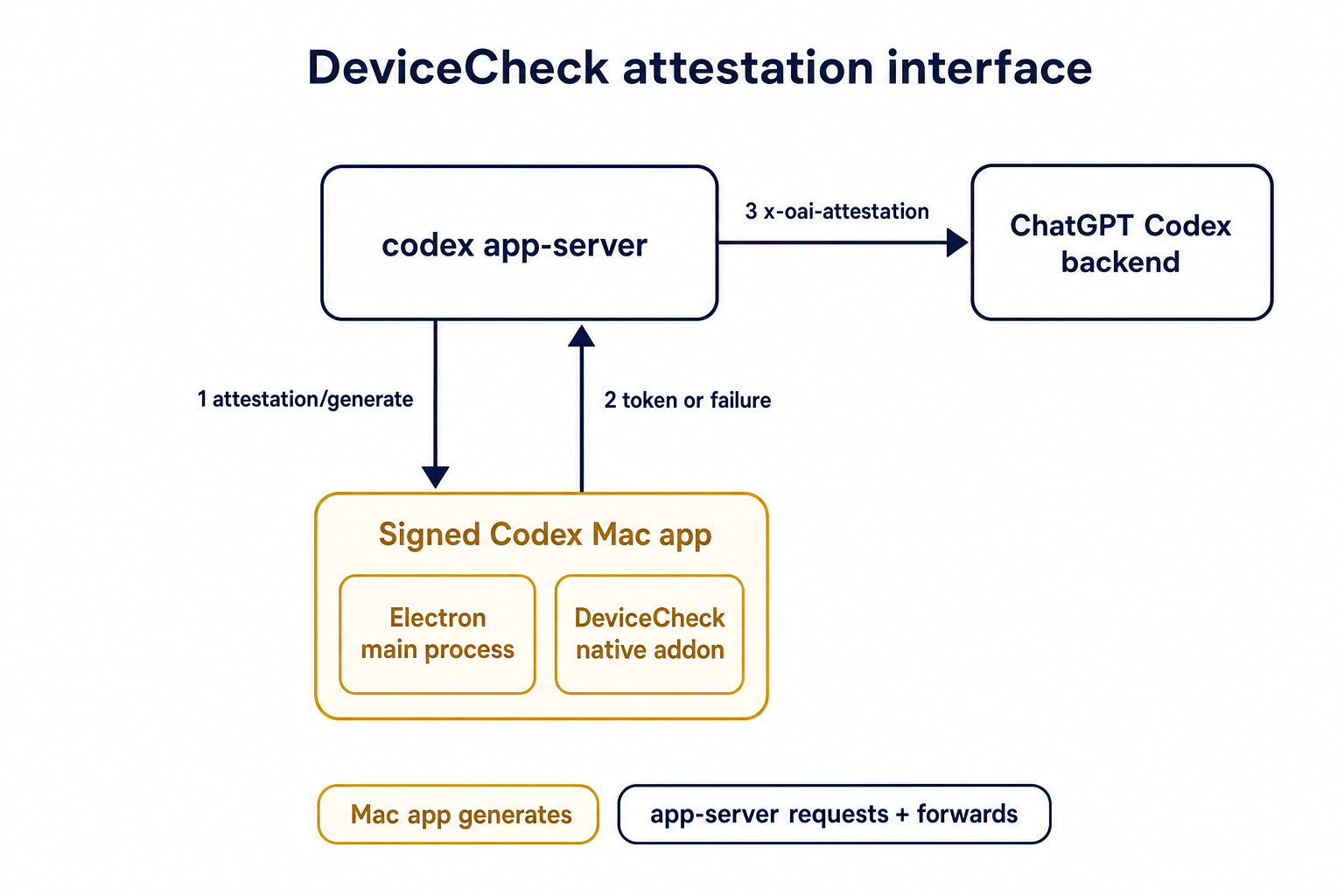
## Details
This PR teaches the Codex app-server runtime how to request and attach
an attestation token. It does not generate DeviceCheck tokens directly;
instead, it relies on the connected desktop app to advertise that it can
generate attestation and then asks that app for a fresh header value
when needed.
The flow is:
1. The Codex desktop app connects to app-server.
2. During `initialize`, the app can advertise that it supports
`requestAttestation`.
3. Before app-server calls selected ChatGPT Codex endpoints, it sends
the internal server request `attestation/generate` to the app.
4. app-server receives a pre-encoded header value back.
5. app-server forwards that value as `x-oai-attestation` on the scoped
outbound requests.
The code in this repo is mostly protocol and runtime plumbing: it adds
the app-server request/response shape, introduces an attestation
provider in core, wires that provider into Responses / compaction /
realtime setup paths, and covers the intended scoping with tests. The
signed macOS DeviceCheck generation remains owned by the desktop app PR.
## Related PR
- Codex desktop app implementation:
https://github.com/openai/openai/pull/878649
## Validation
<details>
<summary>Tests run</summary>
```sh
cargo test -p codex-app-server-protocol
cargo test -p codex-core attestation --lib
cargo test -p codex-app-server --lib attestation
```
Also ran:
```sh
just fix -p codex-core
just fix -p codex-app-server
just fix -p codex-app-server-protocol
just fmt
just write-app-server-schema
```
</details>
<details>
<summary>E2E DeviceCheck validation</summary>
First validated the signed desktop app boundary directly: launched a
packaged signed `Codex.app`, sent `attestation/generate`, decoded the
returned `v1.` attestation header, and validated the extracted
DeviceCheck token with `personal/jm/verify_devicecheck_token.py` using
bundle ID `com.openai.codex`. Apple returned `status_code: 200` and
`is_ok: true`.
Then ran the fuller app + app-server flow. The packaged `Codex.app`
launched a current-branch app-server via `CODEX_CLI_PATH`, and a local
MITM proxy intercepted outbound `chatgpt.com` traffic. The app-server
requested `attestation/generate` from the real Electron app process, and
the intercepted `/backend-api/codex/responses` traffic included
`x-oai-attestation` on both routes:
```text
GET /backend-api/codex/responses Upgrade: websocket x-oai-attestation: present
POST /backend-api/codex/responses Upgrade: none x-oai-attestation: present
```
The captured header decoded to a DeviceCheck token that also validated
with Apple for `com.openai.codex` (`status_code: 200`, `is_ok: true`,
team `2DC432GLL2`).
</details>
---------
Co-authored-by: Codex <noreply@openai.com>
## Why

The earlier PRs add stdio transport support and the config-backed
environment provider, but the feature remains inert until normal Codex
entrypoints construct `EnvironmentManager` with enough context to
discover `CODEX_HOME/environments.toml`. This final stack PR activates
the provider while preserving the legacy `CODEX_EXEC_SERVER_URL`
fallback when no environments file exists.

**Stack position:** this is PR 5 of 5. It is the product wiring PR that
activates the configured environment provider added in PR 4.

## What Changed

- Thread `codex_home` into `EnvironmentManagerArgs`.
- Change `EnvironmentManager::new(...)` to load the provider from
`CODEX_HOME`.
- Preserve legacy behavior by falling back to
`DefaultEnvironmentProvider::from_env()` when `environments.toml` is
absent.
- Make `environments.toml`-backed managers start new threads with all
configured environments, default first, while keeping the legacy env-var
path single-default.
- Update the app-server, TUI, exec, MCP server, connector, prompt-debug,
and thread-manager-sample callsites to pass `codex_home` and handle
provider-loading errors.

## Self-Review Notes

- The multi-environment startup path is intentionally tied to the
`environments.toml` provider. Using `>1` configured environment as the
only signal would also expand the legacy `CODEX_EXEC_SERVER_URL`
provider because it keeps `local` addressable alongside `remote`.
- The startup environment list is still derived inside
`EnvironmentManager`; the provider only says whether its snapshot should
start new threads with all configured environments.
- The thread-manager sample was updated to pass the current
`ThreadManager::new(...)` installation id argument so the stack compiles
under Bazel.

## Stack

- 1. https://github.com/openai/codex/pull/20663 - Add stdio exec-server
listener
- 2. https://github.com/openai/codex/pull/20664 - Add stdio exec-server
client transport
- 3. https://github.com/openai/codex/pull/20665 - Make environment
providers own default selection
- 4. https://github.com/openai/codex/pull/20666 - Add CODEX_HOME
environments TOML provider
- **5. This PR:** https://github.com/openai/codex/pull/20667 - Load
configured environments from CODEX_HOME

Split from original draft: https://github.com/openai/codex/pull/20508

## Validation

- `just fmt`
- `git diff --check`
- `bazel build --config=remote --strategy=remote
--remote_download_toplevel
//codex-rs/thread-manager-sample:codex-thread-manager-sample`
- `bazel test --config=remote --strategy=remote
--remote_download_toplevel
//codex-rs/exec-server:exec-server-unit-tests`
- `bazel test --config=remote --strategy=remote
--remote_download_toplevel --test_sharding_strategy=disabled
--test_arg=default_thread_environment_selections_use_manager_default_id
//codex-rs/core:core-unit-tests`
- `bazel test --config=remote --strategy=remote
--remote_download_toplevel --test_sharding_strategy=disabled
--test_arg=start_thread_uses_all_default_environments_from_codex_home
//codex-rs/core:core-unit-tests`

## Documentation

This activates `CODEX_HOME/environments.toml`; user-facing documentation
should be added before this stack is treated as a documented public
workflow.

---------

Co-authored-by: Codex <noreply@openai.com>
## Why

We want terminal tool review analytics, but the reducer should not stamp
review timing from its own wall clock.

This PR plumbs review timing through the real protocol and app-server
seams so downstream analytics can consume the emitter's timestamps
directly. Guardian reviews keep their enriched `started_at` /
`completed_at` analytics fields by deriving those legacy second-based
values from the same protocol-native millisecond lifecycle timestamps,
rather than sampling a separate analytics clock.

## What changed

- add `started_at_ms` to user approval request payloads
- add `started_at_ms` / `completed_at_ms` to guardian review
notifications
- preserve Guardian review `started_at` / `completed_at` enrichment from
the protocol-native timing source
- stamp typed `ServerResponse` analytics facts with app-server-observed
`completed_at_ms`
- thread the new timing fields through core, protocol, app-server, TUI,
and analytics fixtures

## Verification

- `cargo test -p codex-app-server outgoing_message --manifest-path
codex-rs/Cargo.toml`
- `cargo test -p codex-app-server-protocol guardian --manifest-path
codex-rs/Cargo.toml`
- `cargo test -p codex-tui guardian --manifest-path codex-rs/Cargo.toml`
- `cargo test -p codex-analytics analytics_client_tests --manifest-path
codex-rs/Cargo.toml`

---
[//]: # (BEGIN SAPLING FOOTER)
Stack created with [Sapling](https://sapling-scm.com). Best reviewed
with [ReviewStack](https://reviewstack.dev/openai/codex/pull/21434).
* #18748
* __->__ #21434
* #18747
* #17090
* #17089
* #20514

