## Why

Managed command policies need to require a human decision independently of automatic review, hook allowances, and saved approvals.

## What changed

- Support `decision = "prompt-user"` in managed `requirements.toml` prefix rules, requiring a fresh, one-time human decision for matching commands.
- Add experimental `humanCommand` approval requests for clients advertising both `experimentalApi` and `requiredHumanApproval`. Accept only `accept`, `decline`, or `cancel`; reject commands when no capable client is available.
- Restrict responses to capable clients that received the request, and replay pending prompts to compatible clients on reconnect.
- Enable the capability in the TUI and update protocol schemas and client bindings.

## Testing

Add coverage for fresh decisions overriding saved allowances, hook allowances, and automatic review, plus child-thread approval routing and rejection of responses from incompatible or unrelated clients.

GitOrigin-RevId: 0b95ff6aab7f8a04b7298c8a4329d1fddf6a603e
## Why

Thread startup can prewarm the Responses WebSocket before the creating client is registered with the thread, leaving the handshake unable to request attestation from that client.

## What changed

Reserve a thread ID and register the creating connection before starting the thread, including for ephemeral threads. Remove the thread state if startup fails.

## Testing

Extend the attestation round-trip test to cover persistent and ephemeral threads. Handle attestation requests while awaiting `thread/start` and `turn/start` responses, and verify the WebSocket handshake includes the expected `x-oai-attestation` header.

GitOrigin-RevId: 1bdb38bac641253eed58a2431658ab54d93819c5
## Why

Clients with a gateway sign-in UI need to control when browser authorization starts and inspect credential readiness before making authenticated requests.

## What changed

- Add `initialize.capabilities.explicitGatewayOauth` to require explicit login while allowing existing credentials to refresh. Preserve automatic authorization for clients that omit the capability, and prevent later connections from undoing explicit opt-in.
- Add `account/gatewayOAuth/read`, `account/gatewayOAuth/login`, and `account/gatewayOAuth/cancel`, plus `account/gatewayOAuth/changed` notifications. Send the authorization URL only to the initiating connection and cancel its login on disconnect.
- Check gateway authentication before returning cached results from `model/list`, with restart guidance when provider settings have changed.
- Update protocol schemas, TypeScript and Python bindings, and document capability probing and the sign-in lifecycle.

## Testing

Add tests for passive readiness reads, credential reuse after login, token exchange failures, cancellation and immediate retry, connection ownership, legacy versus explicit login, and model-list authentication checks.

GitOrigin-RevId: a26e116a62c9f3db84dc238a40b7f4e816eb1594
## Why

Switching providers or authentication could reuse a previous identity's model catalog, including its default service tier. An in-flight refresh could also overwrite a newer account's catalog after cache storage completed.

## What changed

- Require a matching provider and auth identity for disk and in-memory catalog reuse. Treat legacy entries without an identity as cache misses and fall back to bundled metadata when the in-memory identity no longer matches.
- Recheck identity after fetching and storing a catalog before publishing it.
- Renew cache freshness only when the client version, identity, and ETag match the stored entry.
- Update cache fixtures to include the configured provider and auth identity.

## Testing

Add regression coverage for provider and auth switches, credential rotation, legacy and mismatched cache entries, conditional TTL renewal, and an account switch during cache storage. Verify that API-key requests do not inherit a ChatGPT catalog's default `service_tier`, while explicit tier selection still works.

GitOrigin-RevId: e15d7ffff238d951d7a1c6a68381cbb479994146
## Why

App-server logs can be persisted or included in submitted diagnostics, so credentials used by model providers, authentication refreshes, and attestation requests must not appear in diagnostic output.

## What changed

- Add `RedactedString`, which preserves serialization and string access while replacing debug output with `<redacted>`.
- Use it for model-provider bearer tokens, header and query values, authentication command arguments, and attestation tokens.
- Avoid logging JSON-RPC error payloads and parser or authentication errors that may echo credentials; retain safe context such as error codes and categories.

## Testing

- Add an app-server regression test that exercises provider credentials, refreshed authentication tokens, and attestation tokens, then verifies none appear in persisted SQLite or submitted diagnostic logs.

GitOrigin-RevId: 8c50408adf94d93847658b1320682cf3b637d2cc
## Why

App-server clients need to advertise structured MCP extension settings, including supported MCP App UI MIME types, rather than only opting into OpenAI form elicitation with a boolean.

## What changed

- Add an `extensions` map to initialize capabilities and preserve `mcpServerOpenaiFormElicitation` as a legacy alias for `openai/form`.
- Capture the declared extension profile when a thread is started, resumed, or forked, propagate it to subagents, and advertise it to downstream MCP servers during initialization.
- Keep the profile stable for the lifetime of the loaded session instead of changing it on later turns or direct tool calls.

## Testing

- Cover extension conversion, downstream MCP initialization, session isolation, legacy form support, and subagent inheritance.

GitOrigin-RevId: fbcedbb74ce788e574b0f884a4c45c4cedb9de54
## Why

We should be running as many integrations tests as possible against the
split cross-OS configuration.

## What

- migrate eligible thread starts and builders to auto env
- keep explicit custom/local-executor cases local with rationale
comments
- keep auto-env coverage where possible and add narrow `TODO(anp)` skips
for fixtures that are not target-native yet
## Why

The app server is long-lived, but its shared model cache otherwise
refreshes only when a caller needs it. Once the five-minute cache
expires, starting a thread or calling `model/list` can wait for
`/models` on the request path.

Refresh the cache in the background before it expires so foreground
callers normally use fresh local state.

## What changed

- Start an app-server worker that refreshes models immediately and then
every three minutes using the existing models-manager API.
- Hold only a weak reference to the models manager between refreshes, so
the worker does not extend its lifetime.
- Stop scheduling refreshes when the app-server lifecycle handle is shut
down or dropped. A refresh already in progress is allowed to finish.
- Adjust affected app-server test fixtures to distinguish the background
`/models` probe from the connection they are testing.

The existing models-manager cache, refresh strategies, auth handling,
ETag behavior, and concurrency semantics are unchanged.

## Testing

-
`models_refresh_worker::tests::refreshes_immediately_periodically_and_stops_when_dropped`
-
`suite::v2::remote_control::listen_off_honors_persisted_remote_control_enable`
-
`suite::v2::attestation::attestation_generate_round_trip_adds_header_to_responses_websocket_handshake`
This PR brought to you via VS Code rather than Codex...

- opened `codex-rs/app-server/tests/common/mcp_process.rs`
- put the cursor on `McpServer`
- hit `F2` and renamed the symbol to `TestAppServer`
- went to the file tree
- hit enter and renamed `mcp_process.rs` to `test_app_server.rs`
- ran **Save All Files** from the Command Palette
- ran `just fmt`

The End

(Admittedly, most of the local variables for `TestAppServer` are still
named `mcp`, though.)
## Summary

Adds an optional `clientId` field to app-server v2 `UserInput` and
carries it through the core `UserInput` model so clients can correlate
echoed user input items without relying on payload equality.

## Details

- Adds `client_id: Option<String>` to core `UserInput` variants.
- Exposes the v2 app-server field as `clientId` on the wire and in
generated TypeScript.
- Preserves the id when converting between app-server v2 and core
protocol types.
- Regenerates app-server schema fixtures.

## Validation

- `just fmt`
- `just write-app-server-schema`
- `cargo test -p codex-app-server-protocol`
- `cargo test -p codex-protocol`
- `just fix -p codex-app-server-protocol`
- `just fix -p codex-protocol`
- `git diff --check`
## Summary
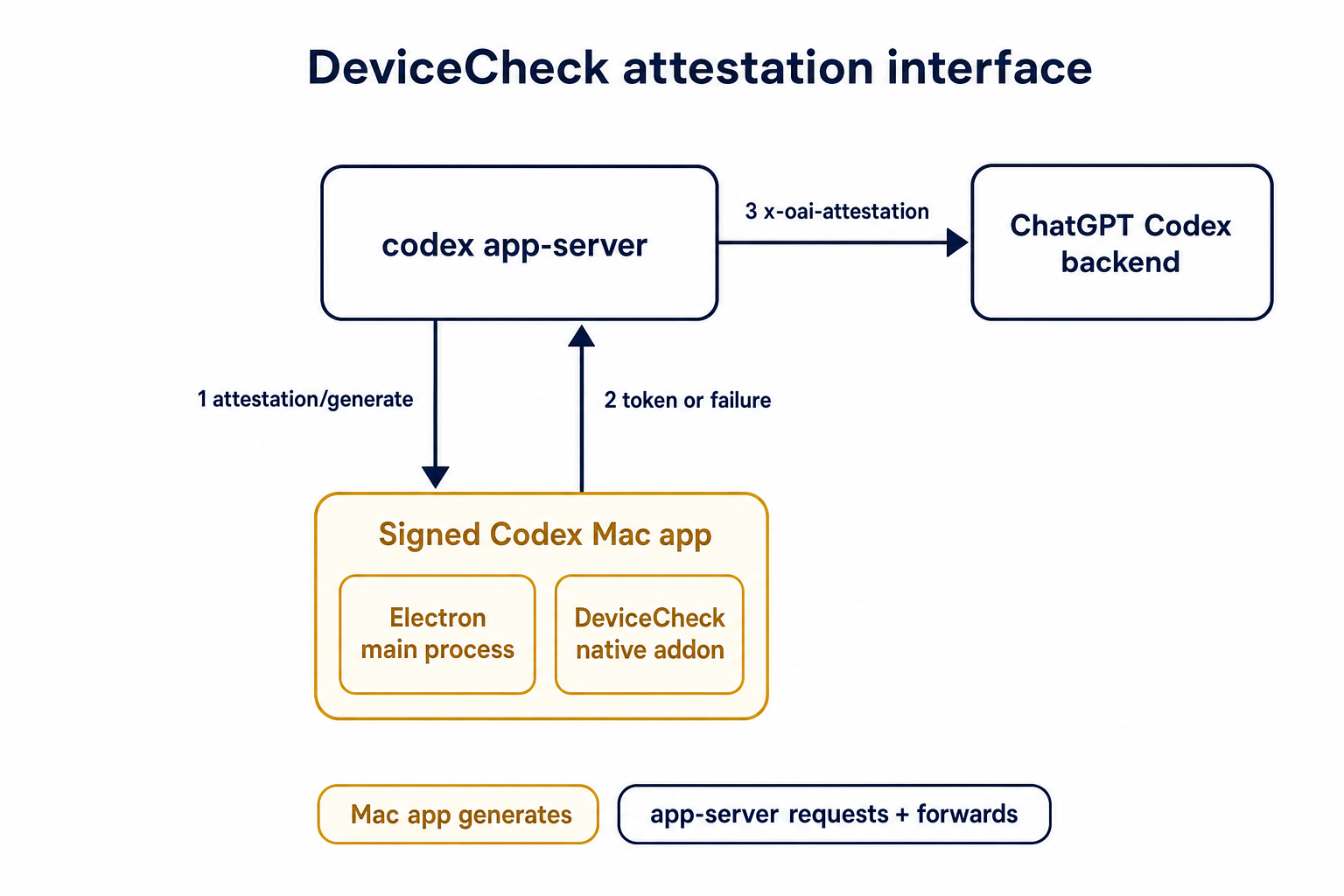
TL;DR: teaches `codex-rs` / app-server to request a desktop-provided
attestation token and attach it as `x-oai-attestation` on the scoped
ChatGPT Codex request paths.
## Details
This PR teaches the Codex app-server runtime how to request and attach
an attestation token. It does not generate DeviceCheck tokens directly;
instead, it relies on the connected desktop app to advertise that it can
generate attestation and then asks that app for a fresh header value
when needed.
The flow is:
1. The Codex desktop app connects to app-server.
2. During `initialize`, the app can advertise that it supports
`requestAttestation`.
3. Before app-server calls selected ChatGPT Codex endpoints, it sends
the internal server request `attestation/generate` to the app.
4. app-server receives a pre-encoded header value back.
5. app-server forwards that value as `x-oai-attestation` on the scoped
outbound requests.
The code in this repo is mostly protocol and runtime plumbing: it adds
the app-server request/response shape, introduces an attestation
provider in core, wires that provider into Responses / compaction /
realtime setup paths, and covers the intended scoping with tests. The
signed macOS DeviceCheck generation remains owned by the desktop app PR.
## Related PR
- Codex desktop app implementation:
https://github.com/openai/openai/pull/878649
## Validation
<details>
<summary>Tests run</summary>
```sh
cargo test -p codex-app-server-protocol
cargo test -p codex-core attestation --lib
cargo test -p codex-app-server --lib attestation
```
Also ran:
```sh
just fix -p codex-core
just fix -p codex-app-server
just fix -p codex-app-server-protocol
just fmt
just write-app-server-schema
```
</details>
<details>
<summary>E2E DeviceCheck validation</summary>
First validated the signed desktop app boundary directly: launched a
packaged signed `Codex.app`, sent `attestation/generate`, decoded the
returned `v1.` attestation header, and validated the extracted
DeviceCheck token with `personal/jm/verify_devicecheck_token.py` using
bundle ID `com.openai.codex`. Apple returned `status_code: 200` and
`is_ok: true`.
Then ran the fuller app + app-server flow. The packaged `Codex.app`
launched a current-branch app-server via `CODEX_CLI_PATH`, and a local
MITM proxy intercepted outbound `chatgpt.com` traffic. The app-server
requested `attestation/generate` from the real Electron app process, and
the intercepted `/backend-api/codex/responses` traffic included
`x-oai-attestation` on both routes:
```text
GET /backend-api/codex/responses Upgrade: websocket x-oai-attestation: present
POST /backend-api/codex/responses Upgrade: none x-oai-attestation: present
```
The captured header decoded to a DeviceCheck token that also validated
with Apple for `com.openai.codex` (`status_code: 200`, `is_ok: true`,
team `2DC432GLL2`).
</details>
---------
Co-authored-by: Codex <noreply@openai.com>
 jif
