## Why

Persisted multi-agent v2 children created after the client disconnects need lifecycle listeners so their runtimes can be released once idle. Listener attachment must also wait for an earlier runtime's cleanup to finish.

## What changed

- Start lifecycle listeners for persisted v2 children even when no initialized clients are connected, and defer attachment until pending unload cleanup completes.
- Keep ephemeral children loaded so follow-up tasks retain their model context.
- Raise the default `thread_unload_delay_secs` from 60 seconds to 1800 seconds (30 minutes), updating the configuration documentation and sample.

## Testing

Add regression coverage for children spawned after disconnect with zero- and one-second unload delays, including waiting for pending cleanup, keeping running threads loaded, releasing idle runtimes, and preserving an ephemeral child's earlier reply across a follow-up. Update configuration tests for the new default and explicit overrides.

GitOrigin-RevId: 2fecc77b5c03237aa8fd7eacc4bd119b99d36e0a
## What changed

- Route app-server idle unloading of multi-agent v2 children through local eviction that preserves unread mail and environment selections for reload.
- Hold residency pins through input submission so newly reloaded children cannot be evicted before receiving their work.
- Guard listener cleanup against replacement runtimes and subscriptions, and reject local eviction of host-controlled threads.

## Testing

Add coverage for unsubscribe-driven eviction followed by `followup_task`, verifying restored conversation context and exactly-once delivery of queued mail. Extend tests to check that residency pins block eviction and that rejected host eviction preserves the thread and mailbox.

GitOrigin-RevId: e36723730af683d2081e495e637f0e6d23548b8d
## Why

User goal edits and clears need to reach the model as user instructions, including when a thread is unloaded or history is being compacted. Automatic goal lifecycle updates must not supply user authorization.

## What changed

- Add optional `origin` values of `user` and `automatic` to `thread/goal/set` and `thread/goal/clear`, and mark TUI goal requests as user actions. Omitted origins do not supply user authorization.
- Persist explicit user objective, status, and clear instructions before changing goal state. Recording failures leave goal state unchanged.
- Coordinate goal edits with thread resume, reload stored history under writer ownership, and preserve edits accepted after the compaction input snapshot.
- Update generated protocol schemas and TypeScript and Python bindings.

## Testing

Add coverage for user edits and clears on loaded and unloaded threads, concurrent path-based resume, exclusion of automatic goals from user instructions, preservation of edits during compaction, and recording failures that leave goal state unchanged.

GitOrigin-RevId: d779d7c678a0c32a6ef76975dbe5b1400d1df245
## Why

Resuming a running thread with a summary initial page cloned every active-turn item before discarding those outside the summary, including potentially large reasoning payloads.

## What changed

- Snapshot the active turn using the requested `TurnItemsView`, copying only the first user message and final agent message for summaries and no items for `NotLoaded`.
- Preserve full snapshots when the resume response includes full turns, even if its initial page requests a summary.
- Share item selection between snapshots and page responses, and skip selection when a turn already has the requested view.

## Testing

Add unit coverage for summary selection, completed-turn metadata, and metadata-only snapshots. Extend running-thread resume coverage for default summaries, explicit full pages, and full turns returned alongside a summary page.

GitOrigin-RevId: 6ddcd93c44dbc8083827ac82f442b31730a4edde
## Why

Resuming a running thread cloned the active turn's items even when the response did not need them.

## What changed

Add a metadata-only turn snapshot and use it for resume status checks and initial pages with `TurnItemsView::NotLoaded`. Only snapshot items when including turns or requesting an initial page with items, preserving item data for `Summary` and `Full` views.

## Testing

Add lifecycle coverage for metadata snapshots and extend running-thread resume tests to check metadata-only responses and populated `Summary` and `Full` pages.

GitOrigin-RevId: 281a2b7e1faf3a3fc07e007a065b16235eda08b6
## Why

App-server callers that only need the active turn ID or its presence currently create a full turn snapshot, unnecessarily cloning its items.

## What changed

Expose `ThreadState::active_turn_id()` and use it for interrupt validation, elicitation turn ID fallback, and teardown and shutdown logging, preserving the existing turn selection behavior.

## Testing

Update the interrupt integration test to wait for `turn/started` instead of a fixed delay and verify that an incorrect turn ID is rejected before successfully interrupting the active turn.

GitOrigin-RevId: 4a030655fbc4d229809cf13f80c3d7f788f19c13
## What changed

Remove `thread/rollback`, its request and response types, generated bindings, and the core `Op::ThreadRollback` operation. Requests now follow the generic unknown-method rejection path. Document `thread/revert` as the alternative for paginated threads.

Keep historical `ThreadRolledBack` markers and legacy error deserialization so existing rollouts remain compatible with replay and migration.

## Testing

Adapt retained-context and Guardian history tests to append legacy rollback markers and resume threads, preserving coverage of surviving instructions, answers, and review history.

GitOrigin-RevId: b3da1becdf86b1869275aacb0ffc2817cee5af2e
## What changed

- Accept `disabledPluginIds` in `thread/settings/update` and `turn/start`. A supplied list replaces the saved selection; omission or `null` preserves it, and `[]` clears it.
- Return the selection in thread start, resume, and fork responses and `thread/settings/updated` notifications. Update generated schemas and client types.
- Restore disabled plugin IDs from the history retained at the requested fork boundary, preserving explicit overrides.

The selection persists across resume but does not yet filter plugin capabilities.

## Testing

Add coverage for replacing, preserving, and clearing selections without inference; turn-start notifications; resume; and fork boundaries across legacy and paginated history, with loaded and restarted parents. Add a core regression test for history restoration and explicit clearing.

GitOrigin-RevId: 654a8c2a0527228d422c0dd4919228447e2663db
## Why

Thread startup, running-thread resume, and rollback could outlive their request handlers, allowing connection draining and request serialization to finish too early.

## What changed

- Await thread startup and listener completion for running-thread resume and rollback.
- Release the thread-list permit before waiting for resume completion so the listener can finish rollback responses.
- Release pending rollback waiters when clearing a listener, and discard queued requests when their connection closes.

## Testing

Add coverage for releasing queued requests and rollback waiters, and pipeline resume during rollback to check that both responses complete. Update diagnostics expectations to allow startup to remain in flight after its response is queued.

GitOrigin-RevId: 138156179afbc40de29965820db7fa9cd3669cc7
## Why

Realtime history should be recorded consistently for every Core host, including
when no app-server event listener is attached.

## What changed

- Move transcript segmentation, session boundaries, and backing-agent artifact
  promotion into Core for paginated threads.
- Persist canonical realtime items through the thread store in event order and
  emit dedicated history lifecycle events for hosts to present.
- Translate those Core events into the existing app-server realtime item
  notifications without app-server persisting the items a second time.

## Testing

- Cover Core-only persistence across repeated sessions, ephemeral sessions,
  accepted and rejected steering, typed input ordering, and artifact promotion.
- Verify app-server notifications correspond to the persisted timeline.

GitOrigin-RevId: 7cbef14129d77f6d6d7099b733be91f5279c55f5
## Why

Clients need a bounded view of realtime conversations that preserves the order of speech, agent work, and turn lifecycle events without loading the full thread history.

## What changed

- Persist realtime session boundaries, transcript segments, and promoted agent items in paginated thread rollouts.
- Add the experimental `thread/timeline/list` API to page ordinary items, realtime items, and turn boundaries in canonical rollout order. Include `activeRealtimeSessionAtPageStart` so each page can be rendered independently.
- Emit typed `thread/realtime/item/started`, `thread/realtime/item/transcript/delta`, and `thread/realtime/item/completed` notifications around durable realtime items.
- Keep the existing `thread/items/list` response and legacy thread history behavior unchanged.

## Testing

- Cover mixed timeline pagination, realtime-session state at page boundaries, rollout replay, subagent history prefixes, transcript streaming, steering, and promoted agent artifacts.

GitOrigin-RevId: faa2c420192d63e060e8fb32446e3c797422656e
## Why

Multi-Agent V2 children are owned by their parent at runtime. Resuming an
unloaded child directly could rebuild it from caller-provided settings instead
of the parent's current authority.

## What changed

- Route child reloads through their loaded immediate parent and reject direct
  cold resume when that parent is unavailable.
- Preserve the child's recorded model, provider, reasoning effort, and role
  while inheriting the parent's execution policy and MCP extensions.
- Validate cached environments against the parent, intersect local permission
  profiles, and reject stale remote or workspace-root configurations.
- Keep paginated cold-resume token usage attribution when attaching to the
  reloaded child.

## Testing

Add coverage for owner validation, nested-parent reloads, permission and
environment changes, role instruction restoration, paginated usage replay,
and app-server child resume behavior.

GitOrigin-RevId: 84014762bcdb57f94fc23974c9c1af55dc1babf1
## What changed

- Add experimental `thread/queue/add`, `list`, `update`, `delete`, `reorder`, and `start` requests for persistent queued user submissions.
- Automatically dispatch queued submissions in FIFO order after completed or failed turns, while leaving the queue paused after interruption.
- Emit `thread/queue/changed` notifications and expose paginated queue contents with stable submission and client message IDs.
- Export the new protocol types through the generated JSON Schema and TypeScript bindings.

## Testing

- Add app-server integration coverage for capability gating, CRUD, pagination, capacity limits, notifications, automatic dispatch, cold-thread resume, interruption, and explicit queue starts.

GitOrigin-RevId: 89caf5577192199bda77cf6c372a59d26cdd910e
## What changed

- Add the experimental `thread/revert` request, which replaces a loaded paginated thread's durable history with the prefix before `beforeTurnId` while preserving the thread ID.
- Interrupt any active turn, reload the replacement history without unloading the thread, preserve mutable thread settings, and emit `thread/reverted`.
- Return backward pagination cursors for the retained turns and items, reject stale rollout paths after a revert, and document that local file changes are unaffected.

## Testing

- Cover history replacement, pagination, stale paths, missing turns, subsequent turns, active-turn interruption, and preserved thread settings.

GitOrigin-RevId: 435a8163ad4f310cc47219b436f6bdde21f2b83a
## What changed

- Add `codex-history` for model-history and persisted-rollout domain types, including `RolloutItem`, `RolloutLine`, `CompactedItem`, and initial/resumed history state.
- Re-export the persisted types from `codex-rollout` and update consumers to use the new crate boundary instead of `codex-protocol`.
- Preserve existing rollout serialization, including legacy numeric compacted-window IDs.

## Testing

- Add `codex-history` tests for rollout JSON round trips, compacted-history compatibility, persisted history modes, and multi-agent version selection.

GitOrigin-RevId: 944daa9297ddd231d3aebbdcb05fff4adf8b4e1b
## Why

Extension warnings need a stable thread target even when they are emitted outside an active turn.

## What changed

- Add `ExtensionWarning` and a dedicated `ExtensionEventSink::emit_warning` path with an explicit thread ID and optional turn ID.
- Deliver extension warnings as thread-scoped app-server `warning` notifications, preserving listener ordering and waiting briefly for a subscriber when no listener is active.
- Move skills warnings to the new path, limiting provider catalog warnings to four messages of 256 bytes each.

## Testing

- Cover warning routing, ordering, UTF-8-safe truncation, subscriber fallback, and invalid thread IDs.
- Verify skills warning bounds and app-server delivery of executor catalog budget warnings.

GitOrigin-RevId: 4dcb1ba7f17c0edb1a9d548f9568e0c734bffc15
## Why

Streamed message deltas can be dropped when the transport is saturated, leaving
clients with a truncated final response.

## What changed

- Include the last non-empty final agent message in successful `turn/completed`
  notifications and mark the items as a summary.
- Treat completed message content as authoritative in the TUI, repairing an
  incomplete stream while avoiding duplicate messages when `item/completed` was
  already received.
- Continue backfilling full turn items for persisted `codex exec` threads when a
  completion contains only the summary view.

## Testing

Added coverage for completion summaries, dropped stream deltas, duplicate item
handling, and directive-only responses.

GitOrigin-RevId: ffe9d36d683d6b6690e4a468ff68aa9189fe6ab7
## Why

Clients that use full-history resume or request full items in turn pages should
work consistently across legacy and paginated threads.

## What changed

- Materialize complete turns and items from the paginated projection for
  `thread/resume` and `thread/turns/list` when requested.
- Support `initialTurnsPage` during paginated resume, including merging a live
  active turn while preserving the requested page size and cursors.
- Keep metadata-only resume behavior and backwards cursors available through
  `excludeTurns: true`.

## Testing

- Extend app-server coverage for full paginated history, full item views, and
  initial resume pages on running threads.

GitOrigin-RevId: e340f44d631ce135895c95d7e1baa7bfecd86e71
## What changed

- Allow `thread/start` to select experimental `historyMode: "paginated"` when the thread store supports turn and item pagination.
- Resume paginated threads with bounded model context and require `excludeTurns: true` instead of loading full history.
- Return `turnsBackwardsCursor` and `itemsBackwardsCursor` from `thread/resume` so clients can hydrate durable history through `thread/turns/list` and `thread/items/list` while newer records arrive through live notifications.
- Reject operations that still require full history, including `initialTurnsPage`, `thread/read` with `includeTurns: true`, `thread/rollback`, and detached review.
- Make item cursors independent of the optional `turnId` filter.

## Testing

- Cover paginated thread start, cold and live resume, backwards cursor hydration, metadata reads, unsupported operations, and stores without pagination support.

GitOrigin-RevId: c42f9b268e29d049843330f474fa3ecde12f5b8a
## Why

Ultra should be one user-facing reasoning selection for work that
benefits from both maximum reasoning and proactive multi-agent
delegation. Without it, clients must coordinate maximum reasoning with
the experimental `multiAgentMode` setting, even though the inference
backend still expects its existing `max` effort value.

This change makes reasoning effort the source of truth: clients select
`ultra`, core derives proactive multi-agent behavior when the turn is
eligible for multi-agent V2, and inference requests continue to use the
backend-compatible `max` value.

## What changed

- Add `ultra` as a first-class reasoning effort and preserve
model-catalog ordering when exposing it to clients.
- Convert `ultra` to `max` at the inference request boundary, including
Responses HTTP/WebSocket requests, startup prewarm, compaction, and
memory summarization.
- Derive effective multi-agent mode per turn from effective reasoning
effort:
  - eligible multi-agent V2 + `ultra` → `proactive`
  - eligible multi-agent V2 + any other effort → `explicitRequestOnly`
- V1 or otherwise ineligible sessions → no multi-agent mode instruction
- Keep the derived effective mode in turn context history so successive
turns can emit a developer-message update only when the effective mode
changes.
- Remove selected multi-agent mode from core session configuration, turn
construction, thread settings, resume/fork restoration, and subagent
spawn plumbing. Subagents inherit reasoning effort and derive their own
effective mode.
- Retain the experimental app-server `multiAgentMode` fields for wire
compatibility while marking them deprecated. Request values are accepted
but ignored; compatibility response fields report `explicitRequestOnly`.
- Display Ultra in the TUI using the order supplied by `model/list`.

## Validation

- `just test -p codex-core ultra_reasoning_uses_max_for_requests`
- `just test -p codex-tui model_reasoning_selection_popup`
## Why

Once multi-agent mode can be selected per turn, clients also need to
choose the initial selection when creating a thread and observe that
selection through lifecycle and settings APIs.

The selected value is intentionally distinct from the effective
model-visible value: no client selection is represented as `null`, even
though an eligible multi-agent v2 turn derives `explicitRequestOnly` as
its effective default.

## What changed

- Add the optional experimental `thread/start.multiAgentMode` parameter
and pass it through thread creation.
- Preserve an omitted initial value as an unset selection rather than
eagerly storing `explicitRequestOnly`.
- Apply an explicit `thread/start` selection to the first turn through
the session configuration established at thread creation.
- Restore the latest persisted effective mode as the selected baseline
on cold resume when rollout history contains one.
- Inherit the optional selected mode from a loaded parent when creating
related runtime threads.
- Return the current selected `multiAgentMode` from `thread/start`,
`thread/resume`, `thread/fork`, and thread settings, using `null` when
no mode is selected.
- Keep lifecycle reporting independent from model capability and feature
eligibility; core turn construction remains responsible for calculating
and persisting the effective mode.

## Not covered

- Clearing an existing loaded-session selection back to unset through
`turn/start`; omitted or `null` currently retains the session's
selection.
- A TUI control, slash command, or `config.toml` preference.

## Verification

- `CARGO_INCREMENTAL=0 just test -p codex-app-server-protocol`
- `CARGO_INCREMENTAL=0 just test -p codex-app-server multi_agent_mode`

The focused app-server coverage verifies explicit `thread/start`
initialization, first-turn prompting, nullable reporting for an omitted
selection, and retention of selections that are not currently
runtime-eligible.

## Stack

Stacked on #28685. This PR contains only the thread initialization and
lifecycle/settings API layer.
## Why

Make it possible to load AGENTS.md from remote exec-servers whose OS is
different than app-server.

## What

- keep `AGENTS.md` discovery and provenance as `PathUri`, with
root-aware parent and ancestor traversal
- expose lifecycle instruction sources as legacy app-server path strings
in events while retaining `PathUri` internally
- preserve and test mixed POSIX and Windows paths in model context and
TUI status output
- cover remote Windows loading end to end by seeding the Wine prefix
through host filesystem APIs
- fix bug in `PathUri`'s parent() implementation that would erase
Windows drive letters
## What

Server should request:

```
{
  "id": 42,
  "method": "currentTime/read",
  "params": {
    "threadId": "11111111-1111-1111-1111-aaaaafdc2c11"
  }
}
```

Client should respond with something like:

```rust
{
  "id": 42,
  "result": {
    "currentTimeAt": 1781717655
  }
}
```

## Why

Sessions configured with `clock_source = "external"` need a
thread-specific external time source before inference. The system clock
remains the default production provider.

## Validation

- `cargo test -p codex-app-server-protocol`
- `cargo test -p codex-app-server --test all
current_time_read_round_trip_adds_reminder_to_model_input`
- `cargo test -p codex-app-server
first_attestation_capable_connection_for_thread_only_uses_thread_subscribers`
- `cargo test -p codex-analytics`
- `just fix -p codex-app-server-protocol`
- `just fix -p codex-app-server`

Stacked on #28824.
## Stack

1. [#26547](https://github.com/openai/codex/pull/26547) - [1 of 2] Align
goal extension with core behavior
2. [#26548](https://github.com/openai/codex/pull/26548) - [2 of 2] Move
goal runtime to extension

## Why

This PR completes the switch of the goal behavior to the
extension-backed runtime and removes the old core goal implementation.

## What Changed

- Installs the goal extension for app-server `ThreadManager` sessions.
- Routes app-server thread goal `get`, `set`, and `clear` through
`GoalService`.
- Uses thread-idle lifecycle emission after goal resume and snapshot
ordering so the extension can decide whether to continue the goal.
- Forwards extension goal updates through a FIFO async app-server
notification path so backpressure does not drop them or reorder updates.
- Keeps review turns from enabling goal runtime behavior.
- Plans extension tools before dynamic tools so built-in goal tool names
keep their old precedence when goals are enabled.
- Removes the old core goal runtime, core goal tool handlers, and core
goal tool specs.
- Updates tests that were coupled to the core-owned goal runtime while
leaving the legacy `<goal_context>` compatibility path in core for old
threads.
- Removes the stale cargo-shear ignore now that `codex-goal-extension`
is used by the workspace.
- Keeps realtime event matching exhaustive after removing the old
goal-specific realtime text path.


## Validation

- Ran manual `/goal` runs in TUI. Validated time accounting matched
wall-clock time and goal lifecycle state transitions.
## Summary

The client currently calls `thread/resume` to establish live updates and
immediately follows it with `thread/turns/list` to hydrate recent turns.
This lets `thread/resume` return that page directly, eliminating a round
trip and the ordering/deduplication gap between the two calls.

Experimental clients opt in with `initialTurnsPage: { limit,
sortDirection, itemsView }`. The response returns `initialTurnsPage` as
a `TurnsPage`, including cursors for paging further back in history.
Keeping the controls in a nested opt-in object provides the useful
`thread/turns/list` knobs without spreading page-specific parameters
across `thread/resume`.

## Verification

- `just fmt`
- `just write-app-server-schema --experimental`
- `just write-app-server-schema`
- `cargo test -p codex-app-server-protocol`
- `cargo test -p codex-app-server
thread_resume_initial_turns_page_matches_requested_turns_list_page
--tests`
- `cargo test -p codex-app-server
thread_resume_rejoins_running_thread_even_with_override_mismatch
--tests`
- `just fix -p codex-app-server-protocol -p codex-app-server`
## Why

App-server clients need a way to update a thread's next-turn settings
without starting a turn, adding transcript content, or waiting for turn
lifecycle events. This gives settings UI a direct path for durable
thread settings while clients observe the eventual effective state
through a notification.

This is a simplified rework of PR
https://github.com/openai/codex/pull/22509. In particular, it changes
the `thread/settings/update` api to return immediately rather than
waiting and returning the effective (updated) thread settings. This
makes the new api consistent with `turn/start` and greatly reduces the
complexity of the implementation relative to the earlier attempt.

## What Changed

- Adds experimental `thread/settings/update` with partial-update request
fields and an empty acknowledgment response.
- Adds experimental `thread/settings/updated`, carrying full effective
`ThreadSettings` and scoped by `threadId` to subscribed clients for the
affected thread.
- Shares durable settings validation with `turn/start`, including
`sandboxPolicy` plus `permissions` rejection and `serviceTier: null`
clearing.
- Emits the same settings notification when `turn/start` overrides
change the stored effective thread settings.
- Regenerates app-server protocol schema fixtures and updates
`app-server/README.md`.
## Summary

Remote clients can still receive large `thread/resume` histories when
prior turns include MCP tool call payloads or image-generation results.
This adds a temporary response-only redaction path for the known remote
client names.

Longer term we will move towards fully paginated APIs backed by SQLite.

## Changes

- Redact MCP tool call payload-bearing fields in `thread/resume`
responses for `codex_chatgpt_android_remote` and
`codex_chatgpt_ios_remote`.
- Drop `imageGeneration` items from those `thread/resume` responses.
- Keep redaction out of persisted rollout files, `thread/read`,
`thread/turns/list`, live notifications, and token usage replay.
- Cover the behavior with app-server helper tests and a v2 resume
integration test that checks both remote clients plus a non-target
control client.

## Testing

- `cargo test -p codex-app-server thread_resume_redaction`
- `cargo test -p codex-app-server
thread_resume_redacts_payloads_for_chatgpt_remote_clients`
## Why

The app-server watcher relocation leaves the generic filesystem watcher
as the last watcher-specific implementation still living inside
`codex-core`. Moving that code to a small crate keeps `codex-core`
focused on thread execution and lets app-server depend on the watcher
without reaching back into core for filesystem watching primitives.

This PR is stacked on #21287.

## What changed

- Added a new `codex-file-watcher` crate containing the existing watcher
implementation and its unit tests.
- Updated app-server `fs_watch`, `skills_watcher`, and listener state to
import watcher types from `codex-file-watcher`.
- Removed the `file_watcher` module and `notify` dependency from
`codex-core`.
- Updated Cargo workspace metadata and `Cargo.lock` for the new internal
crate.

## Validation

- `cargo check -p codex-file-watcher -p codex-core -p codex-app-server`
- `cargo test -p codex-file-watcher`
- `cargo test -p codex-app-server
skills_changed_notification_is_emitted_after_skill_change`
- `just bazel-lock-update`
- `just bazel-lock-check`
- `just fix -p codex-file-watcher`
- `just fix -p codex-core`
- `just fix -p codex-app-server`
## Why

PR #21460 reverted the earlier move of skills change watching from
`codex-core` into app-server. This reapplies that boundary change so
app-server owns client-facing `skills/changed` notifications and core no
longer carries the watcher.

## What

- Restore the app-server `SkillsWatcher` and register it from thread
listener setup.
- Remove the core-owned skills watcher and its core live-reload
integration surface.
- Restore app-server coverage for `skills/changed` notifications after a
watched skill file changes.

## Validation

- `cargo test -p codex-app-server --test all
suite::v2::skills_list::skills_changed_notification_is_emitted_after_skill_change
-- --exact --nocapture`
- `cargo test -p codex-core --lib --no-run`
## Summary
TL;DR: teaches `codex-rs` / app-server to request a desktop-provided
attestation token and attach it as `x-oai-attestation` on the scoped
ChatGPT Codex request paths.
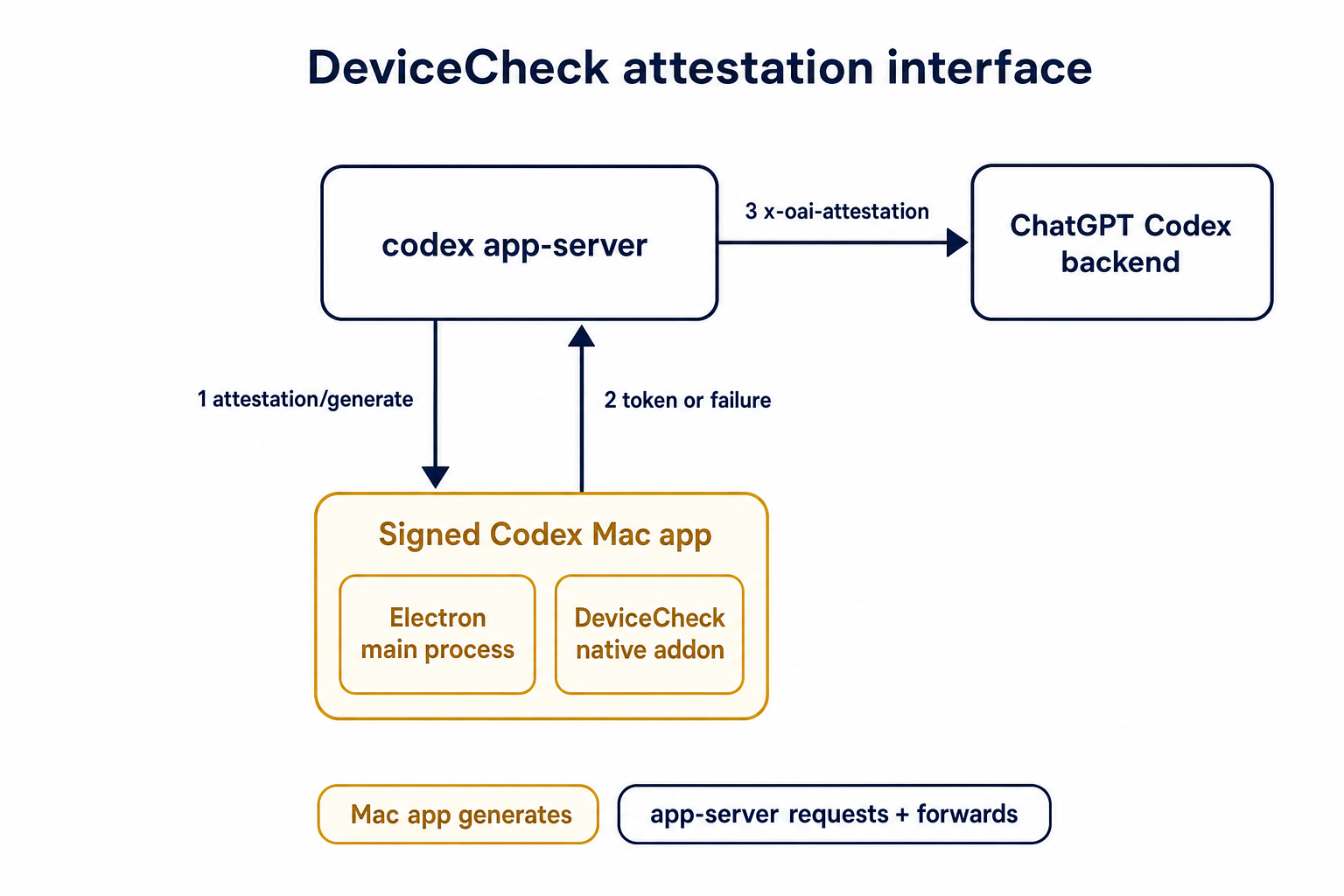
## Details
This PR teaches the Codex app-server runtime how to request and attach
an attestation token. It does not generate DeviceCheck tokens directly;
instead, it relies on the connected desktop app to advertise that it can
generate attestation and then asks that app for a fresh header value
when needed.
The flow is:
1. The Codex desktop app connects to app-server.
2. During `initialize`, the app can advertise that it supports
`requestAttestation`.
3. Before app-server calls selected ChatGPT Codex endpoints, it sends
the internal server request `attestation/generate` to the app.
4. app-server receives a pre-encoded header value back.
5. app-server forwards that value as `x-oai-attestation` on the scoped
outbound requests.
The code in this repo is mostly protocol and runtime plumbing: it adds
the app-server request/response shape, introduces an attestation
provider in core, wires that provider into Responses / compaction /
realtime setup paths, and covers the intended scoping with tests. The
signed macOS DeviceCheck generation remains owned by the desktop app PR.
## Related PR
- Codex desktop app implementation:
https://github.com/openai/openai/pull/878649
## Validation
<details>
<summary>Tests run</summary>
```sh
cargo test -p codex-app-server-protocol
cargo test -p codex-core attestation --lib
cargo test -p codex-app-server --lib attestation
```
Also ran:
```sh
just fix -p codex-core
just fix -p codex-app-server
just fix -p codex-app-server-protocol
just fmt
just write-app-server-schema
```
</details>
<details>
<summary>E2E DeviceCheck validation</summary>
First validated the signed desktop app boundary directly: launched a
packaged signed `Codex.app`, sent `attestation/generate`, decoded the
returned `v1.` attestation header, and validated the extracted
DeviceCheck token with `personal/jm/verify_devicecheck_token.py` using
bundle ID `com.openai.codex`. Apple returned `status_code: 200` and
`is_ok: true`.
Then ran the fuller app + app-server flow. The packaged `Codex.app`
launched a current-branch app-server via `CODEX_CLI_PATH`, and a local
MITM proxy intercepted outbound `chatgpt.com` traffic. The app-server
requested `attestation/generate` from the real Electron app process, and
the intercepted `/backend-api/codex/responses` traffic included
`x-oai-attestation` on both routes:
```text
GET /backend-api/codex/responses Upgrade: websocket x-oai-attestation: present
POST /backend-api/codex/responses Upgrade: none x-oai-attestation: present
```
The captured header decoded to a DeviceCheck token that also validated
with Apple for `com.openai.codex` (`status_code: 200`, `is_ok: true`,
team `2DC432GLL2`).
</details>
---------
Co-authored-by: Codex <noreply@openai.com>
## Why

Skills update notifications are app-server API behavior, but the watcher
lived in `codex-core` and surfaced through
`EventMsg::SkillsUpdateAvailable`. Moving the watcher out keeps core
focused on thread execution and lets app-server own both cache
invalidation and the `skills/changed` notification.

## What changed

- Added an app-server-owned skills watcher that watches local skill
roots, clears the shared skills cache, and emits `skills/changed`
directly.
- Registers skill watches from the common app-server thread listener
attach path, including direct starts, resumes, and app-server-observed
child or forked threads.
- Stores the `WatchRegistration` on `ThreadState`, so listener
replacement, thread teardown, idle unload, and app-server shutdown
deregister by dropping the RAII guard.
- Removed `EventMsg::SkillsUpdateAvailable`, the core watcher, and the
old core live-reload test.
- Extended the app-server skills change test to verify a cached skills
list is refreshed after a filesystem change without forcing reload.

## Validation

- `cargo check -p codex-core -p codex-app-server -p codex-mcp-server -p
codex-rollout -p codex-rollout-trace`
- `cargo test -p codex-app-server
skills_changed_notification_is_emitted_after_skill_change`
## Why

Apply-patch file changes are now part of the core turn item stream, so
v2 clients can consume the same first-class item lifecycle path used by
other turn items instead of relying on app-server-specific remapping
from legacy patch events.

## What changed

- Added a core `TurnItem::FileChange` carrying apply-patch changes and
completion metadata.
- Updated the apply-patch tool emitter to send `ItemStarted` /
`ItemCompleted` with the new `FileChange` item while preserving legacy
`PatchApplyBegin` / `PatchApplyEnd` fan-out.
- Updated app-server v2 conversion to render the new core item directly
and stopped `event_mapping` from remapping old patch begin/end events
into item notifications.
- Kept thread history reconstruction based on the existing old
apply-patch events for rollout compatibility.

## Verification

- `cargo test -p codex-protocol -p codex-app-server-protocol`
- `cargo test -p codex-core --test all
apply_patch_tool_executes_and_emits_patch_events`
- `cargo test -p codex-app-server bespoke_event_handling`
Adds the app-server v2 goal API on top of the persisted goal state from
PR 1.

## Why

Clients need a stable app-server surface for reading and controlling
materialized thread goals before the model tools and TUI can use them.
Goal changes also need to be observable by app-server clients, including
clients that resume an existing thread.

## What changed

- Added v2 `thread/goal/get`, `thread/goal/set`, and `thread/goal/clear`
RPCs for materialized threads.
- Added `thread/goal/updated` and `thread/goal/cleared` notifications so
clients can keep local goal state in sync.
- Added resume/snapshot wiring so reconnecting clients see the current
goal state for a thread.
- Added app-server handlers that reconcile persisted rollout state
before direct goal mutations.
- Updated the app-server README plus generated JSON and TypeScript
schema fixtures for the new API surface.

## Verification

- Added app-server v2 coverage for goal get/set/clear behavior,
notification emission, resume snapshots, and non-local thread-store
interactions.
- Route cold thread/resume and thread/fork source loading through
ThreadStore reads instead of direct rollout path operations
- Keep lookups that explicitly specify a rollout-path using the local
thread store methods but return an invalid-request error for remote
ThreadStore configurations
- Add some additional unit tests for code path coverage
Fix a bug where the `turn/interrupt` RPC hangs when interrupting a turn
that has already completed.

Before this change, `turn/interrupt` requests were queued in app-server
and only answered when a later TurnAborted event arrived. If the target
turn was already complete, core treated Op::Interrupt as a no-op, so no
abort event was emitted and the RPC could hang indefinitely.

This change fixes that in two places:

* Reject turn/interrupt immediately with `INVALID_REQUEST` when the
requested turn is no longer the active turn.
* Resolve any already-accepted pending interrupt requests when the turn
reaches TurnComplete, covering the case where a turn finishes naturally
after the interrupt request is accepted but before it aborts.

I tested this by adding a failing test in
707487c063. You may view the results here:
https://github.com/openai/codex/actions/runs/24585182419/

<img width="1512" height="310" alt="CleanShot 2026-04-17 at 16 33 30@2x"
src="https://github.com/user-attachments/assets/f4a88228-b2a4-41f4-9aaa-ec82814096af"
/>
For callers who expect to be paginating the results for the UI, they can
now call thread/resume or thread/fork with excludeturns:true so it will
not fetch any pages of turns, and instead only set up the subscription.
That call can be immediately followed by pagination requests to
thread/turns/list to fetch pages of turns according to the UI's current
interactions.
Currently app-server may unload actively running threads once the last
connection disconnects, which is not expected.
Instead track when was the last active turn & when there were any
subscribers the last time, also add 30 minute idleness/no subscribers
timer to reduce the churn.
Addresses #17498

Problem: The TUI derived /status instruction source paths from the local
client environment, which could show stale <none> output or incorrect
paths when connected to a remote app server.

Solution: Add an app-server v2 instructionSources snapshot to thread
start/resume/fork responses, default it to an empty list when older
servers omit it, and render TUI /status from that server-provided
session data.

Additional context: The app-server field is intentionally named
instructionSources rather than AGENTS.md-specific terminology because
the loaded instruction sources can include global instructions, project
AGENTS.md files, AGENTS.override.md, user-defined instruction files, and
future dynamic sources.
The disconnect path now reuses the same teardown flow as explicit
unsubscribe, and the thread-state bookkeeping consistently reports only
threads that lost their last subscriber

https://github.com/openai/codex/issues/16895
Guardian events were emitted a bit out of order for CommandExecution
items. This would make it hard for the frontend to render a guardian
auto-review, which has this payload:
```
pub struct ItemGuardianApprovalReviewStartedNotification {
    pub thread_id: String,
    pub turn_id: String,
    pub target_item_id: String,
    pub review: GuardianApprovalReview,
    // FYI this is no longer a json blob
    pub action: Option<JsonValue>,
}
```

There is a `target_item_id` the auto-approval review is referring to,
but the actual item had not been emitted yet.

Before this PR:
- `item/autoApprovalReview/started`
- `item/autoApprovalReview/completed`, and if approved...
- `item/started`
- `item/completed`

After this PR:
- `item/started`
- `item/autoApprovalReview/started`
- `item/autoApprovalReview/completed`
- `item/completed`

This lines up much better with existing patterns (i.e. human review in
`Default mode`, where app-server would send a server request to prompt
for user approval after `item/started`), and makes it easier for clients
to render what guardian is actually reviewing.

We do this following a similar pattern as `FileChange` (aka apply patch)
items, where we create a FileChange item and emit `item/started` if we
see the apply patch approval request, before the actual apply patch call
runs.
## Why

Once the repo-local lint exists, `codex-rs` needs to follow the
checked-in convention and CI needs to keep it from drifting. This commit
applies the fallback `/*param*/` style consistently across existing
positional literal call sites without changing those APIs.

The longer-term preference is still to avoid APIs that require comments
by choosing clearer parameter types and call shapes. This PR is
intentionally the mechanical follow-through for the places where the
existing signatures stay in place.

After rebasing onto newer `main`, the rollout also had to cover newly
introduced `tui_app_server` call sites. That made it clear the first cut
of the CI job was too expensive for the common path: it was spending
almost as much time installing `cargo-dylint` and re-testing the lint
crate as a representative test job spends running product tests. The CI
update keeps the full workspace enforcement but trims that extra
overhead from ordinary `codex-rs` PRs.

## What changed

- keep a dedicated `argument_comment_lint` job in `rust-ci`
- mechanically annotate remaining opaque positional literals across
`codex-rs` with exact `/*param*/` comments, including the rebased
`tui_app_server` call sites that now fall under the lint
- keep the checked-in style aligned with the lint policy by using
`/*param*/` and leaving string and char literals uncommented
- cache `cargo-dylint`, `dylint-link`, and the relevant Cargo
registry/git metadata in the lint job
- split changed-path detection so the lint crate's own `cargo test` step
runs only when `tools/argument-comment-lint/*` or `rust-ci.yml` changes
- continue to run the repo wrapper over the `codex-rs` workspace, so
product-code enforcement is unchanged

Most of the code changes in this commit are intentionally mechanical
comment rewrites or insertions driven by the lint itself.

## Verification

- `./tools/argument-comment-lint/run.sh --workspace`
- `cargo test -p codex-tui-app-server -p codex-tui`
- parsed `.github/workflows/rust-ci.yml` locally with PyYAML

---

* -> #14652
* #14651
The issue was due to a circular `Drop` schema where the embedded
app-server wait for some listeners that wait for this app-server
them-selves.

The fix is an explicit cleaning

**Repro:**
* Start codex
* Ask it to spawn a sub-agent
* Close Codex
* It takes 5s to exit
## Summary
- ensure `thread.resume` reuses the stored `gitInfo` instead of
rebuilding it from the live working tree
- persist and apply thread git metadata through the resume flow and add
a regression test covering branch mismatch cases

## Testing
- Not run (not requested)
## Summary
This removes the old app-server v1 methods and notifications we no
longer need, while keeping the small set the main codex app client still
depends on for now.

The remaining legacy surface is:
- `initialize`
- `getConversationSummary`
- `getAuthStatus`
- `gitDiffToRemote`
- `fuzzyFileSearch`
- `fuzzyFileSearch/sessionStart`
- `fuzzyFileSearch/sessionUpdate`
- `fuzzyFileSearch/sessionStop`

And the raw `codex/event/*` notifications emitted from core. These
notifications will be removed in a followup PR.

## What changed
- removed deprecated v1 request variants from the protocol and
app-server dispatcher
- removed deprecated typed notifications: `authStatusChange`,
`loginChatGptComplete`, and `sessionConfigured`
- updated the app-server test client to use v2 flows instead of deleted
v1 flows
- deleted legacy-only app-server test suites and added focused coverage
for `getConversationSummary`
- regenerated app-server schema fixtures and updated the MCP interface
docs to match the remaining compatibility surface

## Testing
- `just write-app-server-schema`
- `cargo test -p codex-app-server-protocol`
- `cargo test -p codex-app-server`
Stop `thread/start` from blocking other app-server requests.

Before this change, `thread/start ran` inline on the request loop, so
slow startup paths like MCP auth checks could hold up unrelated requests
on the same connection, including `thread/loaded/list`. This moves
`thread/start` into a background task.

While doing so, it revealed an issue where we were doing nested locking
(and there were some race conditions possible that could introduce a
"phantom listener"). This PR also refactors the listener/subscription
bookkeeping - listener/subscription state is now centralized in
`ThreadStateManager` instead of being split across multiple lock
domains. That makes late auto-attach on `thread/start` race-safe and
avoids reintroducing disconnected clients as phantom subscribers.
Replay pending client requests after `thread/resume` and emit resolved
notifications when those requests clear so approval/input UI state stays
in sync after reconnects and across subscribed clients.

Affected RPCs:
- `item/commandExecution/requestApproval`
- `item/fileChange/requestApproval`
- `item/tool/requestUserInput`

Motivation:
- Resumed clients need to see pending approval/input requests that were
already outstanding before the reconnect.
- Clients also need an explicit signal when a pending request resolves
or is cleared so stale UI can be removed on turn start, completion, or
interruption.

Implementation notes:
- Use pending client requests from `OutgoingMessageSender` in order to
replay them after `thread/resume` attaches the connection, using
original request ids.
- Emit `serverRequest/resolved` when pending requests are answered
or cleared by lifecycle cleanup.
- Update the app-server protocol schema, generated TypeScript bindings,
and README docs for the replay/resolution flow.

High-level test plan:
- Added automated coverage for replaying pending command execution and
file change approval requests on `thread/resume`.
- Added automated coverage for resolved notifications in command
approval, file change approval, request_user_input, turn start, and turn
interrupt flows.
- Verified schema/docs updates in the relevant protocol and app-server
tests.

Manual testing:
- Tested reconnect/resume with multiple connections.
- Confirmed state stayed in sync between connections.
 jif
