## Summary

Remove the deprecated `experimental_instructions_file` config setting
from the typed config surface and the remaining deprecation-notice
plumbing. `model_instructions_file` remains the supported setting and
its loading path is unchanged.

The setting was deprecated when it was renamed to
`model_instructions_file` on January 20, 2026 in
https://github.com/openai/codex/pull/9555.

## Changes

- Remove `experimental_instructions_file` from `ConfigToml` and
`ConfigProfile`.
- Delete the custom config-layer scan and session deprecation notice for
the removed setting.
- Stop clearing the removed field from generated session config locks.
- Remove the obsolete deprecation-notice test case while keeping
`model_instructions_file` coverage intact.

## Validation

- `just write-config-schema`
- `just fmt`
- `cargo test -p codex-config`
- `cargo test -p codex-core model_instructions_file`
- `just fix -p codex-core`
- `git diff --check`

Co-authored-by: Codex <noreply@openai.com>
## Summary
- add a scoped level_id to ExtensionData and expose it through
level_id()
- remove thread_id/turn_id parameters from extension contributor inputs
where the scoped ExtensionData already carries that identity
- move turn-scoped extension data onto TurnContext so token usage and
lifecycle contributors can share the same turn store

## Testing
- cargo check -p codex-extension-api -p codex-core --tests
- cargo test -p codex-extension-api
- cargo test -p codex-guardian
- cargo test -p codex-core --lib
record_token_usage_info_notifies_extension_contributors
- cargo test -p codex-core --lib
submission_loop_channel_close_emits_thread_stop_lifecycle
- cargo test -p codex-core --lib
submission_loop_channel_close_aborts_active_turn_before_thread_stop_lifecycle
- just fix -p codex-extension-api
- just fix -p codex-guardian
- just fix -p codex-core
- just fmt

## Note
- Attempted cargo test -p codex-core; it aborted in
agent::control::tests::spawn_agent_fork_last_n_turns_keeps_only_recent_turns
with the existing stack overflow before the full suite completed.
## Why

Extensions that need thread-scoped state currently only get a start-time
callback. That is enough for seeding stores, but it leaves the host
without a shared extension seam for later thread rehydrate and flush
work as thread ownership evolves. This PR turns that start-only seam
into a host-owned thread lifecycle contributor contract so
extension-private state can stay behind the extension API instead of
leaking extra orchestration through core.

## What changed

- Replaced `ThreadStartContributor` with `ThreadLifecycleContributor`
and added typed lifecycle inputs for thread start, resume, and stop. The
contract lives in
[`contributors/thread_lifecycle.rs`](d0e9211f70/codex-rs/ext/extension-api/src/contributors/thread_lifecycle.rs (L1-L64)).
- Kept the existing start-time behavior intact by routing session
construction through `on_thread_start`.
- Invoked `on_thread_stop` during session shutdown before thread-scoped
extension state is dropped, while isolating contributor failures behind
warning logs.
- Migrated `git-attribution` and `guardian` onto the lifecycle
registration path.
- Renamed the extension registry plumbing from start-specific
contributors to lifecycle-specific contributors.

## Notes

`on_thread_resume` is introduced at the API boundary here so extensions
can target the final lifecycle shape; host resume dispatch can be wired
where that runtime path is finalized.
Part 1 of guardian as extension. This bind all the logic to spawn
another agent from an extension and it adds `ThreadId` in the start
thread collaborator
## Why

We've added support for auth elicitation behind the auth_elicitation
flag, but servers need to explicitly check the capability before it
decides to send elicitations in order to be backward compatible. This PR
adds the capability advertising conditioned on the flag.

## What changed

- Build `client_elicitation_capability` from the `AuthElicitation`
feature state.
- Thread that capability through MCP config, session startup, and
`McpConnectionManager` so RMCP initialization advertises the correct
elicitation support.
- Advertise both `form` and `url` elicitation when the feature is
enabled, and preserve the empty default capability when it is disabled.
- Add coverage for the feature-derived config shape and the advertised
initialization payload.

## Testing

- `cargo test -p codex-mcp`
- `cargo test -p codex-core
to_mcp_config_preserves_auth_elicitation_feature_from_config`
- `cargo test -p codex-core` *(currently fails outside this change in
`tools::handlers::multi_agents::tests::tool_handlers_cascade_close_and_resume_and_keep_explicitly_closed_subtrees_closed`
with a stack overflow after unrelated tests have started running)*
## Why

[#21736](https://github.com/openai/codex/pull/21736) introduces the
typed extension API, but the runtime does not yet carry a registry
through thread/session startup or give contributors host-owned stores to
read from. This PR wires that host-side path so later feature migrations
can move product-specific behavior behind typed contributions without
adding another bespoke seam directly to `codex-core`.

## What changed

- Thread `ExtensionRegistry<Config>` through `ThreadManager`,
`CodexSpawnArgs`, `Session`, and sub-agent spawn paths.
- Wire `ThreadStartContributor` and `ContextContributor`
- Expose the small supporting surface needed by non-core callers that
construct threads directly, including `empty_extension_registry()`
through `codex-core-api`.

This PR lands the host plumbing only: the app-server registry is still
empty, and concrete feature migrations are intended to follow
separately.
## Why

PR #21460 reverted the earlier move of skills change watching from
`codex-core` into app-server. This reapplies that boundary change so
app-server owns client-facing `skills/changed` notifications and core no
longer carries the watcher.

## What

- Restore the app-server `SkillsWatcher` and register it from thread
listener setup.
- Remove the core-owned skills watcher and its core live-reload
integration surface.
- Restore app-server coverage for `skills/changed` notifications after a
watched skill file changes.

## Validation

- `cargo test -p codex-app-server --test all
suite::v2::skills_list::skills_changed_notification_is_emitted_after_skill_change
-- --exact --nocapture`
- `cargo test -p codex-core --lib --no-run`
## Summary
TL;DR: teaches `codex-rs` / app-server to request a desktop-provided
attestation token and attach it as `x-oai-attestation` on the scoped
ChatGPT Codex request paths.
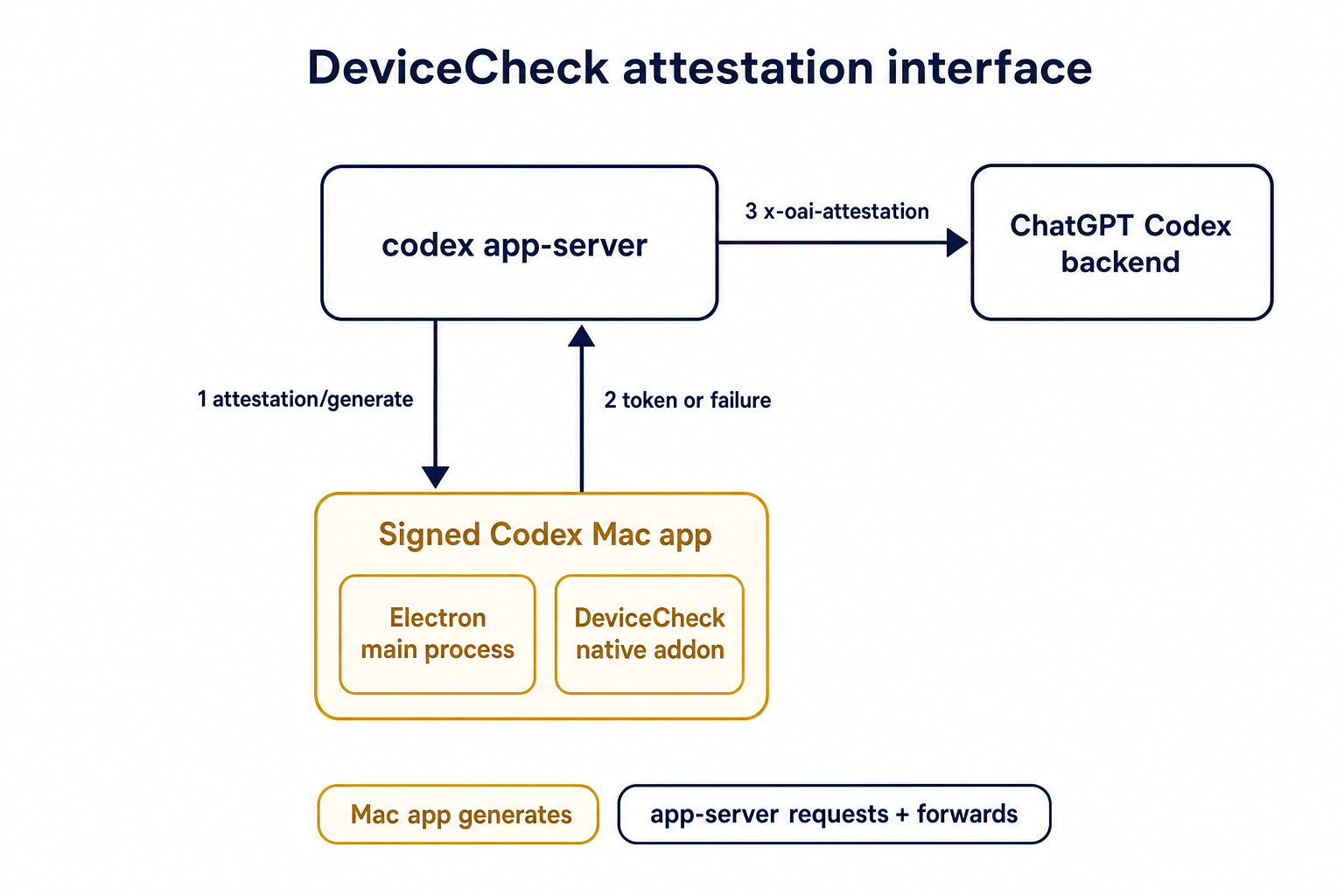
## Details
This PR teaches the Codex app-server runtime how to request and attach
an attestation token. It does not generate DeviceCheck tokens directly;
instead, it relies on the connected desktop app to advertise that it can
generate attestation and then asks that app for a fresh header value
when needed.
The flow is:
1. The Codex desktop app connects to app-server.
2. During `initialize`, the app can advertise that it supports
`requestAttestation`.
3. Before app-server calls selected ChatGPT Codex endpoints, it sends
the internal server request `attestation/generate` to the app.
4. app-server receives a pre-encoded header value back.
5. app-server forwards that value as `x-oai-attestation` on the scoped
outbound requests.
The code in this repo is mostly protocol and runtime plumbing: it adds
the app-server request/response shape, introduces an attestation
provider in core, wires that provider into Responses / compaction /
realtime setup paths, and covers the intended scoping with tests. The
signed macOS DeviceCheck generation remains owned by the desktop app PR.
## Related PR
- Codex desktop app implementation:
https://github.com/openai/openai/pull/878649
## Validation
<details>
<summary>Tests run</summary>
```sh
cargo test -p codex-app-server-protocol
cargo test -p codex-core attestation --lib
cargo test -p codex-app-server --lib attestation
```
Also ran:
```sh
just fix -p codex-core
just fix -p codex-app-server
just fix -p codex-app-server-protocol
just fmt
just write-app-server-schema
```
</details>
<details>
<summary>E2E DeviceCheck validation</summary>
First validated the signed desktop app boundary directly: launched a
packaged signed `Codex.app`, sent `attestation/generate`, decoded the
returned `v1.` attestation header, and validated the extracted
DeviceCheck token with `personal/jm/verify_devicecheck_token.py` using
bundle ID `com.openai.codex`. Apple returned `status_code: 200` and
`is_ok: true`.
Then ran the fuller app + app-server flow. The packaged `Codex.app`
launched a current-branch app-server via `CODEX_CLI_PATH`, and a local
MITM proxy intercepted outbound `chatgpt.com` traffic. The app-server
requested `attestation/generate` from the real Electron app process, and
the intercepted `/backend-api/codex/responses` traffic included
`x-oai-attestation` on both routes:
```text
GET /backend-api/codex/responses Upgrade: websocket x-oai-attestation: present
POST /backend-api/codex/responses Upgrade: none x-oai-attestation: present
```
The captured header decoded to a DeviceCheck token that also validated
with Apple for `com.openai.codex` (`status_code: 200`, `is_ok: true`,
team `2DC432GLL2`).
</details>
---------
Co-authored-by: Codex <noreply@openai.com>
- Route live thread renames through `ThreadStore` metadata updates.
- Read resumed thread names from store metadata with legacy local
fallback preserved in the store.
## DISCLAIMER
This is experimental and no production service must rely on this

## Why

Built-in MCPs are product-owned runtime capabilities, but they were
previously flattened into the same config-backed stdio path as
user-configured servers. That made them depend on a hidden `codex
builtin-mcp` re-exec path, exposed them through config-oriented CLI
flows, and erased distinctions the runtime needs to preserve—most
notably whether an MCP call should count as external context for
memory-mode pollution.

## What changed

- Model product-owned built-ins separately from config-backed MCP
servers via `BuiltinMcpServer` and `EffectiveMcpServer`.
- Launch built-ins in process through a reusable async transport instead
of the hidden `builtin-mcp` stdio subcommand.
- Keep config-oriented CLI operations such as `codex mcp
list/get/login/logout` scoped to configured servers, while merging
built-ins only into the effective runtime server set.
- Retain server metadata after launch so parallel-tool support and
context classification come from the live server set; built-in
`memories` is now classified as local Codex state rather than external
context.

## Test plan

- `cargo test -p codex-mcp`
- `cargo test -p codex-core --test suite
builtin_memories_mcp_call_does_not_mark_thread_memory_mode_polluted_when_configured`

---------

Co-authored-by: Codex <noreply@openai.com>
## Why

Reverts #20689 to restore the previous optional state DB plumbing. The
conflict resolution keeps the newer installation ID and session/thread
identity changes that landed after #20689, while removing the mandatory
state DB and agent graph store dependency from ThreadManager
construction.

## What changed

- Restored `Option<StateDbHandle>` through app-server, MCP server,
prompt debug, and test entry points.
- Removed the `codex-core` dependency on `codex-agent-graph-store` and
reverted descendant lookup back to the existing state DB path when
available.
- Kept newer `installation_id` forwarding by passing it beside the
optional DB handle.
- Kept local thread-name updates working when the optional state DB
handle is absent.

## Validation

- `git diff --check`
- `cargo test -p codex-thread-store`
- `cargo test -p codex-state -p codex-rollout -p
codex-app-server-protocol`
- Attempted `env CARGO_INCREMENTAL=0 cargo test -p codex-core -p
codex-app-server -p codex-app-server-client -p codex-mcp-server -p
codex-thread-manager-sample -p codex-tui`; blocked locally by a rustc
ICE while compiling `v8 v146.4.0` with `rustc 1.93.0 (254b59607
2026-01-19)` on `aarch64-apple-darwin`.
## Why

Skills update notifications are app-server API behavior, but the watcher
lived in `codex-core` and surfaced through
`EventMsg::SkillsUpdateAvailable`. Moving the watcher out keeps core
focused on thread execution and lets app-server own both cache
invalidation and the `skills/changed` notification.

## What changed

- Added an app-server-owned skills watcher that watches local skill
roots, clears the shared skills cache, and emits `skills/changed`
directly.
- Registers skill watches from the common app-server thread listener
attach path, including direct starts, resumes, and app-server-observed
child or forked threads.
- Stores the `WatchRegistration` on `ThreadState`, so listener
replacement, thread teardown, idle unload, and app-server shutdown
deregister by dropping the RAII guard.
- Removed `EventMsg::SkillsUpdateAvailable`, the core watcher, and the
old core live-reload test.
- Extended the app-server skills change test to verify a cached skills
list is refreshed after a filesystem change without forcing reload.

## Validation

- `cargo check -p codex-core -p codex-app-server -p codex-mcp-server -p
codex-rollout -p codex-rollout-trace`
- `cargo test -p codex-app-server
skills_changed_notification_is_emitted_after_skill_change`
# Motivation

Browser Use origin-access prompts are MCP elicitations, not direct
tool-call approval prompts, so they were bypassing the Guardian approval
path. We need a generic opt-in that lets eligible MCP elicitations use
Guardian when the current turn already routes approvals there.

# Description

Add a generic elicitation reviewer hook in codex-mcp and wire codex-core
to pass a Guardian reviewer callback when creating the MCP connection
manager. The reviewer validates explicit mcp_tool_call opt-in metadata,
builds a Guardian MCP tool-call review request from
server/tool/connector metadata and tool params, and maps Guardian
approval, denial, timeout, and cancellation decisions back to MCP
elicitation responses.

The new option to trigger this in the `_meta` object is:
```
"codex_request_type": "approval_request",
```

# Testing

- RUST_MIN_STACK=8388608 NEXTEST_STATUS_LEVEL=leak cargo nextest run
--no-fail-fast --cargo-profile ci-test --test-threads 2
- cargo clippy --tests -- -D warnings
- cargo fmt -- --config imports_granularity=Item --check
- cargo shear
- pnpm run format
- python3 .github/scripts/verify_cargo_workspace_manifests.py
- python3 .github/scripts/verify_tui_core_boundary.py
- python3 .github/scripts/verify_bazel_clippy_lints.py
- git diff --check
## Why

Message history was implemented inside `codex-core` and surfaced through
core protocol ops and `SessionConfiguredEvent` fields even though the
current consumer is TUI-local prompt recall. That made core own UI
history persistence and exposed `history_log_id` / `history_entry_count`
through surfaces that app-server and other clients do not need.

This change moves message history persistence out of core and keeps the
recall plumbing local to the TUI.

## What changed

- Added a new `codex-message-history` crate for appending, looking up,
trimming, and reading metadata from `history.jsonl`.
- Removed core protocol history ops/events: `AddToHistory`,
`GetHistoryEntryRequest`, and `GetHistoryEntryResponse`.
- Removed `history_log_id` and `history_entry_count` from
`SessionConfiguredEvent` and updated exec/MCP/test fixtures accordingly.
- Updated the TUI to dispatch local app events for message-history
append/lookup and keep its persistent-history metadata in TUI session
state.

## Validation

- `cargo test -p codex-message-history -p codex-protocol`
- `cargo test -p codex-exec event_processor_with_json_output`
- `cargo test -p codex-mcp-server outgoing_message`
- `cargo test -p codex-tui`
- `just fix -p codex-message-history -p codex-protocol -p codex-core -p
codex-tui -p codex-exec -p codex-mcp-server`
## Summary

- resolve or inject the installation ID before core startup and pass it
through `ThreadManager`, `CodexSpawnArgs`, and `Session` as a plain
`String`
- keep child sessions on the parent installation ID instead of
rediscovering it inside core
- propagate installation ID startup failures in `mcp-server` instead of
panicking

## Why

Core was still touching the filesystem on the session startup path to
discover `installation_id`. This moves that work to the outer host
boundary so core no longer depends on `codex_home` reads during session
construction.

---------

Co-authored-by: Codex <noreply@openai.com>
## Why

MCP tool calls already include `session_id` in `x-codex-turn-metadata`,
but descendant threads intentionally share that value with the root
thread. Consumers that need to correlate work at the concrete thread
level also need the current `thread_id`.

## What changed

- add `thread_id` to `x-codex-turn-metadata` while preserving
`session_id` as the shared session identity
- thread the two identities separately through normal turns and spawned
review threads
- add regression coverage for resumed sessions, reserved metadata
fields, and deferred MCP tool calls

## Verification

- added focused coverage in `core/src/session/tests.rs`,
`core/src/turn_metadata_tests.rs`, and `core/tests/suite/search_tool.rs`
## Summary

Related to
https://openai.slack.com/archives/C095U48JNL9/p1777537279707449
TLDR:
We update the meaning of session ids and thread ids:
* thread_id stays as now
* session_id become a shared id between every thread under a /root
thread (i.e. every sub-agent share the same session id)

This PR introduces an explicit `SessionId` and threads it through the
protocol/client boundary so `session_id` and `thread_id` can diverge
when they need to, while preserving compatibility for older serialized
`session_configured` events.

---------

Co-authored-by: Codex <noreply@openai.com>
## Summary
- make `thread_source` an explicit optional thread-level field on
`thread/start`, `thread/fork`, and returned thread payloads
- persist `thread_source` in rollout/session metadata so resumed live
threads retain the original value
- replace the old best-effort `session_source` -> `thread_source`
mapping with an explicit caller-supplied analytics classification

## Why
Before this change, analytics `thread_source` was populated by a
best-effort mapping from `session_source`. `session_source` describes
the runtime/client surface, not the actual thread-level origin, so that
projection was not accurate enough to distinguish cases such as `user`,
`subagent`, `memory_consolidation`, and future thread origins reliably.

Making `thread_source` explicit keeps one thread-level analytics field
while letting callers provide the real classification directly instead
of recovering it indirectly from `session_source`.

## Impact
For new analytics events, `thread_source` now reflects the explicit
thread-level classification supplied by the caller rather than an
inferred value derived from `session_source`. Existing protocol fields
remain optional; callers that omit `threadSource` now produce `null`
instead of a best-effort inferred value.

## Validation
- `just write-app-server-schema`
- `cargo test -p codex-analytics -p codex-core -p
codex-app-server-protocol --no-run`
- `cargo test -p codex-app-server-protocol
generated_ts_optional_nullable_fields_only_in_params`
- `cargo test -p codex-analytics
thread_initialized_event_serializes_expected_shape`
- `cargo test -p codex-core
resume_stopped_thread_from_rollout_preserves_thread_source`
## Why

We want the agent graph store to be passed down the stack as a real
dependency, the same way we already treat the thread store.

This will let us inject the agent graph store as a real dependency and
support implementations other than the local SQLite-backed one. Right
now most code instantiates a state DB and an agent graph store
just-in-time. Ideally, we would not depend on the state DB directly but
only read through the higher-level interfaces.

This change makes the dependency boundaries explicit and moves state DB
initialization to process bootstrap instead of hiding it inside local
store implementations.

## What changed

- `ThreadManager` now requires a `StateDbHandle` and an
`AgentGraphStore` at construction time instead of treating them as
optional internals.
- The local store constructors no longer lazily initialize SQLite.
Callers now initialize the state DB once per process and use that shared
handle to build:
  - `LocalThreadStore`
  - `LocalAgentGraphStore`
- App bootstraps (`app-server`, `mcp-server`, `prompt_debug`, and the
thread-manager sample) now initialize the state DB up front and inject
the resulting handle down the stack.
- `app-server` now consistently uses its process-scoped state DB handle
instead of reopening SQLite or trying to recover it from loaded threads.
- Device-key storage now reuses the shared state DB handle instead of
maintaining its own lazy opener.
- The thread archive / descendant traversal paths now use the injected
`AgentGraphStore` instead of reaching through local
thread-store-specific state.

## Verification

- `cargo check -p codex-core -p codex-thread-store -p codex-app-server
-p codex-mcp-server -p codex-thread-manager-sample --tests`
- `cargo test -p codex-thread-store`
- `cargo test -p codex-core
thread_manager_accepts_separate_agent_graph_store_and_thread_store --
--nocapture`
- `cargo test -p codex-app-server
thread_archive_archives_spawned_descendants -- --nocapture`
# Why

Revert #20524 for now because the computer use plugin has not migrated
off legacy `notify` yet. Keeping the deprecation in place today would
show users a warning before the plugin path is ready to move, so this
rolls the change back until that migration is complete.

# What

- revert the legacy `notify` deprecation change from #20524
- restore the prior `notify` behavior and remove the temporary
deprecation metrics/docs from that change

Once the computer use plugin has migrated, we can land the same
deprecation again.
## Why

SQLite state was still being opened from consumer paths, including lazy
`OnceCell`-backed thread-store call sites. That let one process
construct multiple state DB connections for the same Codex home, which
makes SQLite lock contention and `database is locked` failures much
easier to hit.

State DB lifetime should be chosen by main-like entrypoints and tests,
then passed through explicitly. Consumers should use the supplied
`Option<StateDbHandle>` or `StateDbHandle` and keep their existing
filesystem fallback or error behavior when no handle is available.

The startup path also needs to keep the rollout crate in charge of
SQLite state initialization. Opening `codex_state::StateRuntime`
directly bypasses rollout metadata backfill, so entrypoints should
initialize through `codex_rollout::state_db` and receive a handle only
after required rollout backfills have completed.

## What Changed

- Initialize the state DB in main-like entrypoints for CLI, TUI,
app-server, exec, MCP server, and the thread-manager sample.
- Pass `Option<StateDbHandle>` through `ThreadManager`,
`LocalThreadStore`, app-server processors, TUI app wiring, rollout
listing/recording, personality migration, shell snapshot cleanup,
session-name lookup, and memory/device-key consumers.
- Remove the lazy local state DB wrapper from the thread store so
non-test consumers use only the supplied handle or their existing
fallback path.
- Make `codex_rollout::state_db::init` the local state startup path: it
opens/migrates SQLite, runs rollout metadata backfill when needed, waits
for concurrent backfill workers up to a bounded timeout, verifies
completion, and then returns the initialized handle.
- Keep optional/non-owning SQLite helpers, such as remote TUI local
reads, as open-only paths that do not run startup backfill.
- Switch app-server startup from direct
`codex_state::StateRuntime::init` to the rollout state initializer so
app-server cannot skip rollout backfill.
- Collapse split rollout lookup/list APIs so callers use the normal
methods with an optional state handle instead of `_with_state_db`
variants.
- Restore `getConversationSummary(ThreadId)` to delegate through
`ThreadStore::read_thread` instead of a LocalThreadStore-specific
rollout path special case.
- Keep DB-backed rollout path lookup keyed on the DB row and file
existence, without imposing the filesystem filename convention on
existing DB rows.
- Verify readable DB-backed rollout paths against `session_meta.id`
before returning them, so a stale SQLite row that points at another
thread's JSONL falls back to filesystem search and read-repairs the DB
row.
- Keep `debug prompt-input` filesystem-only so a one-off debug command
does not initialize or backfill SQLite state just to print prompt input.
- Keep goal-session test Codex homes alive only in the goal-specific
helper, rather than leaking tempdirs from the shared session test
helper.
- Update tests and call sites to pass explicit state handles where DB
behavior is expected and explicit `None` where filesystem-only behavior
is intended.

## Validation

- `CARGO_TARGET_DIR=/tmp/codex-target-state-db cargo check -p
codex-rollout -p codex-thread-store -p codex-app-server -p codex-core -p
codex-tui -p codex-exec -p codex-cli --tests`
- `CARGO_TARGET_DIR=/tmp/codex-target-state-db cargo test -p
codex-rollout state_db_`
- `CARGO_TARGET_DIR=/tmp/codex-target-state-db cargo test -p
codex-rollout find_thread_path`
- `CARGO_TARGET_DIR=/tmp/codex-target-state-db cargo test -p
codex-rollout find_thread_path -- --nocapture`
- `CARGO_TARGET_DIR=/tmp/codex-target-state-db cargo test -p
codex-rollout try_init_ -- --nocapture`
- `CARGO_TARGET_DIR=/tmp/codex-target-state-db cargo test -p
codex-rollout`
- `CARGO_TARGET_DIR=/tmp/codex-target-state-db cargo clippy -p
codex-rollout --lib -- -D warnings`
- `CARGO_TARGET_DIR=/tmp/codex-target-state-db cargo test -p
codex-thread-store
read_thread_falls_back_when_sqlite_path_points_to_another_thread --
--nocapture`
- `CARGO_TARGET_DIR=/tmp/codex-target-state-db cargo test -p
codex-thread-store`
- `CARGO_TARGET_DIR=/tmp/codex-target-state-db cargo test -p codex-core
shell_snapshot`
- `CARGO_TARGET_DIR=/tmp/codex-target-state-db cargo test -p codex-core
--test all personality_migration`
- `CARGO_TARGET_DIR=/tmp/codex-target-state-db cargo test -p codex-core
--test all rollout_list_find`
- `RUST_MIN_STACK=8388608 CODEX_SKIP_VENDORED_BWRAP=1
CARGO_TARGET_DIR=/tmp/codex-target-state-db cargo test -p codex-core
--test all rollout_list_find::find_prefers_sqlite_path_by_id --
--nocapture`
- `RUST_MIN_STACK=8388608 CODEX_SKIP_VENDORED_BWRAP=1
CARGO_TARGET_DIR=/tmp/codex-target-state-db cargo test -p codex-core
--test all rollout_list_find -- --nocapture`
- `CARGO_TARGET_DIR=/tmp/codex-target-state-db cargo test -p codex-core
interrupt_accounts_active_goal_before_pausing`
- `CARGO_TARGET_DIR=/tmp/codex-target-state-db cargo test -p
codex-app-server get_auth_status -- --test-threads=1`
- `CODEX_SKIP_VENDORED_BWRAP=1
CARGO_TARGET_DIR=/tmp/codex-target-state-db cargo test -p
codex-app-server --lib`
- `CODEX_SKIP_VENDORED_BWRAP=1
CARGO_TARGET_DIR=/tmp/codex-target-state-db cargo check -p codex-rollout
-p codex-app-server --tests`
- `CARGO_TARGET_DIR=/tmp/codex-target-state-db just fix -p codex-rollout
-p codex-thread-store -p codex-core -p codex-app-server -p codex-tui -p
codex-exec -p codex-cli`
- `CODEX_SKIP_VENDORED_BWRAP=1
CARGO_TARGET_DIR=/tmp/codex-target-state-db just fix -p codex-rollout -p
codex-app-server`
- `CARGO_TARGET_DIR=/tmp/codex-target-state-db just fix -p
codex-rollout`
- `CODEX_SKIP_VENDORED_BWRAP=1
CARGO_TARGET_DIR=/tmp/codex-target-state-db just fix -p codex-core`
- `just argument-comment-lint -p codex-core`
- `just argument-comment-lint -p codex-rollout`

Focused coverage added in `codex-rollout`:

- `recorder::tests::state_db_init_backfills_before_returning` verifies
the rollout metadata row exists before startup init returns.
- `state_db::tests::try_init_waits_for_concurrent_startup_backfill`
verifies startup waits for another worker to finish backfill instead of
disabling the handle for the process.
-
`state_db::tests::try_init_times_out_waiting_for_stuck_startup_backfill`
verifies startup does not hang indefinitely on a stuck backfill lease.
-
`tests::find_thread_path_accepts_existing_state_db_path_without_canonical_filename`
verifies DB-backed lookup accepts valid existing rollout paths even when
the filename does not include the thread UUID.
-
`tests::find_thread_path_falls_back_when_db_path_points_to_another_thread`
verifies DB-backed lookup ignores a stale row whose existing path
belongs to another thread and read-repairs the row after filesystem
fallback.

Focused coverage updated in `codex-core`:

- `rollout_list_find::find_prefers_sqlite_path_by_id` now uses a
DB-preferred rollout file with matching `session_meta.id`, so it still
verifies that valid SQLite paths win without depending on stale/empty
rollout contents.

`cargo test -p codex-app-server thread_list_respects_search_term_filter
-- --test-threads=1 --nocapture` was attempted locally but timed out
waiting for the app-server test harness `initialize` response before
reaching the changed thread-list code path.

`bazel test //codex-rs/thread-store:thread-store-unit-tests
--test_output=errors` was attempted locally after the thread-store fix,
but this container failed before target analysis while fetching `v8+`
through BuildBuddy/direct GitHub. The equivalent local crate coverage,
including `cargo test -p codex-thread-store`, passes.

A plain local `cargo check -p codex-rollout -p codex-app-server --tests`
also requires system `libcap.pc` for `codex-linux-sandbox`; the
follow-up app-server check above used `CODEX_SKIP_VENDORED_BWRAP=1` in
this container.
## Why
This is a prep PR in the multi-environment process-tool stack. It
separates ownership/config cleanup from the behavior change that teaches
process tools to route by selected environment, so the follow-up PR can
focus on model-facing `environment_id` behavior.

## Stack
1. https://github.com/openai/codex/pull/20646 - `EnvironmentContext`
rendering for selected environments
2. https://github.com/openai/codex/pull/20669 - selected-environment
ownership and tool config prep (this PR)
3. https://github.com/openai/codex/pull/20647 - process-tool
`environment_id` routing

## What Changed
- keep the resolved turn environment list wrapped in
`ResolvedTurnEnvironments` through `TurnContext` instead of unwrapping
it back to a raw `Vec`
- add `TurnContext::resolve_path_against` so cwd-relative path
resolution has one shared helper
- replace the old tool config boolean with `ToolEnvironmentMode::{None,
Single, Multiple}`

## Testing
- Tests not run locally; this prep refactor is covered by GitHub CI for
the stack.

Co-authored-by: Codex <noreply@openai.com>
## Summary
- make selected turn environments the source of truth for session
runtime cwd and MCP runtime environment selection
- keep local/no-selection fallback behavior intact
- add coverage for duplicate selected environments, cwd resolution, and
MCP runtime environment selection

## Validation
- git diff --check
- rustfmt was run on touched Rust files during the implementation
workflow

CI should provide the full Bazel/test signal.

---------

Co-authored-by: Codex <noreply@openai.com>
# Why

`notify` is the remaining compatibility surface from the legacy hook
implementation. The newer lifecycle hook engine now owns the active hook
system, so we should start steering users away from adding new `notify`
configs before removing the old path entirely. This also adds a
lightweight watchpoint for the deprecation so we can see how much legacy
usage remains before the clean drop.

# What

- emit a startup deprecation notice when a non-empty `notify` command is
configured
- emit `codex.notify.configured` when a session starts with legacy
`notify` configured
- emit `codex.notify.run` when the legacy notify path fires after a
completed turn
- mark `notify` as deprecated in the config schema and repo docs
- remove the orphaned `codex-rs/hooks/src/user_notification.rs` file
that is no longer compiled
- add regression coverage for the new deprecation notice

# Next steps

A follow-up PR can remove the legacy notify path entirely once we are
ready for the clean drop. Before then, we can watch
`codex.notify.configured` and `codex.notify.run` to understand the
deprecation impact and remaining active usage. The cleanup PR should
then delete the `notify` config field, the `legacy_notify`
implementation, the old compatibility dispatch types and callsites that
only exist for the legacy path, and the remaining compatibility
docs/tests.

# Testing

- `cargo test -p codex-hooks`
- `cargo test -p codex-config`
- `cargo test -p codex-core emits_deprecation_notice_for_notify`
## Why

For reproducibility. A hand-written `config.toml` is not enough to
recreate what a Codex session actually ran with because layered config,
CLI overrides, defaults, feature aliases, resolved feature config,
prompt setup, and model-catalog/session values can all affect the final
runtime behavior.

This PR adds an effective config lockfile path: one run can export the
resolved session config, and a later run can replay that lockfile and
fail early if the regenerated effective config drifts.

## What Changed

- Add a dedicated `ConfigLockfileToml` wrapper with top-level lockfile
metadata plus the replayable config:

  ```toml
  version = 1
  codex_version = "..."

  [config]
  # effective ConfigToml fields
  ```

- Keep lockfile metadata out of regular `ConfigToml`; replay loads
`ConfigLockfileToml` and then uses its nested `config` as the
authoritative config layer.
- Add `debug.config_lockfile.export_dir` to write
`<thread_id>.config.lock.toml` when a root session starts.
- Add `debug.config_lockfile.load_path` to replay a saved lockfile and
validate the regenerated session lockfile against it.
- Add `debug.config_lockfile.allow_codex_version_mismatch` to optionally
tolerate Codex binary version drift while still comparing the rest of
the lockfile.
- Add `debug.config_lockfile.save_fields_resolved_from_model_catalog` so
lock creation can either save model-catalog/session-resolved fields or
intentionally leave those fields dynamic.
- Build lockfiles from the effective config plus resolved runtime values
such as model selection, reasoning settings, prompts, service tier, web
search mode, feature states/config, memories config, skill instructions,
and agent limits.
- Materialize feature aliases and custom feature config into the
lockfile so replay compares canonical resolved behavior instead of
user-authored alias shape.
- Strip profile/debug/file-include/environment-specific inputs from
generated lockfiles so they contain replayable values rather than the
inputs that produced those values.
- Surface JSON-RPC server error code/data in app-server client and TUI
bootstrap errors so config-lock replay failures include the actual TOML
diff.
- Regenerate the config schema for the new debug config keys.

## Review Notes

The main flow is split across these files:

- `config/src/config_toml.rs`: lockfile/debug TOML shapes.
- `core/src/config/mod.rs`: loading `debug.config_lockfile.*`, replaying
a lockfile as a config layer, and preserving the expected lockfile for
validation.
- `core/src/session/config_lock.rs`: exporting the current session
lockfile and materializing resolved session/config values.
- `core/src/config_lock.rs`: lockfile parsing, metadata/version checks,
replay comparison, and diff formatting.

## Usage

Export a lockfile from a normal session:

```sh
codex -c 'debug.config_lockfile.export_dir="/tmp/codex-locks"'
```

Export a lockfile without saving model-catalog/session-resolved fields:

```sh
codex -c 'debug.config_lockfile.export_dir="/tmp/codex-locks"' \
  -c 'debug.config_lockfile.save_fields_resolved_from_model_catalog=false'
```

Replay a saved lockfile in a later session:

```sh
codex -c 'debug.config_lockfile.load_path="/tmp/codex-locks/<thread_id>.config.lock.toml"'
```

If replay resolves to a different effective config, startup fails with a
TOML diff.

To tolerate Codex binary version drift during replay:

```sh
codex -c 'debug.config_lockfile.load_path="/tmp/codex-locks/<thread_id>.config.lock.toml"' \
  -c 'debug.config_lockfile.allow_codex_version_mismatch=true'
```

## Limitations

This does not support custom rules/network policies.

## Verification

- `cargo test -p codex-core config_lock`
- `cargo test -p codex-config`
- `cargo test -p codex-thread-manager-sample`
- Build one app-server process ThreadStore from startup config and share
it with ThreadManager and CodexMessageProcessor.
- Remove per-thread/fork store reconstruction so effective thread config
cannot switch the persistence backend.
- Add params to ThreadStore create/resume for specifying thread
metadata, since otherwise the metadata from store creation would be used
(incorrectly).
## Why

After `hooks/list` exposes the hook inventory, clients need a way to
persist user hook preferences, make those changes effective in
already-open sessions, and distinguish user-controllable hooks from
managed requirements without adding another bespoke app-server write
API.

## What

- Extends `hooks/list` entries with effective `enabled` state.
- Persists user-level hook state under `hooks.state.<hook-id>` so the
model can grow beyond a single boolean over time.
- Uses the existing `config/batchWrite` path for hook state updates
instead of introducing a dedicated hook write RPC.
- Refreshes live session hook engines after config writes so
already-open threads observe updated enablement without a restart.

## Stack

1. openai/codex#19705
2. openai/codex#19778
3. This PR - openai/codex#19840
4. openai/codex#19882

## Reviewer Notes

The generated schema files account for much of the raw diff. The core
behavior is in:

- `hooks/src/config_rules.rs`, which resolves per-hook user state from
the config layer stack.
- `hooks/src/engine/discovery.rs`, which projects effective enablement
into `hooks/list` from source-derived managedness.
- `config/src/hook_config.rs`, which defines the new `hooks.state`
representation.
- `core/src/session/mod.rs`, which rebuilds live hook state after user
config reloads.

---------

Co-authored-by: Codex <noreply@openai.com>
## Why

Plugins can bundle lifecycle hooks, but Codex previously only discovered
hooks from user, project, and managed config layers. This adds the
plugin discovery and runtime plumbing needed for plugin-bundled hooks
while keeping execution behind the `plugin_hooks` feature flag.

## What

- Discovers plugin hook sources from each plugin's default
`hooks/hooks.json`.
- Supports `plugin.json` manifest `hooks` entries as either relative
paths or inline hook objects.
- Plumbs discovered plugin hook sources through plugin loading into the
hook runtime when `plugin_hooks` is enabled.
- Marks plugin-originated hook runs as `HookSource::Plugin`.
- Injects `PLUGIN_ROOT` and `CLAUDE_PLUGIN_ROOT` into plugin hook
command environments.
- Updates generated schemas and hook source metadata for the plugin hook
source.

## Stack

1. This PR - openai/codex#19705
2. openai/codex#19778
3. openai/codex#19840
4. openai/codex#19882

## Reviewer Notes

- Core logic is in `codex-rs/core-plugins/src/loader.rs` and
`codex-rs/hooks/src/engine/discovery.rs`
- Moved existing / adding new tests to
`codex-rs/core-plugins/src/loader_tests.rs` hence the large diff there
- Otherwise mostly plumbing and minor schema updates

### Core Changes

The `codex-rs/core` changes are limited to wiring plugin hook support
into existing core flows:

- `core/src/session/session.rs` conditionally pulls effective plugin
hook sources and plugin hook load warnings from `PluginsManager` when
`plugin_hooks` is enabled, then passes them into `HooksConfig`.
- `core/src/hook_runtime.rs` adds the `plugin` metric tag for
`HookSource::Plugin`.
- `core/config.schema.json` picks up the new `plugin_hooks` feature
flag, and `core/src/plugins/manager_tests.rs` updates fixtures for the
added plugin hook fields.

---------

Co-authored-by: Codex <noreply@openai.com>
Keep extracting memories out of core and moving the write trigger in the
app-server
This is temporary and it should move at the client level as a follow-up
This makes core fully independant from `codex-memories-write`

---------

Co-authored-by: Codex <noreply@openai.com>
## Why

`ThreadConfigSnapshot` is used by app-server and thread metadata code as
a stable view of active runtime settings. Keeping both `sandbox_policy`
and `permission_profile` in the snapshot duplicates permission state and
makes it possible for the legacy projection to drift from the canonical
profile.

The legacy `sandbox` value is still needed at app-server compatibility
boundaries, so this PR derives it on demand from the snapshot profile
and cwd instead of storing it.

## What Changed

- Removes `ThreadConfigSnapshot.sandbox_policy`.
- Adds `ThreadConfigSnapshot::sandbox_policy()` as a compatibility
projection from `permission_profile` plus `cwd`.
- Updates app-server response/metadata code and tests to call the
projection only where legacy fields still exist.
- Keeps snapshot construction profile-only so split filesystem rules,
disabled enforcement, and external enforcement remain represented by the
canonical profile.

## Verification

- `cargo test -p codex-app-server
thread_response_permission_profile_preserves_enforcement --lib`
- `cargo test -p codex-core
dispatch_reclaims_stale_global_lock_and_starts_consolidation --lib`


---
[//]: # (BEGIN SAPLING FOOTER)
Stack created with [Sapling](https://sapling-scm.com). Best reviewed
with [ReviewStack](https://reviewstack.dev/openai/codex/pull/19775).
* #19900
* #19899
* #19776
* __->__ #19775
## Why

`SessionConfiguredEvent` is the internal event that tells clients what
permissions are active for a session. Emitting both `sandbox_policy` and
`permission_profile` leaves two possible authorities and forces every
consumer to decide which one to honor. At this point in the migration,
the profile is expressive enough to represent managed, disabled, and
external sandbox enforcement, so the internal event can be profile-only.

The wire compatibility concern is older serialized events or rollout
data that only contain `sandbox_policy`; those still need to
deserialize.

## What Changed

- Removes `sandbox_policy` from `SessionConfiguredEvent` and makes
`permission_profile` required.
- Adds custom deserialization so old payloads with only `sandbox_policy`
are upgraded to a cwd-anchored `PermissionProfile`.
- Updates core event emission and TUI session handling to sync
permissions from the profile directly.
- Updates app-server response construction to derive the legacy
`sandbox` response field from the active thread snapshot instead of from
`SessionConfiguredEvent`.
- Updates yolo-mode display logic to treat both
`PermissionProfile::Disabled` and managed unrestricted filesystem plus
enabled network as full-access, while still preserving the distinction
between no sandbox and external sandboxing.

## Verification

- `cargo test -p codex-protocol session_configured_event --lib`
- `cargo test -p codex-protocol serialize_event --lib`
- `cargo test -p codex-exec session_configured --lib`
- `cargo test -p codex-app-server
thread_response_permission_profile_preserves_enforcement --lib`
- `cargo test -p codex-core
session_configured_reports_permission_profile_for_external_sandbox
--lib`
- `cargo test -p codex-tui session_configured --lib`
- `cargo test -p codex-tui
yolo_mode_includes_managed_full_access_profiles --lib`


---
[//]: # (BEGIN SAPLING FOOTER)
Stack created with [Sapling](https://sapling-scm.com). Best reviewed
with [ReviewStack](https://reviewstack.dev/openai/codex/pull/19774).
* #19900
* #19899
* #19776
* #19775
* __->__ #19774
## Why

The experimental `PermissionProfile` API had both `:cwd` and
`:project_roots` special filesystem paths, which made the permission
root ambiguous. This PR removes the unstable `current_working_directory`
special path before the permissions API is stabilized, so callers use
`:project_roots` for symbolic project-root access.

## What changed

- Removes `FileSystemSpecialPath::CurrentWorkingDirectory` from protocol
and app-server protocol models, plus regenerated app-server
JSON/TypeScript schemas.
- Replaces internal `:cwd` permission entries with `:project_roots`
entries.
- Keeps the existing cwd-update behavior for legacy-shaped
workspace-write profiles, while removing the deleted
`CurrentWorkingDirectory` case from that compatibility path.
- Keeps `PermissionProfile::workspace_write()` as the reusable symbolic
workspace-write helper, with docs noting that `:project_roots` entries
resolve at enforcement time.
- Updates app-server docs/examples and approval UI labeling to stop
advertising `:cwd` as a permission token.

## Compatibility

Persisted rollout items may contain the old
`{"kind":"current_working_directory"}` tag from earlier experimental
`permissionProfile` snapshots. This PR keeps that tag as a
deserialize-only alias for `ProjectRoots { subpath: None }`, while
continuing to serialize only the new `project_roots` tag.

## Follow-up

This PR intentionally does not introduce an explicit project-root set on
`SessionConfiguration` or runtime sandbox resolution. Today, the
resolver still uses the active cwd as the single implicit project root.
A follow-up should model project roots separately from tool cwd so
`:project_roots` entries can resolve against the configured project
roots, and resolve to no entries when there are no project roots.

## Verification

- `cargo test -p codex-protocol permissions:: --lib`
- `cargo test -p codex-app-server-protocol`
- `cargo test -p codex-sandboxing -p codex-exec-server --lib`
- `cargo test -p codex-core session_configuration_apply_ --lib`
- `cargo test -p codex-app-server
command_exec_permission_profile_project_roots_use_command_cwd --test
all`
- `cargo test -p codex-tui
thread_read_session_state_does_not_reuse_primary_permission_profile
--lib`
- `cargo test -p codex-tui
preset_matching_accepts_workspace_write_with_extra_roots --lib`
- `cargo test -p codex-config --lib`
## Why

The remaining migration work still needs `SandboxPolicy` at a few
compatibility boundaries, but those projections should come from one
canonical path. Keeping ad hoc legacy projections scattered through
app-server, CLI, and config code makes it easy for behavior to drift as
`PermissionProfile` gains fidelity that the legacy enum cannot
represent.

## What Changed

- Adds `Permissions::legacy_sandbox_policy(cwd)` and
`Config::legacy_sandbox_policy()` as the compatibility projection from
the canonical `PermissionProfile`.
- Adds `Permissions::can_set_legacy_sandbox_policy()` so legacy inputs
are checked after they are converted into profile semantics.
- Updates app-server command handling, Windows sandbox setup, session
configuration, and sandbox summaries to use the centralized projection
helper.
- Leaves `SandboxPolicy` in place only for boundary inputs/outputs that
still speak the legacy abstraction.

## Verification

- `cargo check -p codex-config -p codex-core -p codex-sandboxing -p
codex-app-server -p codex-cli -p codex-tui`
- `cargo test -p codex-tui
permissions_selection_history_snapshot_full_access_to_default --
--nocapture`
- `cargo test -p codex-tui
permissions_selection_sends_approvals_reviewer_in_override_turn_context
-- --nocapture`
- `bazel test //codex-rs/tui:tui-unit-tests-bin
--test_arg=permissions_selection_history_snapshot_full_access_to_default
--test_output=errors`
- `bazel test //codex-rs/tui:tui-unit-tests-bin
--test_arg=permissions_selection_sends_approvals_reviewer_in_override_turn_context
--test_output=errors`


---
[//]: # (BEGIN SAPLING FOOTER)
Stack created with [Sapling](https://sapling-scm.com). Best reviewed
with [ReviewStack](https://reviewstack.dev/openai/codex/pull/19734).
* #19737
* #19736
* #19735
* __->__ #19734
## Why

Runtime decisions should not infer permissions from the lossy legacy
sandbox projection once `PermissionProfile` is available. In particular,
`Disabled` and `External` need to remain distinct, and managed profiles
with split filesystem or deny-read rules should not be collapsed before
approval, network, safety, or analytics code makes decisions.

## What Changed

- Changes managed network proxy setup and network approval logic to use
`PermissionProfile` when deciding whether a managed sandbox is active.
- Migrates patch safety, Guardian/user-shell approval paths, Landlock
helper setup, analytics sandbox classification, and selected
turn/session code to profile-backed permissions.
- Validates command-level profile overrides against the constrained
`PermissionProfile` rather than a strict `SandboxPolicy` round trip.
- Preserves configured deny-read restrictions when command profiles are
narrowed.
- Adds coverage for profile-backed trust, network proxy/approval
behavior, patch safety, analytics classification, and command-profile
narrowing.

## Verification

- `cargo test -p codex-core direct_write_roots`
- `cargo test -p codex-core runtime_roots_to_legacy_projection`
- `cargo test -p codex-app-server
requested_permissions_trust_project_uses_permission_profile_intent`


---
[//]: # (BEGIN SAPLING FOOTER)
Stack created with [Sapling](https://sapling-scm.com). Best reviewed
with [ReviewStack](https://reviewstack.dev/openai/codex/pull/19393).
* #19395
* #19394
* __->__ #19393
## Why

After #19391, `PermissionProfile` and the split filesystem/network
policies could still be stored in parallel. That creates drift risk: a
profile can preserve deny globs, external enforcement, or split
filesystem entries while a cached projection silently loses those
details. This PR makes the profile the runtime source and derives
compatibility views from it.

## What Changed

- Removes stored filesystem/network sandbox projections from
`Permissions` and `SessionConfiguration`; their accessors now derive
from the canonical `PermissionProfile`.
- Derives legacy `SandboxPolicy` snapshots from profiles only where an
older API still needs that field.
- Updates MCP connection and elicitation state to track
`PermissionProfile` instead of `SandboxPolicy` for auto-approval
decisions.
- Adds semantic filesystem-policy comparison so cwd changes can preserve
richer profiles while still recognizing equivalent legacy projections
independent of entry ordering.
- Updates config/session tests to assert profile-derived projections
instead of parallel stored fields.

## Verification

- `cargo test -p codex-core direct_write_roots`
- `cargo test -p codex-core runtime_roots_to_legacy_projection`
- `cargo test -p codex-app-server
requested_permissions_trust_project_uses_permission_profile_intent`


---
[//]: # (BEGIN SAPLING FOOTER)
Stack created with [Sapling](https://sapling-scm.com). Best reviewed
with [ReviewStack](https://reviewstack.dev/openai/codex/pull/19392).
* #19395
* #19394
* #19393
* __->__ #19392
## Why

This supersedes #19391. During stack repair, GitHub marked #19391 as
merged into a temporary stack branch rather than into `main`, so the
runtime-config change needed a fresh PR.

`PermissionProfile` is now the canonical permissions shape after #19231
because it can distinguish `Managed`, `Disabled`, and `External`
enforcement while also carrying filesystem rules that legacy
`SandboxPolicy` cannot represent cleanly. Core config and session state
still needed to accept profile-backed permissions without forcing every
profile through the strict legacy bridge, which rejected valid runtime
profiles such as direct write roots.

The unrelated CI/test hardening that previously rode along with this PR
has been split into #19683 so this PR stays focused on the permissions
model migration.

## What Changed

- Adds `Permissions.permission_profile` and
`SessionConfiguration.permission_profile` as constrained runtime state,
while keeping `sandbox_policy` as a legacy compatibility projection.
- Introduces profile setters that keep `PermissionProfile`, split
filesystem/network policies, and legacy `SandboxPolicy` projections
synchronized.
- Uses a compatibility projection for requirement checks and legacy
consumers instead of rejecting profiles that cannot round-trip through
`SandboxPolicy` exactly.
- Updates config loading, config overrides, session updates, turn
context plumbing, prompt permission text, sandbox tags, and exec request
construction to carry profile-backed runtime permissions.
- Preserves configured deny-read entries and `glob_scan_max_depth` when
command/session profiles are narrowed.
- Adds `PermissionProfile::read_only()` and
`PermissionProfile::workspace_write()` presets that match legacy
defaults.

## Verification

- `cargo test -p codex-core direct_write_roots`
- `cargo test -p codex-core runtime_roots_to_legacy_projection`
- `cargo test -p codex-app-server
requested_permissions_trust_project_uses_permission_profile_intent`


---
[//]: # (BEGIN SAPLING FOOTER)
Stack created with [Sapling](https://sapling-scm.com). Best reviewed
with [ReviewStack](https://reviewstack.dev/openai/codex/pull/19606).
* #19395
* #19394
* #19393
* #19392
* __->__ #19606
Adds the core runtime behavior for active goals on top of the model
tools from PR 3.

## Why

A long-running goal should be a core runtime concern, not something
every client has to implement. Core owns the turn lifecycle, tool
completion boundaries, interruptions, resume behavior, and token usage,
so it is the right place to account progress, enforce budgets, and
decide when to continue work.

## What changed

- Centralized goal lifecycle side effects behind
`Session::goal_runtime_apply(GoalRuntimeEvent::...)`.
- Starts goal continuation turns only when the session is idle; pending
user input and mailbox work take priority.
- Accounts token and wall-clock usage at turn, tool, mutation,
interrupt, and resume boundaries; `get_thread_goal` remains read-only.
- Preserves sub-second wall-clock remainder across accounting boundaries
so long-running goals do not drift downward over time.
- Treats token budget exhaustion as a soft stop by marking the goal
`budget_limited` and injecting wrap-up steering instead of aborting the
active turn.
- Suppresses budget steering when `update_goal` marks a goal complete.
- Pauses active goals on interrupt and auto-reactivates paused goals
when a thread resumes outside plan mode.
- Suppresses repeated automatic continuation when a continuation turn
makes no tool calls.
- Added continuation and budget-limit prompt templates.

## Verification

- Added focused core coverage for continuation scheduling, accounting
boundaries, budget-limit steering, completion accounting, interrupt
pause behavior, resume auto-activation, and wall-clock remainder
accounting.
- Route cold thread/resume and thread/fork source loading through
ThreadStore reads instead of direct rollout path operations
- Keep lookups that explicitly specify a rollout-path using the local
thread store methods but return an invalid-request error for remote
ThreadStore configurations
- Add some additional unit tests for code path coverage
## Why

The profile conversion path still required a `cwd` even when it was only
translating a legacy `SandboxPolicy` into a `PermissionProfile`. That
made profile producers invent an ambient `cwd`, which is exactly the
anchoring we are trying to remove from permission-profile data. A legacy
workspace-write policy can be represented symbolically instead: `:cwd =
write` plus read-only `:project_roots` metadata subpaths.

This PR creates that cwd-free base so the rest of the stack can stop
threading cwd through profile construction. Callers that actually need a
concrete runtime filesystem policy for a specific cwd still have an
explicitly named cwd-bound conversion.

## What Changed

- `PermissionProfile::from_legacy_sandbox_policy` now takes only
`&SandboxPolicy`.
- `FileSystemSandboxPolicy::from_legacy_sandbox_policy` is now the
symbolic, cwd-free projection for profiles.
- The old concrete projection is retained as
`FileSystemSandboxPolicy::from_legacy_sandbox_policy_for_cwd` for
runtime/boundary code that must materialize legacy cwd behavior.
- Workspace-write profiles preserve `CurrentWorkingDirectory` and
`ProjectRoots` special entries instead of materializing cwd into
absolute paths.

## Verification

- `cargo check -p codex-protocol -p codex-core -p
codex-app-server-protocol -p codex-app-server -p codex-exec -p
codex-exec-server -p codex-tui -p codex-sandboxing -p
codex-linux-sandbox -p codex-analytics --tests`
- `just fix -p codex-protocol -p codex-core -p codex-app-server-protocol
-p codex-app-server -p codex-exec -p codex-exec-server -p codex-tui -p
codex-sandboxing -p codex-linux-sandbox -p codex-analytics`


---
[//]: # (BEGIN SAPLING FOOTER)
Stack created with [Sapling](https://sapling-scm.com). Best reviewed
with [ReviewStack](https://reviewstack.dev/openai/codex/pull/19414).
* #19395
* #19394
* #19393
* #19392
* #19391
* __->__ #19414
## Why

`PermissionProfile` is becoming the canonical permissions abstraction,
but the old shape only carried optional filesystem and network fields.
It could describe allowed access, but not who is responsible for
enforcing it. That made `DangerFullAccess` and `ExternalSandbox` lossy
when profiles were exported, cached, or round-tripped through app-server
APIs.

The important model change is that active permissions are now a disjoint
union over the enforcement mode. Conceptually:

```rust
pub enum PermissionProfile {
    Managed {
        file_system: FileSystemSandboxPolicy,
        network: NetworkSandboxPolicy,
    },
    Disabled,
    External {
        network: NetworkSandboxPolicy,
    },
}
```

This distinction matters because `Disabled` means Codex should apply no
outer sandbox at all, while `External` means filesystem isolation is
owned by an outside caller. Those are not equivalent to a broad managed
sandbox. For example, macOS cannot nest Seatbelt inside Seatbelt, so an
inner sandbox may require the outer Codex layer to use no sandbox rather
than a permissive one.

## How Existing Modeling Maps

Legacy `SandboxPolicy` remains a boundary projection, but it now maps
into the higher-fidelity profile model:

- `ReadOnly` and `WorkspaceWrite` map to `PermissionProfile::Managed`
with restricted filesystem entries plus the corresponding network
policy.
- `DangerFullAccess` maps to `PermissionProfile::Disabled`, preserving
the “no outer sandbox” intent instead of treating it as a lax managed
sandbox.
- `ExternalSandbox { network_access }` maps to
`PermissionProfile::External { network }`, preserving external
filesystem enforcement while still carrying the active network policy.
- Split runtime policies that legacy `SandboxPolicy` cannot faithfully
express, such as managed unrestricted filesystem plus restricted
network, stay `Managed` instead of being collapsed into
`ExternalSandbox`.
- Per-command/session/turn grants remain partial overlays via
`AdditionalPermissionProfile`; full `PermissionProfile` is reserved for
complete active runtime permissions.

## What Changed

- Change active `PermissionProfile` into a tagged union: `managed`,
`disabled`, and `external`.
- Keep partial permission grants separate with
`AdditionalPermissionProfile` for command/session/turn overlays.
- Represent managed filesystem permissions as either `restricted`
entries or `unrestricted`; `glob_scan_max_depth` is non-zero when
present.
- Preserve old rollout compatibility by accepting the pre-tagged `{
network, file_system }` profile shape during deserialization.
- Preserve fidelity for important edge cases: `DangerFullAccess`
round-trips as `disabled`, `ExternalSandbox` round-trips as `external`,
and managed unrestricted filesystem + restricted network stays managed
instead of being mistaken for external enforcement.
- Preserve configured deny-read entries and bounded glob scan depth when
full profiles are projected back into runtime policies, including
unrestricted replacements that now become `:root = write` plus deny
entries.
- Regenerate the experimental app-server v2 JSON/TypeScript schema and
update the `command/exec` README example for the tagged
`permissionProfile` shape.

## Compatibility

Legacy `SandboxPolicy` remains available at config/API boundaries as the
compatibility projection. Existing rollout lines with the old
`PermissionProfile` shape continue to load. The app-server
`permissionProfile` field is experimental, so its v2 wire shape is
intentionally updated to match the higher-fidelity model.

## Verification

- `just write-app-server-schema`
- `cargo check --tests`
- `cargo test -p codex-protocol permission_profile`
- `cargo test -p codex-protocol
preserving_deny_entries_keeps_unrestricted_policy_enforceable`
- `cargo test -p codex-app-server-protocol
permission_profile_file_system_permissions`
- `cargo test -p codex-app-server-protocol serialize_client_response`
- `cargo test -p codex-core
session_configured_reports_permission_profile_for_external_sandbox`
- `just fix`
- `just fix -p codex-protocol`
- `just fix -p codex-app-server-protocol`
- `just fix -p codex-core`
- `just fix -p codex-app-server`
## Why

`codex-models-manager` had grown to own provider-specific concerns:
constructing OpenAI-compatible `/models` requests, resolving provider
auth, emitting request telemetry, and deciding how provider catalogs
should be sourced. That made the manager harder to reuse for providers
whose model catalog is not fetched from the OpenAI `/models` endpoint,
such as Amazon Bedrock.

This change moves provider-specific model discovery behind
provider-owned implementations, so the models manager can focus on
refresh policy, cache behavior, picker ordering, and model metadata
merging.

## What Changed

- Introduced a `ModelsManager` trait with separate `OpenAiModelsManager`
and `StaticModelsManager` implementations.
- Added `ModelsEndpointClient` so OpenAI-compatible HTTP fetching lives
outside `codex-models-manager`.
- Moved `/models` request construction, provider auth resolution,
timeout handling, and request telemetry into `codex-model-provider` via
`OpenAiModelsEndpoint`.
- Added provider-owned `models_manager(...)` construction so configured
OpenAI-compatible providers use `OpenAiModelsManager`, while
static/catalog-backed providers can return `StaticModelsManager`.
- Added an Amazon Bedrock static model catalog for the GPT OSS Bedrock
model IDs.
- Updated core/session/thread manager code and tests to depend on
`Arc<dyn ModelsManager>`.
- Moved offline model test helpers into
`codex_models_manager::test_support`.
## Metadata References

The Bedrock catalog metadata is based on the official Amazon Bedrock
OpenAI model documentation:

- [Amazon Bedrock OpenAI
models](https://docs.aws.amazon.com/bedrock/latest/userguide/model-parameters-openai.html)
lists the Bedrock model IDs, text input/output modalities, and `128,000`
token context window for `gpt-oss-20b` and `gpt-oss-120b`.
- [Amazon Bedrock `gpt-oss-120b` model
card](https://docs.aws.amazon.com/bedrock/latest/userguide/model-card-openai-gpt-oss-120b.html)
lists the `bedrock-runtime` model ID `openai.gpt-oss-120b-1:0`, the
`bedrock-mantle` model ID `openai.gpt-oss-120b`, text-only modalities,
and `128K` context window.
- [OpenAI `gpt-oss-120b` model
docs](https://developers.openai.com/api/docs/models/gpt-oss-120b)
document configurable reasoning effort with `low`, `medium`, and `high`,
plus text input/output modality.

The display names, default reasoning effort, and priority ordering are
Codex-local catalog choices.

## Test Plan
- Manually verified app-server model listing with an AWS profile:

```shell
CODEX_HOME="$(mktemp -d)" cargo run -p codex-app-server-test-client -- \
  --codex-bin ./target/debug/codex \
  -c 'model_provider="amazon-bedrock"' \
  -c 'model_providers.amazon-bedrock.aws.profile="codex-bedrock"' \
  -c 'model_providers.amazon-bedrock.aws.region="us-west-2"' \
  model-list
```

The response returned the Bedrock catalog with `openai.gpt-oss-120b-1:0`
as the default model and `openai.gpt-oss-20b-1:0` as the second listed
model, both text-only and supporting low/medium/high reasoning effort.
## Summary

Adds the debug CLI entry point for reducing recorded rollout traces.
This gives developers a direct way to inspect whether the emitted trace
stream reduces into the expected conversation/runtime model.

## Stack

This is PR 5/5 in the rollout trace stack.

- [#18876](https://github.com/openai/codex/pull/18876): Add rollout
trace crate
- [#18877](https://github.com/openai/codex/pull/18877): Record core
session rollout traces
- [#18878](https://github.com/openai/codex/pull/18878): Trace tool and
code-mode boundaries
- [#18879](https://github.com/openai/codex/pull/18879): Trace sessions
and multi-agent edges
- [#18880](https://github.com/openai/codex/pull/18880): Add debug trace
reduction command

## Review Notes

This PR is intentionally last: it depends on the trace crate, core
recorder, runtime/tool events, and session/agent edge data all existing.
The command should remain a debug/developer tool and avoid adding new
runtime behavior.

The useful review question is whether the CLI exposes the reducer in the
smallest practical way for local inspection without turning the debug
command into a supported user-facing workflow.
Begin migrating the thread write codepaths to ThreadStore.

This starts using ThreadStore inside of core session code, not only in
the app server code.

Rework the interfaces around thread recording/persistence. We're left
with the following:

* `ThreadManager`: owns the process-level registry of loaded threads and
handles cross-thread orchestration: start, resume, fork, lookup, remove,
and route ops to running CodexThreads.
* `CodexThread`: represents one loaded/running thread from the outside.
It is the handle app-server and callers use to submit ops, inspect
session metadata, and shut the thread down.
* `LiveThread`: session-owned persistence lifecycle handle for one
active thread. Core session code uses it to append rollout items,
materialize lazy persistence, flush, shutdown, discard init-failed
writers, and load that thread’s persisted history.
* `ThreadStore`: storage backend abstraction. It answers “how are
threads persisted, read, listed, updated, archived?” Local and remote
implementations live behind this trait.
* `LocalThreadStore`: local ThreadStore implementation. It owns the
file/sqlite-specific details and keeps RolloutRecorder as a local
implementation detail.

This is a few too many Thread abstractions for my liking, but they do
all represent different concepts / needs / layers.

Migration note: in places where the core code explicitly requires a
path, rather than a thread ID, throw an error if we're running with a
remote store.

Cover the new local live-writer lifecycle with focused tests and
preserve app-server thread-start behavior, including ephemeral pathless
sessions.

