mirror of
https://github.com/openai/codex.git
synced 2026-11-24 23:20:47 +00:00
6809c8b24362d3fc6b73932ace8a3945bf0739e6
303
Commits
| Author | SHA1 | Message | Date | |
|---|---|---|---|---|
 Michael Bolin |
89aeae6c21 |
core: route realtime and memories through HTTP client factory (#31362)
## Why `ModelClient` already carries the `HttpClientFactory` resolved from session configuration, but realtime call creation and memory summarization still constructed the legacy default client directly. Consequently, those first-party API requests could ignore `features.respect_system_proxy` even when Responses traffic honored it. These are the final direct default-client constructions in `core/src/client.rs`, so they form one small migration unit on top of #31361. ## What changed - Generalize `build_responses_transport` to `build_api_transport`. - Route realtime call creation through the helper using the selected provider and `/realtime/calls` destination. - Route `/memories/trace_summarize` through the same helper. - Remove the now-unused direct `build_reqwest_client` import. ## Review guide 1. The helper rename at the bottom of `core/src/client.rs` is mechanical and keeps existing Responses behavior unchanged. 2. The realtime call path computes the route from the final provider, including `api_provider_override`. 3. The memories path supplies its existing endpoint to the same API route class. ## Validation - `cargo check --tests -p codex-core` - `just fix -p codex-core` ## Follow-up Direct HTTP clients outside `ModelClient` remain separate migration slices. --- [//]: # (BEGIN SAPLING FOOTER) Stack created with [Sapling](https://sapling-scm.com). Best reviewed with [ReviewStack](https://reviewstack.dev/openai/codex/pull/31362). * #31637 * #31431 * #31363 * __->__ #31362 |
||
|
Michael Bolin
|
e621d7df8c |
core: preserve Responses WebSockets with system proxy (#31441)
## Why Responses WebSockets are the normal lower-latency transport for WebSocket-capable providers. They must not bypass an OS-selected proxy when `features.respect_system_proxy` is enabled, but disabling WebSockets whenever the feature is enabled would impose a substantial performance penalty. Merged PR #31622 introduced the reusable proxy-aware WebSocket transport. This PR makes the Responses API its first consumer so the existing fast path uses the same effective proxy and trust policy as HTTP. ## What changed - Register `codex-websocket-client` as a workspace dependency and use it from `codex-api`. - Feed the shared crate’s route-independent `WebSocketConnection` into the existing Responses message pump. - Require a configured `HttpClientFactory` for normal Responses WebSocket connections and the CLI doctor probe, so neither path can open a connection without consulting the effective proxy policy. - Pass the session factory from `core` and the effective configuration factory from `doctor`. - Add an end-to-end Responses test that enables `RespectSystemProxy`, asserts the resolved policy, completes a turn over WebSocket, and verifies the connection and request counts. - Keep the existing Responses protocol handling, ping/pong pump, and session-scoped HTTP fallback unchanged. The DNS, proxy, TLS, custom-CA, and Happy Eyeballs implementation and its transport tests live in merged PR #31622. This PR deliberately contains only the Responses integration and does not duplicate that transport code. ## Review guide 1. `codex-rs/codex-api/src/endpoint/responses_websocket.rs` constructs the shared connector and adapts its uniform stream to the existing pump. 2. `codex-rs/core/src/client.rs` supplies the session-scoped factory for production Responses connections. 3. `codex-rs/cli/src/doctor.rs` supplies the effective configuration factory to the handshake probe. 4. `codex-rs/core/tests/suite/client_websockets.rs` covers the enabled-feature path end to end. ## Test plan - `cargo check --tests -p codex-api -p codex-core -p codex-cli` - `just test -p codex-api` - `just test -p codex-core responses_websocket_streams_with_system_proxy_feature` - `cargo shear` - `just bazel-lock-check` --- [//]: # (BEGIN SAPLING FOOTER) Stack created with [Sapling](https://sapling-scm.com). Best reviewed with [ReviewStack](https://reviewstack.dev/openai/codex/pull/31441). * #31637 * #31431 * #31363 * #31362 * #31361 * __->__ #31441 |
||
|
lt-oaiandpakrym-oai
|
8784de445e |
[codex] Add externally provided Codex auth (#31274)
## Summary Add an in-memory externally provided Codex auth snapshot with explicit runtime capabilities, installed through the existing `ExternalAuth` provider path. ## Testing - `just fmt-check` - `cargo test -p codex-login --lib externally_provided_auth` - `cargo test -p codex-core --lib external_auth_snapshot_is_installed_from_runtime_config` - `cargo test -p codex-model-provider --lib external_auth` - `cargo test -p codex-mcp-extension --test hosted_apps_mcp hosted_apps_mcp_accepts_external_provided_codex_auth` - `cargo check -p codex-app-server -p codex-core-api -p codex-thread-manager-sample` --------- Co-authored-by: pakrym-oai <pakrym@openai.com> |
||
|
Michael Bolin
|
6afcf26d5d |
core: route Responses API through system proxy (#31335)
## Why `features.respect_system_proxy` already routes authentication traffic through the OS proxy APIs, but it does not affect the primary inference path. That leaves users behind OS-managed proxies unable to send normal Responses API requests even after login succeeds. This PR is the first product-path migration onto the route-aware transport introduced in #31323 and refined in #31331. It also establishes the construction pattern for later migrations: the effective feature state is resolved once into a required HTTP client factory rather than represented by an optional per-call setting. The scope remains limited to the two HTTP Responses endpoints; WebSockets, model discovery, memories, realtime, and file uploads remain follow-up migrations. ## What changed - Replace the optional proxy marker with an explicit `OutboundProxyPolicy::{ReqwestDefault, RespectSystemProxy}` and a required `HttpClientFactory`. The policy has no default, and the lower-level route-aware reqwest builder is now private. - Have `Config` construct the factory from the effective feature state and require every `ModelClient` constructor to receive it. There is no optional setter or implicit `None` fallback. - Build HTTP clients for `/responses` and `/responses/compact` with `ClientRouteClass::Api`, using the complete destination URL so PAC rules can make URL-specific decisions. - Layer route-aware selection onto Codex's existing default headers, Cloudflare cookie store, custom CA handling, and sandbox no-proxy behavior. - Add an integration test that loads `features.respect_system_proxy` through `config.toml`, creates a real Codex session, and verifies that both a normal Responses turn and remote compaction reach an isolated local proxy. ## Review guide 1. `http-client/src/outbound_proxy.rs` defines the mandatory policy/factory boundary and keeps route resolution private. 2. `core/src/config/mod.rs`, `core/src/session/session.rs`, and `core/src/client.rs` show the compile-time invariant: effective config creates the factory, and `ModelClient` cannot be constructed without one. 3. `login/src/auth/default_client.rs` preserves existing default-client behavior while accepting the required factory for migrated routes. 4. `core/src/client.rs` switches only streaming Responses and remote compaction HTTP transports to the API route class. 5. `core/tests/suite/responses_api_system_proxy.rs` is the behavioral regression boundary. Its Linux subprocess deliberately sets the CGI marker that disables reqwest's implicit environment-proxy handling, so the test fails if session wiring or either Responses call site falls back to the default client. ## Test plan - `cargo check --tests -p codex-http-client -p codex-login -p codex-core` - `just test -p codex-login` - `just test -p codex-core respect_system_proxy_feature_resolves_enabled` - Existing `compact_uses_bearer_after_agent_identity_session_fallback` coverage passes with the new transport construction. - New Linux integration coverage: `responses_and_compact_use_enabled_system_proxy` - `just bazel-lock-check` --- [//]: # (BEGIN SAPLING FOOTER) Stack created with [Sapling](https://sapling-scm.com). Best reviewed with [ReviewStack](https://reviewstack.dev/openai/codex/pull/31335). * #31342 * __->__ #31335 |
||
|
ashwinnathan-openai
|
775ef7dcc7 |
[codex] Support sequential cutoff reasoning summaries (#31306)
## Summary When enabled for the OpenAI provider, Codex sends `stream_options.reasoning_summary_delivery = "sequential_cutoff"` on HTTP and WebSocket requests, including prewarm, and renders completed summary sections from `reasoning_summary_text.done`. Flag-off and non-OpenAI behavior is unchanged. ## Expected rollout ```text reasoning 0 added summary 0 done summary 1 done summary 2 starts summary 2 cancelled / incomplete reasoning 0 done <-- cancel summary 2 work and mark it incomplete message 1 added message 1 text streams message 1 completed ``` Depends on [openai/openai#1096660](https://github.com/openai/openai/pull/1096660). |
||
|
Dylan Hurd
|
b35d4b6b9d |
fix(websockets) ignore metadata for incremental requests (#30770)
## Summary The Responses API may or may not send back metadata on response items. So when comparing request data to the last response, we should discard it and only consider the content. This change results in a higher success rate of incremental requests. Notably, there is one subtle change to the behavior here - we are now ignoring metadata when comparing the previous request items to the new request items as well. This should be fine, since the metadata is explicitly out of scope for the comparison, regardless of whether the item is an item from the request or response. ## Testing - [x] Added unit test coverage for both cases of metadata existence and absence. |
||
|
xli-oai
|
6ff670bd03 |
[codex] emit per-request TTFT completion telemetry (#30883)
## Why Codex telemetry pipeline needs a per-request TTFT value. The existing `codex.turn_ttft` is recorded once per turn, so it cannot represent later inference requests in the same turn and can miss the beginning of hidden reasoning. This restores the low-volume per-request signal proposed in https://github.com/bk-nvidia/codex/pull/3 without bringing back per-WebSocket-event TRACE logging. ## What changed - start a timer when each mapped Responses stream begins - latch the timer on the first `response.output_item.added`, including an empty hidden-reasoning item - attach `ttft_ms` to the existing `codex.sse_event` / `response.completed` telemetry record - cover the new completion field with an integration test ## Semantics The value is per inference request, not per turn. It measures mapped-stream-to-first-output-item latency, matching the customer-proposed metric. For HTTP, the stream is already established before timing begins, so request setup and response-header latency are excluded. `response.output_item.added` is a client-visible proxy for the start of hidden reasoning; this does not claim access to the server's internal first raw-token timestamp. ## Validation - `just test -p codex-otel` (47 passed) - `just test -p codex-core process_sse_emits_completed_telemetry` (1 passed after the final timer-placement change) - attempted `just test -p codex-core`: 2,855 passed and 53 failed because of unrelated local-environment failures (missing `test_stdio_server` fixture binary, shell startup noise, and timing-sensitive tests); the focused telemetry test passed in that run as well |
||
|
Shijie Rao
|
80f54d1266 |
[codex] Treat max as a first-class reasoning effort (#30467)
## Why The Bedrock GPT-5.6 catalog advertises `max`, but Codex treated it as an opaque custom effort. That made the reasoning picker render it as lowercase `max` while known efforts use productized labels. Making `max` a known effort aligns catalog data, parsing, and UI presentation without changing the `max` wire value or persisted representation. ## What changed - Add first-class `ReasoningEffort::Max` parsing and serialization. - Use the typed effort in the Bedrock catalog and render it as `Max` in the TUI. - Preserve forward-compatible custom-effort coverage with a genuinely unknown `future` value. ### Before <img width="559" height="124" alt="Screenshot 2026-06-28 at 12 08 47 PM" src="https://github.com/user-attachments/assets/7c43cf4f-020b-4605-9239-0a9c97eb7364" /> ### After <img width="558" height="107" alt="Screenshot 2026-06-28 at 12 09 10 PM" src="https://github.com/user-attachments/assets/b9cc5ded-c940-43b4-b024-bba25abe0a17" /> |
||
|
Adrian
|
51864b0b4b |
feat: use run agent task auth for inference (#19051)
## Stack This is PR 3 of the simplified HAI single-run-task stack: - [#19047](https://github.com/openai/codex/pull/19047) Agent Identity assertion and task-registration primitives, including the shared run-task helper used by existing Agent Identity JWT auth. - [#19049](https://github.com/openai/codex/pull/19049) Disabled-by-default ChatGPT auth opt-in that provisions/reuses persisted Agent Identity runtime auth and its single run task. - [#19051](https://github.com/openai/codex/pull/19051) Run-scoped provider auth that uses one backend-owned task id for first-party inference and compaction requests. [#19054](https://github.com/openai/codex/pull/19054) collapsed out of the active stack because the simplified design no longer needs a separate background/control-plane task helper. ## Summary This PR moves Agent Identity usage into provider auth resolution. That keeps `AgentAssertion` auth tied to first-party OpenAI provider requests instead of applying a late session-wide override that could affect local, custom, Bedrock, API-key, or external-bearer providers. What changed: - adds a small `ProviderAuthScope` struct carrying the run auth policy and session source needed by provider-scoped auth resolution - lets `Session` opt the existing `ModelClient` into `ChatGptAuth` policy when `use_agent_identity` is enabled, without adding a second model-client constructor - resolves Agent Identity only for first-party OpenAI provider auth paths - uses the persisted run task id from the `AgentIdentityAuth` record to build `AgentAssertion` auth for Responses requests - routes shared request setup through scoped provider auth so unary compact requests use the same run-task assertion path as inference turns - keeps local/custom/Bedrock/env-key/external-bearer provider auth unchanged - lets missing run-task state surface through the existing model-request error path instead of silently falling back to bearer auth This PR intentionally does not create thread-scoped, target-scoped, or background-scoped task identities. The run task is the only task Codex registers in this POC shape. ## Testing - `just test -p codex-model-provider` - `just test -p codex-core client::tests::provider_auth_scope_uses` - `just test -p codex-core remote_compact_uses_agent_identity_assertion` |
||
|
Shijie Rao
|
df1199fddb |
[codex] Add Ultra reasoning effort (#29899)
## Why Ultra should be one user-facing reasoning selection for work that benefits from both maximum reasoning and proactive multi-agent delegation. Without it, clients must coordinate maximum reasoning with the experimental `multiAgentMode` setting, even though the inference backend still expects its existing `max` effort value. This change makes reasoning effort the source of truth: clients select `ultra`, core derives proactive multi-agent behavior when the turn is eligible for multi-agent V2, and inference requests continue to use the backend-compatible `max` value. ## What changed - Add `ultra` as a first-class reasoning effort and preserve model-catalog ordering when exposing it to clients. - Convert `ultra` to `max` at the inference request boundary, including Responses HTTP/WebSocket requests, startup prewarm, compaction, and memory summarization. - Derive effective multi-agent mode per turn from effective reasoning effort: - eligible multi-agent V2 + `ultra` → `proactive` - eligible multi-agent V2 + any other effort → `explicitRequestOnly` - V1 or otherwise ineligible sessions → no multi-agent mode instruction - Keep the derived effective mode in turn context history so successive turns can emit a developer-message update only when the effective mode changes. - Remove selected multi-agent mode from core session configuration, turn construction, thread settings, resume/fork restoration, and subagent spawn plumbing. Subagents inherit reasoning effort and derive their own effective mode. - Retain the experimental app-server `multiAgentMode` fields for wire compatibility while marking them deprecated. Request values are accepted but ignored; compatibility response fields report `explicitRequestOnly`. - Display Ultra in the TUI using the order supplied by `model/list`. ## Validation - `just test -p codex-core ultra_reasoning_uses_max_for_requests` - `just test -p codex-tui model_reasoning_selection_popup` |
||
|
Adam Perry @ OpenAI
|
31372078d1 |
auth: move domain mode below app wire types (#29721)
## Why Authentication mode is a domain concept used by login, model selection, telemetry, and transports. Keeping the canonical type in app-server protocol forces those lower-level crates to depend on an unrelated wire API. ## What changed - Added canonical `codex_protocol::auth::AuthMode` domain values. - Kept the app-server wire DTO unchanged and added an explicit app-side conversion. - Removed production app-server-protocol dependencies from login, model-provider-info, models-manager, and otel call paths. ## Stack This is PR 2 of 6, stacked on [PR #29714](https://github.com/openai/codex/pull/29714). Review only the delta from `codex/split-json-rpc-protocols`. Next: [PR #29722](https://github.com/openai/codex/pull/29722). ## Validation - Auth and login coverage passed in the focused protocol/domain test run. - App-server account and auth conversion coverage passed. |
||
|
alexsong-oai
|
1acb722e8a |
Support thread-level originator overrides (#29477)
## Why Work(TPP) threads can be launched from the Desktop app, but if they all keep the Desktop app's default originator then downstream attribution cannot distinguish local Work launches from cloud-backed Work launches. `thread/start.serviceName` already carries that launch signal, while `SessionMeta.originator` is the durable thread-level value that survives resume and fork. This change converts the Desktop Work service names into an effective originator at thread creation time, persists that originator with the thread, and keeps using it for later model requests and memory writes. ## What changed - Map `CODEX_WORK_LOCAL` and `CODEX_WORK_CLOUD` service names to per-thread originators, while preserving `CODEX_INTERNAL_ORIGINATOR_OVERRIDE` as the highest-precedence override. - Persist the effective originator in `SessionMeta.originator`, read it back on resume/fork, and inherit the parent originator for subagent spawns when there is no persisted session metadata. - Handle truncated `SpawnAgentForkMode::LastNTurns` forks by falling back to the live parent originator when the forked history no longer includes `SessionMeta`. - Thread the per-thread originator through Responses headers, websocket/compaction request paths, thread-store creation, rollout metadata, and memory stage-one telemetry. ## Verification - `just test -p codex-core agent::control::tests::spawn_thread_subagent_inherits_parent_originator_without_fork agent::control::tests::spawn_thread_subagent_fork_last_n_turns_inherits_parent_originator_without_session_meta thread_manager::tests::originator_override_precedes_service_name_remapping` - `just test -p codex-core agent::control::tests::resume_thread_subagent_restores_stored_metadata_and_effective_multi_agent_mode` - `just test -p codex-memories-write` - `just fix -p codex-core -p codex-memories-write` - `git diff --check` |
||
|
rka-oai
|
33cc928d33 |
[codex] Use input items for Responses Lite tools (#27946)
When using Responses Lite, we should all use `additional_tools` and a developer item instead of the top level tools array & instructions field. This keeps things 1-to-1. Forced namespacing for _all_ tools will land in a following PR after some coordination & fixes in Responses API (around collisions & return items). The goal is to eventually expand the scope of this to _all_ requests from codex, but that will require larger coordination across providers & slower rollout. |
||
|
daniel-oai
|
e0ac5d3c15 |
[codex] Expose service tier and reasoning effort in OTEL (#29155)
## Summary NVIDIA asked to measure Fast mode usage and reasoning effort from Codex CLI OTEL logs. Add the finalized `service_tier` and `model_reasoning_effort` to the existing `codex.sse_event` `response.completed` record. This intentionally reuses the existing completion event and leaves transport APIs and shared telemetry plumbing unchanged. ## Testing - `cargo build -p codex-cli --bin codex` - `just test -p codex-core responses_api_emits_api_request_event` - End-to-end with the built CLI and a local OTLP/HTTP collector: - Fast/high emitted `service_tier=priority` and `model_reasoning_effort=high` with token usage. - Standard/low omitted `service_tier` and emitted `model_reasoning_effort=low` with token usage. |
||
|
Celia Chen
|
e65e480e0d |
chore: improve expired Bedrock credential errors (#28992)
## Why Amazon Bedrock returns a `401 Unauthorized` response containing `Signature expired:` when an AWS credential, including a short-lived `AWS_BEARER_TOKEN_BEDROCK`, has expired. Codex currently surfaces that response as a generic `unexpected status` error, which does not explain how to recover. Environment-provided bearer tokens cannot be refreshed automatically, so the error should direct users to refresh their AWS credentials or replace or remove the environment token and restart Codex. This classification belongs to the Amazon Bedrock provider so similar responses from other providers retain their existing behavior. ## What changed - Add a synchronous `ModelProvider::map_api_error` hook that defaults to the existing provider-neutral API error mapping, and route model request, stream, WebSocket, and terminal unauthorized errors through the active provider. - Override the hook for Amazon Bedrock. After preserving the structured status, body, URL, and request metadata, recognize `401` responses containing `Signature expired:` and attach actionable credential guidance. - Keep `codex-protocol` provider-neutral by representing the guidance as an optional `user_message`. Error rendering prefers this message while continuing to append the URL, request ID, Cloudflare ray, and authorization diagnostics. - Add model-provider coverage for expired signatures and negative cases, core coverage for provider dispatch after unauthorized recovery, and a TUI snapshot for the rendered error. ## Testing Tested with a real request with expired bedrock key: <img width="962" height="126" alt="Screenshot 2026-06-22 at 3 56 51 PM" src="https://github.com/user-attachments/assets/7e21cc7c-798e-4662-8467-7f304a2f2b59" /> |
||
|
Owen Lin
|
5b95745eae |
core: rename metadata -> internal_chat_message_metadata_passthrough (#28968)
## Description This PR cuts Codex over from generic `ResponseItem.metadata` (introduced here: https://github.com/openai/codex/pull/28355) to `ResponseItem.internal_chat_message_metadata_passthrough`, which is the blessed path and has strongly-typed keys. For now we have to drop this MAv2 usage of `metadata`: https://github.com/openai/codex/pull/28561 until we figure out where that should live. |
||
|
pakrym-oai
|
f00f93d8c0 |
[codex] Assign response item IDs when recording history (#28814)
## Why Client-created response items enter history without IDs, so their identity is lost across rollout persistence and resume. IDs should be assigned once at the history-recording boundary, while IDs returned by the server must remain unchanged. The Responses API validates item IDs using type-specific prefixes. Locally generated IDs therefore use the matching prefix plus a hyphenated UUIDv7, keeping them valid while distinguishable from server-generated IDs. Because this changes persisted history and provider request shapes, the behavior is opt-in behind the under-development `item_ids` feature. Compaction triggers remain request controls whose API shape does not accept an ID. ## What changed - Register the disabled-by-default `item_ids` feature and expose it in `config.schema.json`. - Make supported optional `ResponseItem` IDs serializable and expose them in the generated app-server schemas. - When `item_ids` is enabled, assign an ID during conversation-history preparation if an item has no ID. - Generate type-prefixed, hyphenated UUIDv7 IDs using the Responses API item conventions. - Preserve existing server IDs without rewriting them. - Persist assigned IDs in rollouts and include them in subsequent Responses requests. - Remove the unsupported ID field from `CompactionTrigger` and document why it has no ID. - Add integration coverage for enabled ID persistence, preservation of server IDs, and omission of generated IDs while the feature is disabled. `prepare_conversation_items_for_history` is the single response-item ID allocation boundary. ## Test plan - `just test -p codex-features` - `just test -p codex-core response_item_ids_persist_across_resume_and_preserve_server_ids` - `just test -p codex-core non_openai_responses_requests_omit_item_turn_metadata` - `just test -p codex-core resize_all_images_prepares_failures_before_history_insertion` - `just test -p codex-protocol` - `just test -p codex-app-server-protocol` - `just test -p codex-api azure_default_store_attaches_ids_and_headers` |
||
|
Peter Bakkum
|
8e7c213f8f |
Always use AVAS for realtime WebRTC calls (#28856)
## Summary - Remove the realtime `architecture` selector from core protocol, app-server protocol, config parsing, generated schemas, and callers. - Always create WebRTC realtime calls with the AVAS query params: `intent=quicksilver&architecture=avas`. - Keep direct websocket realtime behavior on the existing config/default path, while WebRTC starts without an explicit version now default to realtime v1 because AVAS requires v1. ## Notes - WebRTC realtime now means AVAS. If a caller explicitly asks to start WebRTC with realtime v2, Codex rejects that request because the AVAS WebRTC path only supports realtime v1. Websocket realtime is separate and can still use realtime v2. - The old `[realtime] architecture = "realtimeapi" | "avas"` config knob is removed. Local configs that still set it will need to delete that line. - Some app-server tests that were only trying to exercise realtime v2 protocol behavior now use websocket transport, because WebRTC is intentionally locked to AVAS/v1. Separate WebRTC tests cover the AVAS query params, v1 startup, SDP flow, and sideband join. ## Validation - Merged fresh `origin/main` at `83e6a786a2`. - `just fmt` - `just write-config-schema` - `just write-app-server-schema` - `git diff --check` - `just test -p codex-api -p codex-core -p codex-app-server-protocol -p codex-app-server realtime` (176 passed) - `just test -p codex-protocol -p codex-config` (413 passed) |
||
|
Owen Lin
|
040dafa32d |
feat(core): add metadata field to ResponseItem (#28355)
## Description This PR adds an optional `metadata` field to `ResponseItem` for Responses API calls. Only mechanical plumbing, no actual values populated and sent yet. Turns out just adding a new field to `ResponseItem` has quite a large blast radius already. This change is backwards compatible because `metadata` is optional and omitted when absent, so existing response items and rollout history without it still deserialize and requests that do not set it keep the same wire shape. For provider compatibility, we strip out `metadata` before non-OpenAI Responses requests so Azure and AWS Bedrock never see this field. My followup PR here will actually make use of it to start storing and passing along `turn_id`: https://github.com/openai/codex/pull/28360 ## What changed - Added `ResponseItemMetadata` with optional `turn_id`, plus optional `metadata` on Responses API item variants and inter-agent communication. - Preserved item metadata through response-item rewrites such as truncation, missing tool-output synthesis, compaction history rebuilding, visible-history conversion, rollout/resume, and generated app-server schemas/types. - Strip item metadata from non-OpenAI Responses requests while preserving it for OpenAI-shaped requests. - Updated the mechanical fixture/test construction churn required by the new optional field. |
||
|
jif
|
95765542c9 |
avoid cloning websocket request history (#28313)
## Why WebSocket continuations only send the new part of a request. Checking whether a request could be continued was cloning the full previous request, the current request, and their input history. For long conversations or large tool lists, that meant copying several request-sized values on every continuation. ## What changed - compare the request settings by reference - check the previous input and server response as borrowed prefixes - allocate only the new input items that will be sent The reuse rules stay the same, including ignoring `client_metadata` for this check. The comparison is still `O(n)`, but it removes several `O(n)` allocations and copies. Temporary memory no longer grows by multiple full request sizes for each continuation. ## Performance Local rollout traces show continuation checks on turns around 260k input tokens. Before this change the reuse gate cloned the previous request, the current request, and the previous input history before deciding whether it could continue incrementally. After this change it borrows those structures and allocates only the incremental tail. For large continuations with a small delta, that removes roughly three request-sized copies from the hot path and reduces temporary memory from multiple full request sizes to just the new tail. ## Validation - `just test -p codex-core responses_websocket_v2_creates_with_previous_response_id_on_prefix` - `just test -p codex-core responses_websocket_v2_creates_without_previous_response_id_when_non_input_fields_change` |
||
|
Ahmed Ibrahim
|
f297b9f07d |
[codex] Send turn state through compact requests (#28002)
## Context Inline compaction is part of the active logical turn. Compact requests and the sampling requests around them should use the same turn state, including when compaction is the first request to establish it. ## Change Pass the turn-scoped `OnceLock` directly to inline v1 compaction so `/responses/compact` includes an established value in the existing HTTP header. Capture `x-codex-turn-state` from the compact response into that same lock, allowing pre-turn compact to establish the value that subsequent sampling reuses. V2 compact already uses the normal Responses HTTP/WebSocket path and continues to share the same `OnceLock` without separate plumbing. The first returned value wins for the logical turn. ## Test plan Integration coverage verifies that: - pre-turn v1 compact can establish state for the first sampling request - inline v1 compact receives established state over HTTP - inline v2 compact reuses established state over HTTP - inline v2 compact reuses established state over WebSocket CI validates the full change. |
||
|
Ahmed Ibrahim
|
640d61b121 |
[codex] Send request-scoped turn state over WebSocket (#27996)
## Context Turn state is scoped to one logical turn, but the WebSocket path currently exchanges it through upgrade headers, which are scoped to the physical connection. A connection may be reused across turns, so its handshake cannot represent the turn lifecycle reliably. ## Change Exchange turn state on each WebSocket response request instead: - send an established value in `response.create.client_metadata` - read the returned value from the existing `response.metadata` event - retain the first value in the turn-scoped `ModelClientSession` `OnceLock` - start the next logical turn without state, even when it reuses the same WebSocket connection This gives WebSocket requests the same first-value-wins contract as the existing HTTP path. ## Test plan Integration coverage verifies that: - WebSocket replays returned state on same-turn follow-ups - later response metadata does not replace the first value - state resets at the logical turn boundary without requiring a reconnect CI validates the full change. ## Stack This is 1/2. #28002 builds on this request-scoped transport to carry established state through compact requests. |
||
|
Peter Bakkum
|
6652e82dd0 |
realtime: add AVAS architecture override (#27720)
## Summary Adds a `RealtimeConversationArchitecture` option for realtime conversation startup, with `realtimeapi` as the default and `avas` as an opt-in architecture. The AVAS path is limited to realtime v1 conversational WebRTC starts, and WebRTC call creation appends `intent=quicksilver&architecture=avas` to `/v1/realtime/calls`. The existing sideband websocket still joins by `call_id`. This also exposes the per-session architecture override through app-server v2 `thread/realtime/start` params and updates the config schema for `[realtime].architecture`. ## Validation - `just fmt` - `just write-config-schema` - `just test -p codex-api sends_avas_session_call_query_params` - `just test -p codex-core -E 'test(~conversation_webrtc_start_uses_avas_architecture_query)'` - `just test -p codex-core -E 'test(realtime_loads_from_config_toml)'` - `just test -p codex-app-server-protocol -E 'test(~serialize_thread_realtime_start) | test(generated_ts_optional_nullable_fields_only_in_params)'` - `just test -p codex-app-server -E 'test(realtime_webrtc_start_emits_sdp_notification)'` |
||
|
Owen Lin
|
14df0e8833 |
core: Consolidate Responses API Codex metadata (#27122)
## What Introduce a `CodexResponsesMetadata` struct that defines all the core metadata we send to Responses API. Example fields are `thread_id`, `turn_id`, `window_id`, etc. Going forward, `client_metadata["x-codex-turn-metadata"]` will be the canonical way Codex sends metadata to Responses API across both HTTP and websocket transports. For now, we continue to emit the existing top-level HTTP headers and top-level `client_metadata` fields from the same `CodexResponsesMetadata` struct for compatibility reasons. Also, app-server clients who specify additional `responsesapi_client_metadata` via `turn/start` and `turn/steer` will have those fields merged into `client_metadata["x-codex-turn-metadata"]`, but cannot override the reserved fields that core uses (i.e. the fields in `CodexResponsesMetadata`). ## Why Responses API request instrumentation is the source of truth for downstream Codex analytics that join requests by Codex IDs such as session, thread, turn, and context window. Before this change, those values were assembled through several request-specific paths: HTTP request bodies, websocket handshake headers, websocket `response.create` payloads, compaction requests, and the rich `x-codex-turn-metadata` envelope all had their own wiring. That made metadata propagation easy to drift across API-key/direct Responses API requests, ChatGPT-auth/proxied requests, websocket requests, and compaction requests. It also made additions like `window_id` error-prone because a field could be added to one transport projection but missed in another. ## What changed - Added `CodexResponsesMetadata` as the core-owned snapshot for Codex metadata sent to ResponsesAPI. - Render `client_metadata["x-codex-turn-metadata"]`, flat `client_metadata` projections, and direct compatibility headers from that same snapshot. - Include the known Codex-owned fields in the turn metadata blob, including installation/session/thread/turn/window IDs, request kind, lineage, sandbox/workspace metadata, timing, and compaction details. - Treat app-server `responsesapi_client_metadata` as enrichment for the Codex turn metadata blob while preventing those extras from overriding Codex-owned fields. - Use the same metadata path for normal turns, websocket prewarm, local compaction, remote v1 compaction, and remote v2 compaction. - Keep websocket connection-only preconnect metadata separate so handshakes carry compatibility identity headers without inventing a fake turn metadata blob. ## Verification - `cargo check -p codex-core` - `just fix -p codex-core` |
||
|
Curtis 'Fjord' Hawthorne
|
4435ff2810 |
core: strip image detail from Responses Lite requests (#27246)
## Summary - Strip image `detail` fields from every Responses Lite request. - Apply stripping to message images and function/custom tool-output images. - Transform only the formatted request copy without mutating stored history. - Preserve image URLs byte-for-byte, including HTTP(S) URLs, without downloading, validating, or resizing them. - Preserve all image `detail` fields for non-Responses-Lite models. ## Motivation Responses Lite does not support image `detail` tags, so Codex must omit them whenever `model_info.use_responses_lite` is enabled. This transport requirement is independent of the `resize_all_images` feature. Stored history retains the original detail values. This keeps request-specific formatting isolated from conversation state and preserves the information for local image preparation and non-Responses-Lite requests. #### [git stack](https://github.com/magus/git-stack-cli) - ✅ `1` https://github.com/openai/codex/pull/27245 - ✅ `2` https://github.com/openai/codex/pull/27247 - 👉 `3` https://github.com/openai/codex/pull/27246 - ⏳ `4` https://github.com/openai/codex/pull/27266 |
||
|
Celia Chen
|
06afd63f4a |
feat: add Bedrock API key as a managed auth mode (#27443)
## Why Codex needs to manage Amazon Bedrock API key credentials through the existing auth lifecycle instead of introducing a separate auth manager or provider-specific credential file. Treating Bedrock API key login as a primary auth mode gives it the same persistence, keyring, reload, and logout behavior as the existing OpenAI API key and ChatGPT modes. The credential is valid only for the `amazon-bedrock` model provider. OpenAI-compatible providers must reject this auth mode rather than treating the Bedrock key as an OpenAI bearer token. ## What changed - Added `bedrockApiKey` as an app-server `AuthMode` and `CodexAuth::BedrockApiKey` as a primary `AuthManager` mode. - Added `BedrockApiKeyAuth`, containing the API key and AWS region, to the existing `AuthDotJson` payload stored in `$CODEX_HOME/auth.json` or the configured keyring backend. - Added `login_with_bedrock_api_key(...)`, parallel to `login_with_api_key(...)`, which replaces the current stored login with Bedrock credentials. - Reused generic auth reload and logout behavior instead of adding a Bedrock-specific auth manager or logout path. - Updated login restrictions, status reporting, diagnostics, telemetry classification, generated app-server schemas, and auth fixtures for the new mode. - Added explicit errors when Bedrock API key auth is selected with an OpenAI-compatible model provider. This PR establishes managed storage and auth-mode behavior. Routing the managed key and region into Amazon Bedrock requests will be in follow-up PRs. |
||
|
pakrym-oai
|
30ddb3325e |
[codex] Store compact window id in rollout (#27264)
## Why Compaction window identity is part of session history, not model-client transport state. Persisting it with the compacted rollout item lets resumed threads continue from the reconstructed window without keeping mutable window state on `ModelClient`. ## What changed - Added `window_id` to `CompactedItem` and stamp it when `replace_compacted_history` installs compacted history. - Moved auto-compact window id ownership into `AutoCompactWindow` / `SessionState`; `ModelClient` now receives the request window id from callers instead of storing it. - Returned `window_id` from rollout reconstruction for resume. Reconstruction uses the newest surviving compacted item's stored `window_id` when present, and falls back to the legacy compacted-item count when it is absent. - Kept fork startup at the fresh default window id and updated direct model-client tests to pass explicit test window ids. ## Validation - `cargo check -p codex-core --tests` |
||
|
ningyi-oai
|
a815311466 |
Add HTTP window ID to Responses client metadata (#26923)
## Summary - Keep the existing `x-codex-window-id` HTTP header unchanged. - Also send the same window ID in Responses `client_metadata`, allowing supported backend paths to surface it as `x-client-meta-x-codex-window-id`. - Cover normal HTTP Responses and remote compaction v2 requests without changing window generation or compaction behavior. ## Why In the `2026-06-06T23` production hour, all 28,729 HTTP compaction requests had `window_id` in `x-codex-turn-metadata`, but only 73 retained the direct `x-codex-window-id` header. The request-body `client_metadata` path is already used for installation ID and is preserved through supported Responses API paths. This is additive metadata only. It does not change the direct header, request count, model input, compaction routing, window generation, or user response behavior. Legacy `/v1/responses/compact` is intentionally unchanged. Its current server-side `CompressBody` schema does not accept `client_metadata` and rejects unknown fields, so supporting that path requires a backend schema change before the Codex client can safely send this field. ## Validation - Current head: `219baef3c`, rebased onto `origin/main` at `26d932983`. - The post-rebase diff remains limited to the original five files (`22` insertions, `6` deletions); the legacy experiment remains fully reverted. - `just test -p codex-core responses_stream_includes_subagent_header_on_review`: passed; validates normal HTTP Responses metadata. - `just test -p codex-core remote_compact_v2_reuses_compaction_trigger_for_followups`: passed; validates remote compaction v2. - `just test -p codex-core remote_manual_compact_chatgpt_auth_reuses_service_tier_and_prompt_cache_key`: passed; validates that legacy compact keeps its accepted payload shape. - `just test -p codex-core remote_manual_compact_api_auth_omits_service_tier_and_reuses_prompt_cache_key`: passed; validates the legacy API-key payload as well. - `just fmt`: passed; an unrelated root `justfile` rewrite produced by the formatter was discarded. - `git diff --check origin/main...HEAD`: passed. The focused server pytest could not start in the local monorepo environment because test setup is missing the `dotenv` module. Server source and tests explicitly show that `CompressBody` omits `client_metadata` and `/v1/responses/compact` returns HTTP 400 for unknown body fields. |
||
|
rka-oai
|
954e2878bb |
[codex] Send Responses Lite transport header (#26542)
## Summary - send `X-OpenAI-Internal-Codex-Responses-Lite: true` on HTTP Responses requests and WebSocket upgrade requests when model metadata enables Responses Lite - use client metadata when sending it over the websocket This PR is stacked on #26490. ## Why The Responses Lite marker is request-scoped for HTTP but connection-scoped for Responses-over-WebSocket because it is carried on the upgrade request. Reusing a cached socket opened for the opposite mode would therefore send the wrong transport contract. ## Validation - `just test -p codex-core responses_lite` - `just test -p codex-core responses_websocket_reconnects_when_responses_lite_mode_changes` - `just fix -p codex-core` - `just fmt` |
||
|
cooper-oai
|
df7818c7d1 |
[codex-rs] support v2 personal access tokens (#25731)
## Summary - add v2 personal access token support for `codex login --with-access-token` and `CODEX_ACCESS_TOKEN` - classify opaque `at-` tokens separately from legacy Agent Identity JWTs - hydrate required ChatGPT account metadata through AuthAPI `/v1/user-auth-credential/whoami` - use PATs directly as bearer tokens while preserving existing ChatGPT account surfaces - expose PAT-backed auth as the explicit `personalAccessToken` app-server auth mode ## Implementation PAT auth is intentionally small and stateless. Loading a PAT performs one AuthAPI metadata request, stores the hydrated metadata in the in-memory auth object, and redacts the secret from debug output. Legacy Agent Identity JWT handling remains unchanged. The shared access-token classifier lives in a private neutral module because it dispatches between both credential types. PAT hydration fails closed when AuthAPI omits any required metadata, including email. Hydrated metadata is intentionally not persisted: startup performs a live `whoami` preflight so revoked tokens or changed account metadata are not accepted from a stale cache. ## Workspace restriction scope This change intentionally does **not** apply `forced_chatgpt_workspace_id` to PAT authentication. The setting is a client-side config guardrail, not an authorization boundary, and PAT does not currently require workspace-ID parity. The PAT login and `CODEX_ACCESS_TOKEN` paths therefore validate through AuthAPI without threading workspace-restriction state through access-token loading. Existing workspace checks for non-PAT auth remain on their established paths. ## App-server compatibility The public app-server `AuthMode` is shared across v1 and v2, and PAT-backed auth reports `personalAccessToken` through both APIs. Following human review, this intentionally removes the temporary v1 compatibility mapping that reported PATs as `chatgpt`; the deprecated v1 API is kept in parity with v2 rather than maintaining a separate closed enum. Clients with exhaustive auth-mode handling in either API version must add the new case and should generally treat it as ChatGPT-backed unless they need PAT-specific behavior. The v1 auth-status response still omits the raw PAT when `includeToken` is requested because that response cannot carry the account metadata needed to reuse the credential safely. Persisted PAT auth also omits the new enum value so older Codex builds can deserialize `auth.json` and infer PAT auth from the credential field after a rollback. ## Validation Latest review-fix validation: - `CARGO_INCREMENTAL=0 just test -p codex-login` (126 passed) - `CARGO_INCREMENTAL=0 just test -p codex-cli` (263 passed) - `CARGO_INCREMENTAL=0 just test -p codex-cli stored_auth_validation_handles_personal_access_token` - `CARGO_INCREMENTAL=0 just test -p codex-app-server-protocol` (226 passed) - `CARGO_INCREMENTAL=0 just test -p codex-models-manager refresh_available_models_uses_remote_only_catalog_for_chatgpt_auth` - `CARGO_INCREMENTAL=0 just test -p codex-tui existing_non_oauth_chatgpt_login_counts_as_signed_in` - `CARGO_INCREMENTAL=0 just fix -p codex-login -p codex-app-server-protocol -p codex-models-manager -p codex-tui -p codex-cli` - `just fmt` - `git diff --check` The broader `codex-tui` suite previously compiled and ran 2,834 tests. Three unrelated environment-sensitive guardian/IDE-socket tests failed after retries; the PAT-relevant TUI coverage passed. |
||
|
rka-oai
|
e0096db6dc |
[codex] Add use_responses_lite 'override' logic (#26487)
## Summary - add a defaulted `ModelInfo.use_responses_lite` catalog field - support serializing `reasoning.context` while preserving the existing effort and summary path - has not been turned on for any models yet I've added an override to parallel tools if responses_lite is on. I've also forced persistent reasoning when using responses_lite. It would be ideal if we could centralize all the responses_lite plumbing, but I think this is best for now to keep the plumbing & diffs small. ## Testing - `cargo test -p codex-protocol model_info_defaults_availability_nux_to_none_when_omitted` - `RUST_MIN_STACK=8388608 cargo test -p codex-core responses_lite_sets_all_turns_context_and_disables_parallel_tool_calls` - `RUST_MIN_STACK=8388608 cargo test -p codex-core configured_reasoning_summary_is_sent` - `cargo check -p codex-core --tests` - `RUST_MIN_STACK=8388608 cargo clippy -p codex-core --tests` (passes with pre-existing warnings in `codex-code-mode` and `codex-core-plugins`) |
||
|
Ahmed Ibrahim
|
8ac304c299 |
[codex] Support model-defined reasoning efforts (#26444)
## Summary - accept non-empty model-defined reasoning effort values while preserving built-in effort behavior - propagate the non-Copy effort type through core, app-server, TUI, telemetry, and persistence call sites - preserve string wire encoding and expose an open-string schema for clients - update model selection and shortcut behavior for model-advertised effort values ## Root cause `ReasoningEffort` gained a string-backed custom variant, so it could no longer implement `Copy` or rely on derived closed-enum serialization. Existing consumers still moved effort values from shared references and assumed a fixed built-in value set. ## Validation - `just fmt` - Local tests and compilation were not run per request; relying on CI. |
||
|
pakrym-oai
|
d312a53e2a |
Remove response.processed websocket request (#26447)
## Why The Responses websocket client no longer needs to send a follow-up `response.processed` request after a turn response has already been recorded. Keeping that extra acknowledgement path adds feature-gated control flow and a second websocket request shape that no longer carries useful behavior. ## What Changed - Removed the `response.processed` websocket request type and sender. - Removed the `responses_websocket_response_processed` feature flag and schema entry. - Removed turn and remote-compaction plumbing that only tracked response IDs to send the acknowledgement. - Removed tests that existed solely to cover the deleted feature path. ## Validation - `just fix -p codex-core -p codex-api -p codex-features` |
||
|
Owen Lin
|
cf0911076f |
store and expose parent_thread_id on Threads (#25113)
## Why This PR https://github.com/openai/codex/pull/24161#discussion_r3325692763 revealed a subagent data modeling issue, where we overloaded `forked_from_id` to also mean `parent_thread_id`. That's incorrect since guardian and review subagents can be a subagent and NOT fork the main thread's history. The solution here is to explicitly store a new `parent_thread_id` on `SessionMeta`, alongside `forked_from_id` which already exists. While we're at it, also expose it in the app-server protocol on the `Thread` object. A thread->subagent relationship and a fork of thread history are orthogonal concepts. ## What Changed - Added top-level `parent_thread_id` persistence on `SessionMeta` and runtime/session plumbing through `SessionConfiguredEvent`, `CodexSpawnArgs`, `SessionConfiguration`, `ThreadConfigSnapshot`, `TurnContext`, and `ModelClient`. - Made turn metadata, request headers, analytics, and subagent-start events read the separate runtime/top-level parent field instead of deriving general parent lineage from `SessionSource` or `forked_from_thread_id`. - Passed parent lineage separately at delegated subagent, review, guardian, agent-job, and multi-agent spawn construction sites; copied-history fork lineage remains derived only from `InitialHistory`. - Persisted and exposed parent lineage through rollout/thread-store projections and app-server v2 `Thread.parentThreadId`. - Updated app-server README text and regenerated app-server schema fixtures for the additive `parentThreadId` response field. |
||
|
Owen Lin
|
fc9cf62efb |
Add subagent lineage metadata for responsesapi (#24161)
## Why We recently added `forked_from_thread_id` which lets us trace where a thread's _context_ comes from, but we also want to understand subagent lineage (e.g. which parent thread spawned this subagent? what kind of subagent is it?) which is orthogonal. This PR adds `parent_thread_id` and `subagent_kind` to the `x-codex-turn-metadata` header sent to ResponsesAPI. ## What changed - Adds `parent_thread_id` and `subagent_kind` to core-owned `x-codex-turn-metadata`. - Restores persisted `SessionSource` and `ThreadSource` from resumed session metadata so cold-resumed subagent threads keep their lineage on later Responses API requests. - Centralizes parent-thread extraction on `SessionSource` / `SubAgentSource` and reuses it in the Responses client, analytics, agent control, and state parsing paths. - Extends reserved-key, git-enrichment, thread-spawn, and app-server v2 metadata coverage for the new lineage fields. ## Verification - Not run locally per request. - Added focused coverage in `core/src/turn_metadata_tests.rs` and `app-server/tests/suite/v2/client_metadata.rs`. |
||
|
jif-oai
|
c95eb3d07b |
Stabilize Guardian client cache key handling (#24891)
Split from the Guardian prompt cache key change. This PR only updates codex-rs/core/src/client.rs. Validation was not run per request; this branch is expected to rely on the companion split PRs. |
||
|
ningyi-oai
|
bee78806a9 |
[codex] add compaction metadata to turn headers (#24368)
## Summary
- Add `request_kind` values for foreground turn, startup prewarm,
compaction, and detached memory model requests.
- Attach compaction dispatch metadata to local Responses, legacy
`/v1/responses/compact`, and remote v2 compact requests.
- Add the existing logical context-window identifier as `window_id` on
turn-owned model request metadata.
- Keep identity fields optional for detached memory requests, while
still emitting `request_kind="memory"` in non-git/no-sandbox workspaces.

## Root Cause
`x-codex-turn-metadata` has more than one producer. Foreground turns and
compaction requests own a real turn and should carry that turn identity.
Detached memory stage-one requests do not own a foreground turn, so
absent identity fields are valid rather than missing data. Startup
websocket prewarm is also a model request, but it has `generate=false`
and must not be counted as a foreground turn.

`thread_source` or session source identifies where a thread came from
(for example review, guardian, or another subagent). `request_kind`
identifies what the current outbound model request is doing (`turn`,
`prewarm`, `compaction`, or `memory`). A review or guardian thread can
issue either a normal turn request or a compaction request, so source
cannot replace request kind.

## Behavior / Impact
- Ordinary foreground requests send `request_kind="turn"`, their real
identity fields, and `window_id="<thread_id>:<window_generation>"`.
- Startup websocket warmup requests send `request_kind="prewarm"` so
they are not counted as foreground turns.
- Compaction requests send `request_kind="compaction"`, their real
owning turn identity, the existing `window_id`, and
`compaction.{trigger,reason,implementation,phase,strategy}`.
- Detached memory stage-one requests send `request_kind="memory"`
without `session_id`, `thread_id`, `turn_id`, or `window_id`; when no
workspace metadata exists, the kind-only header is still emitted.
- `session_id`, `thread_id`, `turn_id`, and `window_id` remain optional
in the header schema because detached memory requests do not own a
foreground turn or context window.
- `window_id` is not a new ID system: it is copied from the already-sent
`x-codex-window-id` / WS client metadata value at model-request dispatch
time.
- Existing `x-codex-window-id` HTTP/WS emission, value format,
generation advancement, resume behavior, and fork reset behavior are
unchanged.
- `request_kind`, `window_id`, and upstream turn-owned identity fields
remain schema-owned; input `responsesapi_client_metadata` cannot replace
their canonical values.
- No table, DAG, export, app-server API, or MCP `_meta` schema changes
are included.

A compaction attempt stopped by a pre-compact hook issues no model
request and therefore has no request header; its outcome remains in
analytics events. Status, error, duration, and token deltas also remain
analytics fields rather than request-header fields.

Future detached-memory attribution using a real initiating turn ID as
`trigger_turn_id` is intentionally not part of this PR.

## Sync With Main
- Final pushed head `716342e79` is rebased onto `origin/main@0d37db4b2`.
- The metadata conflict came from upstream `#24160`, which added
`forked_from_thread_id` on the same `turn_metadata` surface. Resolution
preserves that field and its protection from client metadata override
alongside this PR's request-kind, compaction, and window-id fields.
- While resolving the overlapping commits, I removed an accidental
recursive model-request overlay and a duplicate detached-memory header
builder before completing the rebase.

## Latency / User Experience Boundary
- Foreground turns perform no new filesystem, git, or network work. New
fields are inserted into metadata already serialized for outgoing
requests.
- Compaction issues the same model/HTTP requests with the same prompt,
model, service tier, and sampling settings; only metadata bytes change.
- Startup prewarm already sent metadata; it is now correctly classified
as `prewarm`.
- Non-git detached memory now sends a small kind-only metadata header
rather than no header.
- This client diff adds no user-visible latency mechanism beyond
negligible serialization and header bytes on already-existing requests.

## Validation
On conflict-resolved head `1d35c2cfb` based on `origin/main@487521733`:
- `just fmt` (passed)
- `just fix -p codex-core` (passed)
- `git diff --check origin/main...HEAD` (passed)
- `just test -p codex-core -E 'test(turn_metadata) |
test(websocket_first_turn_uses_startup_prewarm_and_create) |
test(responses_stream_includes_turn_metadata_header_for_git_workspace_e2e)
|
test(responses_websocket_forwards_turn_metadata_on_initial_and_incremental_create)
| test(remote_compact_v2_retries_failures_with_stream_retry_budget) |
test(window_id_advances_after_compact_persists_on_resume_and_resets_on_fork)'`
(`23 passed`; `bench-smoke` passed)
- `just test -p codex-app-server -E
'test(turn_start_forwards_client_metadata_to_responses_request_v2) |
test(turn_start_forwards_client_metadata_to_responses_websocket_request_body_v2)
| test(auto_compaction_remote_emits_started_and_completed_items)'` (`3
passed`; `bench-smoke` passed)
- `just test -p codex-memories-write` (`29 passed`; `bench-smoke`
passed)
|
||
|
pakrym-oai
|
6ad3a83509 |
[codex] Remove external client session reset plumbing (#24157)
## Why The turn loop no longer needs to decide when a `ModelClientSession` should reset its websocket state after compaction. That reset behavior belongs inside the model client, where the websocket cache and retry state are owned. The repo guidance now calls this out explicitly so future changes let the incremental request logic decide whether the previous request can be reused. ## What Changed - Removed the `reset_client_session` return value from pre-sampling and auto-compact helpers in `core/src/session/turn.rs`. - Changed compaction helpers to return `CodexResult<()>` so callers only handle success or failure. - Made `ModelClientSession::reset_websocket_session` private to `core/src/client.rs`, leaving it callable only from model-client internals. - Added `AGENTS.md` guidance not to call `reset_client_session` unnecessarily. ## Validation - `just test -p codex-core session::turn` |
||
|
jif-oai
|
20fedafff8 |
Trace logical websocket request after untraced warmup (#23581)
## Why `prewarm_websocket` intentionally stays out of rollout inference tracing, but the next traced websocket request can still reuse the warmup `response_id` and send an empty `input` delta. If tracing records that wire payload verbatim, replay sees an incremental request whose parent was never traced and cannot reconstruct the conversation. This fixes that at the producer boundary instead of relaxing `rollout-trace` replay semantics around unresolved `previous_response_id` values. ## What - track whether the last websocket response came from an untraced warmup and clear that state when the websocket session is reset or reconnected - when a traced websocket request reuses that warmup parent, keep sending the compressed websocket request on the wire but record the logical `ResponsesApiRequest` in the rollout trace - add a regression test that proves replay reconstructs the logical user message even though the websocket follow-up carries `previous_response_id = warm-1` with empty `input` - update `InferenceTraceAttempt::record_started` docs to reflect that callers may record a logical request rather than the exact transport payload ## Testing - `cargo test -p codex-core --test all responses_websocket_request_prewarm_traces_logical_request` |
||
|
Shijie Rao
|
370b13afc9 |
Honor client-resolved service tier defaults (#23537)
## Why Model catalog responses can now advertise a nullable `default_service_tier` for each model. Codex needs to preserve three distinct states all the way from config/app-server inputs to inference: - no explicit service tier, so the client may apply the current model catalog default when FastMode is enabled - explicit `default`, meaning the user intentionally wants standard routing - explicit catalog tier ids such as `priority`, `flex`, or future tiers Keeping those states distinct prevents the UI from showing one tier while core sends another, especially after model switches or app-server `thread/start` / `turn/start` updates. ## What Changed - Plumbed `default_service_tier` through model catalog protocol types, app-server model responses, generated schemas, model cache fixtures, and provider/model-manager conversions. - Added the request-only `default` service tier sentinel and normalized legacy config spelling so `fast` in `config.toml` still materializes as the runtime/request id `priority`. - Moved catalog default resolution to the TUI/client side, including recomputing the effective service tier when model/FastMode-dependent surfaces change. - Updated app-server thread lifecycle config construction so `serviceTier: null` preserves explicit standard-routing intent by mapping to `default` instead of internal `None`. - Kept core responsible for validating explicit tiers against the current model and stripping `default` before `/v1/responses`, without applying catalog defaults itself. ## Validation - `CARGO_INCREMENTAL=0 cargo build -p codex-cli` - `CARGO_INCREMENTAL=0 cargo test -p codex-app-server model_list` - `cargo test -p codex-tui service_tier` - `cargo test -p codex-protocol service_tier_for_request` - `cargo test -p codex-core get_service_tier` - `RUST_MIN_STACK=8388608 CARGO_INCREMENTAL=0 cargo test -p codex-core service_tier` |
||
|
jif-oai
|
18cefba922 |
Add timeout for remote compaction requests (#23451)
## Why Remote compaction currently sends a unary `POST /responses/compact` and waits for the full response before replacing history or emitting the completed `ContextCompaction` item. Unlike normal `/responses` streaming requests, this unary compact request had no timeout boundary. If the backend accepts the request and then stalls before returning a body, the existing request retry policy never sees a transport error, so the compact turn can remain stuck after the started item with no completion or actionable error. That matches the reported hang shape in issues such as #18363, where logs show `responses/compact` was posted but no corresponding compact completion followed. A bounded request timeout gives the existing retry policy a concrete timeout error to retry instead of letting the user sit indefinitely on automatic context compaction. ## What - Add a request timeout to legacy `/responses/compact` calls. - Size that timeout from the provider stream idle timeout with a conservative multiplier, so the default compact attempt gets 20 minutes rather than the 5 minute stream idle window. - Map API transport timeouts to a request timeout error instead of the child-process timeout message. ## Testing - Not run (per request; CI will cover). |
||
|
jif-oai
|
80fdd4688f |
Add body_after_prefix auto-compact token limit scope (#22870)
## Why `model_auto_compact_token_limit` has only been able to budget the full active context. That makes it hard to set a small "growth since compaction" budget for sessions that preserve a large carried window prefix: the preserved prefix can consume the whole budget and force immediate repeated compaction. This PR adds an opt-in `body_after_prefix` scope so callers can apply `model_auto_compact_token_limit` to sampled output and later growth after the current carried prefix, while still forcing compaction before the full model context window is exhausted. ## What changed - Adds `AutoCompactTokenLimitScope` with the existing `total` behavior as the default and a new `body_after_prefix` mode: [`config_types.rs`](https://github.com/openai/codex/blob/973806b1cb35792555bead994cb3ed94656eb171/codex-rs/protocol/src/config_types.rs#L24-L37). - Threads `model_auto_compact_token_limit_scope` through config loading, `Config`, `core-api`, and app-server v2 schema/TypeScript generation. - Records the first observed input-token count for a `body_after_prefix` compaction window and uses it as the baseline when deciding whether the scoped auto-compaction budget is exhausted: [`turn.rs`](https://github.com/openai/codex/blob/973806b1cb35792555bead994cb3ed94656eb171/codex-rs/core/src/session/turn.rs#L743-L781). - Keeps a hard context-window cap in `body_after_prefix`, so scoped budgeting cannot let the active context overrun the usable window. ## Verification Added compact-suite coverage for the two key behaviors: `body_after_prefix` does not re-compact just because the carried prefix is larger than the scoped budget, and it still compacts when the total active context reaches the configured context window: [`compact.rs`](https://github.com/openai/codex/blob/973806b1cb35792555bead994cb3ed94656eb171/codex-rs/core/tests/suite/compact.rs#L3003-L3128). |
||
|
pakrym-oai
|
17d552fb4d |
[codex] Remove external websocket session resets (#23384)
## Why Compaction now installs replacement history inside the session, but the turn and compaction callers were still reaching into `ModelClientSession` to reset websocket transport state after that install. That made a transport-level reset part of the compaction API even though websocket incremental request selection already checks whether the next request is a strict extension of the previous one and falls back to a full `response.create` when it is not. ## What changed - Removed the compaction-side calls to `reset_websocket_session` from `compact.rs` and `session/turn.rs`. - Simplified pre-sampling and mid-turn compaction helpers so they return `CodexResult<()>` instead of carrying a reset flag. - Made `ModelClientSession::reset_websocket_session` private to `client.rs`, leaving only the websocket timeout recovery path inside the client as a caller. ## Validation - `cargo test -p codex-core --test all responses_websocket_creates_on_non_prefix` - `cargo test -p codex-core --test all steered_user_input_waits_for_model_continuation_after_mid_turn_compact` - `cargo test -p codex-core --test all pre_sampling_compact_runs_on_switch_to_smaller_context_model` |
||
|
pakrym-oai
|
96833c5b15 |
Remove CODEX_RS_SSE_FIXTURE test hook (#22413)
## Why `CODEX_RS_SSE_FIXTURE` let integration-style CLI, exec, and TUI tests bypass the normal Responses transport by reading SSE from local files. That kept test-only behavior wired through production client code. The affected tests can stay hermetic by using the existing `core_test_support::responses` mock server and passing `openai_base_url` instead. ## What Changed - Removed the `CODEX_RS_SSE_FIXTURE` flag, `codex_api::stream_from_fixture`, the `env-flags` dependency, and the checked-in SSE fixture files. - Repointed the affected core, exec, and TUI tests at `MockServer` with the existing SSE event constructors. - Removed the Bazel test data plumbing for the deleted fixtures and refreshed cargo/Bazel lock state. ## Verification - `cargo build -p codex-cli` - `cargo test -p codex-api` - `cargo test -p codex-core --test all responses_api_stream_cli` - `cargo test -p codex-core --test all integration_creates_and_checks_session_file` - `cargo test -p codex-exec --test all ephemeral` - `cargo test -p codex-exec --test all resume` - `cargo test -p codex-tui --test all resume_startup_does_not_consume_model_availability_nux_count` - `just bazel-lock-update` - `just bazel-lock-check` - `just fix -p codex-api -p codex-core -p codex-exec -p codex-tui` - `git diff --check` |
||
|
cassirer-openai
|
cb55b769d1 |
[rollout-trace] Add x-codex-inference-call-id header to inference calls. (#22311)
This allows us to attach call logs to inference requests in traces. |
||
|
Andrey Mishchenko
|
704ad620f6 |
Add x-codex-ws-stream-request-start-ms (#22113)
For capturing client-side timing information. |
||
|
Jiaming ZhangandCodex
|
5f4d0ec343 |
[codex] request desktop attestation from app (#20619)
## Summary TL;DR: teaches `codex-rs` / app-server to request a desktop-provided attestation token and attach it as `x-oai-attestation` on the scoped ChatGPT Codex request paths. 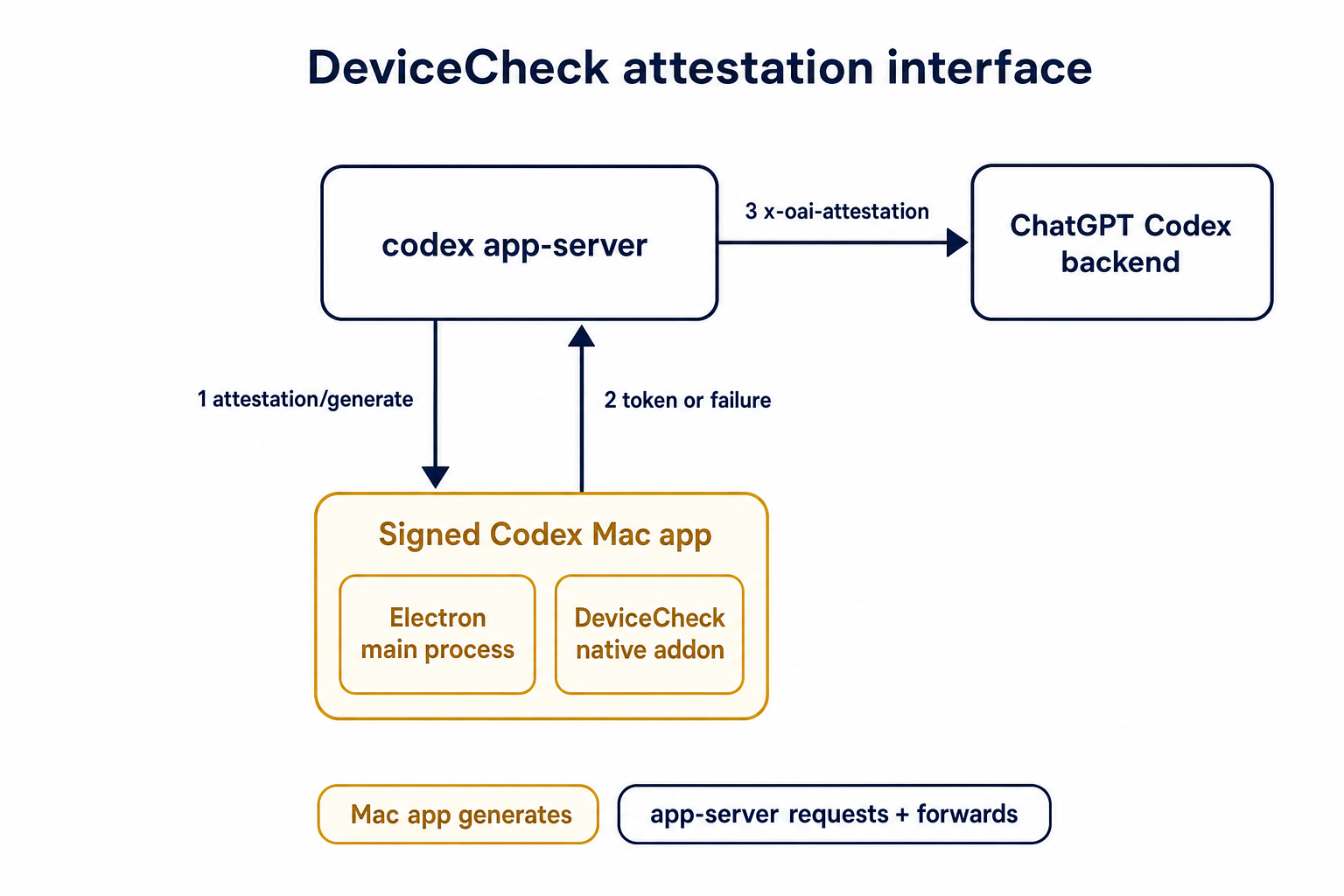 ## Details This PR teaches the Codex app-server runtime how to request and attach an attestation token. It does not generate DeviceCheck tokens directly; instead, it relies on the connected desktop app to advertise that it can generate attestation and then asks that app for a fresh header value when needed. The flow is: 1. The Codex desktop app connects to app-server. 2. During `initialize`, the app can advertise that it supports `requestAttestation`. 3. Before app-server calls selected ChatGPT Codex endpoints, it sends the internal server request `attestation/generate` to the app. 4. app-server receives a pre-encoded header value back. 5. app-server forwards that value as `x-oai-attestation` on the scoped outbound requests. The code in this repo is mostly protocol and runtime plumbing: it adds the app-server request/response shape, introduces an attestation provider in core, wires that provider into Responses / compaction / realtime setup paths, and covers the intended scoping with tests. The signed macOS DeviceCheck generation remains owned by the desktop app PR. ## Related PR - Codex desktop app implementation: https://github.com/openai/openai/pull/878649 ## Validation <details> <summary>Tests run</summary> ```sh cargo test -p codex-app-server-protocol cargo test -p codex-core attestation --lib cargo test -p codex-app-server --lib attestation ``` Also ran: ```sh just fix -p codex-core just fix -p codex-app-server just fix -p codex-app-server-protocol just fmt just write-app-server-schema ``` </details> <details> <summary>E2E DeviceCheck validation</summary> First validated the signed desktop app boundary directly: launched a packaged signed `Codex.app`, sent `attestation/generate`, decoded the returned `v1.` attestation header, and validated the extracted DeviceCheck token with `personal/jm/verify_devicecheck_token.py` using bundle ID `com.openai.codex`. Apple returned `status_code: 200` and `is_ok: true`. Then ran the fuller app + app-server flow. The packaged `Codex.app` launched a current-branch app-server via `CODEX_CLI_PATH`, and a local MITM proxy intercepted outbound `chatgpt.com` traffic. The app-server requested `attestation/generate` from the real Electron app process, and the intercepted `/backend-api/codex/responses` traffic included `x-oai-attestation` on both routes: ```text GET /backend-api/codex/responses Upgrade: websocket x-oai-attestation: present POST /backend-api/codex/responses Upgrade: none x-oai-attestation: present ``` The captured header decoded to a DeviceCheck token that also validated with Apple for `com.openai.codex` (`status_code: 200`, `is_ok: true`, team `2DC432GLL2`). </details> --------- Co-authored-by: Codex <noreply@openai.com> |
||
|
Ahmed IbrahimandCodex
|
7c0e54bf59 |
[codex] Generalize service tier slash commands (#21745)
## Why `/fast` was wired as a one-off slash command even though model metadata now exposes service tiers as catalog data. That meant adding another tier, such as a slower/cheaper tier, would require more hardcoded TUI plumbing instead of letting the model catalog drive the available commands. This change makes service-tier commands data-driven: each advertised `service_tiers` entry becomes a `/name` command using the catalog description, while the request path sends the tier `id` only when the selected model supports it. ## What Changed - Removed the hardcoded `/fast` slash-command variant and introduced dynamic service-tier command items in the composer and command popup. - Added toggle behavior for service-tier commands: invoking `/name` selects that tier, and invoking it again clears the selection. - Preserved the existing Fast-mode keybinding/status affordances by resolving the current model tier whose name is `fast`, while still sending the tier request value such as `priority`. - Persisted service-tier selections as raw request strings so non-fast tiers can round-trip through config. - Updated the Bedrock catalog entry to advertise fast support through `service_tiers` with `id: "priority"` and `name: "fast"`. - Added defensive filtering in core so unsupported selected service tiers are omitted from `/responses` requests. ## Validation - Added/updated coverage for dynamic service-tier slash command lookup, popup descriptions, composer dispatch, TUI fast toggling, and unsupported-tier omission in core request construction. - Local tests were not run per request. --------- Co-authored-by: Codex <noreply@openai.com> |
||
|
pakrym-oai
|
2070d5bfd3 |
[codex] Add response.processed websocket request (#21284)
## Summary - Add a `response.processed` websocket request payload and sender for Responses API websockets. - Send `response.processed` from `try_run_sampling_request` after a response completes, local turn processing succeeds, and the session-owned feature flag is enabled. - Add websocket coverage for both enabled and disabled feature-flag behavior. ## Validation - `just fmt` - `cargo test -p codex-core response_processed` - `cargo test -p codex-api responses_websocket` - `cargo test -p codex-features responses_websocket_response_processed_is_under_development` - `git diff --check` - `just fix -p codex-api -p codex-core -p codex-features` - `git diff --check origin/main...HEAD` |
||
|
Ahmed IbrahimandCodex
|
be1d3cff93 |
2- Use string service tiers in session protocol (#20971)
## Summary - break service tier session/op/app-server protocol fields from the closed enum to string tier ids - send the service tier string directly through model requests, prewarm, compaction, memories, and TUI/app-server turn starts - regenerate app-server protocol JSON/TypeScript schemas, removing the standalone ServiceTier TS enum ## Verification - just fmt - cargo check -p codex-core -p codex-app-server -p codex-tui - just write-app-server-schema --------- Co-authored-by: Codex <noreply@openai.com> |
