## Why

App-server clients need to advertise structured MCP extension settings, including supported MCP App UI MIME types, rather than only opting into OpenAI form elicitation with a boolean.

## What changed

- Add an `extensions` map to initialize capabilities and preserve `mcpServerOpenaiFormElicitation` as a legacy alias for `openai/form`.
- Capture the declared extension profile when a thread is started, resumed, or forked, propagate it to subagents, and advertise it to downstream MCP servers during initialization.
- Keep the profile stable for the lifetime of the loaded session instead of changing it on later turns or direct tool calls.

## Testing

- Cover extension conversion, downstream MCP initialization, session isolation, legacy form support, and subagent inheritance.

GitOrigin-RevId: fbcedbb74ce788e574b0f884a4c45c4cedb9de54
## Why

Clients need to know whether a `request_user_input` request must wait for an
explicit response or may auto-resolve. Using `autoResolutionMs` as that signal
conflated the blocking decision with timeout policy.

## What changed

- Add required `isBlocking` fields to user input protocol and app-server
  request payloads. Plan-mode requests are blocking, while requests from other
  enabled modes are non-blocking.
- Drive the TUI's auto-resolution behavior from `isBlocking` and remove
  `autoResolutionMs` from the model-facing tool schema.
- Deprecate `autoResolutionMs` while retaining it for compatibility, and treat
  legacy payloads without `isBlocking` as blocking.

## Testing

- Cover mode-derived blocking behavior, legacy deserialization, app-server
  forwarding, delegated requests, and TUI auto-resolution.

GitOrigin-RevId: 29aade657ef743065ec264376ba567a9b353d7d7
## What changed

- Recognize the `codex_strict_auto_review` MCP elicitation marker and route
  marked approval requests through the configured automatic reviewer.
- Accept only canonical automatic-review approvals and fail closed without a
  user prompt when review is unavailable, denied, malformed, disallowed by
  policy, or requests persistence.
- Validate Codex Apps approval metadata against the active MCP invocation and
  build the review request from the trusted invocation details.

## Testing

- Add unit coverage for strict review decisions, malformed markers, reviewer
  failures, explicit policy denials, and lifecycle cleanup.
- Add app-server round-trip coverage for approvals, denials, configuration
  constraints, spoofed metadata, persistent requests, and subsequent turns.

GitOrigin-RevId: af73b45a9b63118f25f6429d95b3222c5dbb59fb
## What changed

- Propagate the initiating turn ID through agent spawns, follow-up tasks, reviews, and delegated Codex sessions.
- Add `parent_turn_id` to Responses client and turn metadata while keeping it out of external MCP metadata.
- Preserve parent-turn provenance across queued agent messages when their triggering parent is unambiguous.

## Testing

- Cover spawned, resumed, nested, reviewed, delegated, and WebSocket request metadata.
- Verify queued messages do not claim ambiguous or queue-only parent turns.

GitOrigin-RevId: 481fdebbe7df2031880fe259509273cce50b20a8
## Why

`thread/fork` rejected threads using paginated history, so they could not use the same fork workflow as legacy threads.

## What changed

- Create paginated forks by referencing a frozen source-history prefix while persisting only child-owned records in the new rollout.
- Support latest, `lastTurnId`, and `beforeTurnId` boundaries, including inherited lineage, model-context reconstruction, interruption markers, and approval-reviewer inheritance.
- Make paginated reads and occurrence search traverse referenced history while excluding source records added after the fork.
- Coordinate fork preparation with archive and delete operations, and materialize compressed rollouts before they become fork references.

## Testing

Added app-server and thread-store coverage for boundary selection, active turns, inherited reads and search, compressed lineage, and concurrent source lifecycle operations.

GitOrigin-RevId: 66052d69517d7fb97a3b7817ab77a39c5ad995fd
## Why

Guardian review commands can run without the proxy-port environment used to
configure the parent session. Reconciling persistent Windows sandbox settings
for those commands can discard the parent's proxy configuration.

## What changed

- Add a session-level Windows sandbox proxy-settings mode and use `Preserve`
  for guardian review sessions while keeping `Reconcile` as the default.
- Carry the mode through unified exec and the exec-server sandbox context to
  Windows process launches.
- In preserve mode, reuse the proxy settings recorded by the existing sandbox
  setup marker.

## Testing

Added coverage for guardian session configuration, exec-server transport, and
preserving an existing setup marker when proxy-port environment variables are
absent.

GitOrigin-RevId: 214655c6e6d97360906431773dc0de0fdda2db6e
## What changed

- Add optional `plugin_id` and `script_path` fields to execution approval and guardian assessment events.
- Propagate validated plugin attribution through delegated approvals, guardian-reviewed command items, app-server notifications, thread history, and rollout traces.
- Preserve attribution on both started and completed command items, including declined commands.

## Testing

- Extend core, app-server, thread-history, and rollout-trace tests to cover plugin attribution propagation and serialization.

GitOrigin-RevId: 723684d010cab04142918d7a95e06ed95d008da1
## What changed

- Make `McpRuntime` own the published MCP configuration, connections, elicitation routing, and selected capability roots for a thread.
- Capture immutable MCP bindings for model steps and tool calls so in-flight work keeps a consistent connection set and approval authority while refreshed state is published atomically.
- Mark MCP state dirty when relevant configuration, plugins, environments, authentication, or elicitation capabilities change, then rebuild it before the next sampling request or out-of-band MCP operation.
- Separate config reloads from server invalidation: `ReloadMcpConfig` applies resolved MCP inputs, while `RefreshMcpServers` requests reinitialization from the thread's latest state.

## Testing

- Cover refreshed state visibility for existing turns, stable step bindings, current approval authority, cancelled refresh retries, resource-client reconciliation, and Apps recovery between sampling requests.

GitOrigin-RevId: 59eabb1aa8dc083426bd18ef4d3630508f376401
## Why

Startup prewarms and Guardian review sessions do not need workspace Git metadata. Collecting it for those requests performs redundant work, while user turns still need a fresh view of the repository.

## What changed

- Add a per-session Git enrichment policy.
- Skip enrichment for startup prewarm, preview, and Guardian review turns.
- Keep fresh enrichment enabled for regular sessions and one-shot delegated turns.

## Testing

- Cover prewarm and Guardian requests omitting workspace metadata while subsequent user turns observe repository changes.
- Cover concurrent repositories and worktrees retaining distinct metadata.
- Verify concurrent enrichment is coalesced and canceled enrichment can be retried.

GitOrigin-RevId: 4a68615288bb568c75f2e487d9c0776e3e80f191
## What changed

- Change `ReviewDecision::Denied` to carry a rejection string and update the generated protocol schemas.
- Preserve specific rejection reasons through command, patch, network, MCP, delegated, and automatic approval flows so tool results can return them to the model.
- Distinguish invalid approval responses from user declines and truncate oversized rejection messages before adding them to model context.

## Testing

- Add coverage for denial serialization, invalid app-server approval responses, dropped automatic reviews, network rejection propagation, and rejection-message truncation.

GitOrigin-RevId: d48a55643aa03c7ecfa08a8e4b669913eec5464a
## What changed

- Replace the combined `Codex` wrapper with an `Arc<Session>` and a dedicated
  `SessionIo` handle for submissions, events, status, and loop termination.
- Make `Session::spawn` return the session and I/O handle separately, and have
  `CodexThread` own both.
- Update thread management, delegated sessions, guardian reviews, and agent
  control to use the appropriate session or I/O interface.

GitOrigin-RevId: 8523bad7e7366e2969fd0cc3849b4247b141427a
### summary

We want to pause code-mode from yielding back to the model when a
subcommand triggers an approval prompt. This means that all of these
previously inline blocking requests should also take out a
ElicitationService registration.

This also does some plumbing refactoring to request patch approval to
make it match the other `request_*_approval` methods in that it blocks
on the approval in the function instead of returning the oneshot
channel, this affords our ability to encapsulate the ElicitationService
registration via RAII.

Adds tests to confirm the blocking behavior for code_mode both in suite
tests and that the session holds them.
## Summary

Cancelling an inline review could leave the TUI stuck in MCP startup
state, so subsequent `/review` commands were rejected as though another
task were still running. Specifically, the child’s “Starting MCP
servers” event was incorrectly forwarded to the parent TUI, so the
parent was marking itself as busy.

This keeps delegate-session MCP startup events inside the delegate
instead of exposing them as parent-session state.

## Reproduction

Here's the before -- notice that after I cancel the first review, I'm
prevented from running `/review` again:


https://github.com/user-attachments/assets/571a0793-3253-4bcc-8f10-3782d176162f

And the after -- notice that after I cancel, I can immediately start a
new `/review`:


https://github.com/user-attachments/assets/dd98b1d7-6a71-4a1f-a4b2-3295bc4848e5
## Description

This PR adds a new `historyMode = "legacy" | "paginated"` to `Thread`.
This will be stored in `SessionMeta` in the JSONL rollout file and as a
new column in the SQLite thread_metadata table, and exposed on
`thread/start` and on the `Thread` object in app-server.

## What changed

- Added canonical `ThreadHistoryMode` with `legacy` and `paginated`,
defaulting old and new SessionMeta to `legacy`.
- Carried `history_mode` through core session config, ThreadStore stored
metadata, local/in-memory stores, rollout metadata extraction, and the
existing SQLite `threads` table.
- Added experimental `historyMode` to app-server v2 `Thread` and
`thread/start`.
- Made paginated stored threads metadata-discoverable but unsupported
for legacy full-history reads, `load_history`, live resume, and create
paths.
- Regenerated app-server schema fixtures and added
protocol/state/thread-store/app-server coverage for persistence and
fail-closed behavior.

## Compatibility floor
Because users may be running various versions of Codex binaries on the
same machine (TUI, Codex App, etc.), we will need to establish a
compatibility floor for upcoming paginated threads, which will change
how thread storage reads and writes work.

The overall plan here:
```
Release N:
- Add historyMode to SessionMeta / Thread / SQLite metadata.
- Teach binaries to understand paginated threads.
- If a binary sees `historyMode="paginated"` but does not support the paginated contract, it refuses to resume/mutate the thread.
- Default remains `"legacy"`.

Release N+1:
- First-party clients start opting into paginated threads where appropriate.
- Internal dogfood / staged rollout.
- Measure old-client usage and paginated-thread unsupported errors.

Release N+2:
- Only after Release N+ is overwhelmingly deployed, make paginated the default.
- Accept that a small tail of N-1-or-older binaries may not understand paginated threads.
```

The important behavior change is fail-closed handling for a binary that
encounters a persisted `paginated` thread before it knows how to fully
support paginated history. In app-server, if a thread is `paginated`, we
will:

- allow metadata-only discovery paths like `thread/list` and
`thread/read(includeTurns=false)`, so clients can still see the thread
and inspect its `historyMode`
- reject legacy full-history/live-thread paths like
`thread/read(includeTurns=true)` and `thread/resume` with an unsupported
JSON-RPC error
- avoid silently treating an unknown or future `historyMode` as `legacy`

Under the hood, the ThreadStore layer also rejects legacy operations
that would need to load or replay the full thread history for a
paginated thread. That gives us the behavior we want for Release N:
future paginated threads are visible, but this binary fails closed
instead of trying to operate on them as if they were legacy threads.
## Summary

- add the `code_mode_host` feature flag and select
`ProcessOwnedCodeModeSessionProvider` in `CodeModeService` when enabled
- initialize code-mode sessions lazily so a missing host reports a tool
error without failing thread startup
- resolve `codex-code-mode-host` beside the running Codex binary by
default while preserving `CODEX_CODE_MODE_HOST_PATH` as an override
- add unit and end-to-end coverage for host resolution and graceful
missing-host behavior

## Why

This wires the process-owned session client from #30112 into the core
service behind an opt-in rollout gate. Packaged Codex installations can
place the helper in the same `bin` directory as the main executable
without relying on `PATH`, while development and custom installations
can continue to override the helper path.

## Stack

- Depends on #30112
- Base branch: `cconger/process-owned-session-runtime-4-client`

## Validation

Build `codex` and `codex-code-mode-host`
`CODEX_CODE_MODE_HOST_PATH="$PWD/target/debug/codex-code-mode-host"
./target/debug/codex --enable code_mode_host`
## Why

An MCP refresh can replace the session's current manager while a model
step is still running. The step must execute calls through the same
manager whose tools it advertised.

## Boundary

```text
current session MCP runtime
          |
          | capture once for this model step
          v
StepContext.mcp
  - exact MCP config
  - exact connection manager
  - exact runtime environment context
```

```rust
pub struct McpRuntimeSnapshot {
    config: Arc<McpConfig>,
    manager: Arc<McpConnectionManager>,
    runtime_context: McpRuntimeContext,
}
```

## Example

```text
step A captures runtime A and advertises A's tools
refresh publishes runtime B
step A tool call -> runtime A
next step        -> runtime B
```

Capturing the snapshot is only an `Arc` clone. It does not restart MCPs
or make an RPC.

## What changes

- Captures one MCP runtime in `StepContext`.
- Uses it for tool planning, tool calls, resources, approvals, connector
attribution, and elicitation.
- Publishes replacement runtimes atomically.
- Lets an old runtime live only while an in-flight step or request still
holds its `Arc`.

Most of this diff is mechanical routing from the session-global manager
to `step_context.mcp`; it does not introduce selected-plugin discovery
yet.

## What does not change

- No plugin or extension migration.
- No new MCP cache policy.
- No environment file watching.
- No client sharing between separate managers.

## Stack

1. Extension-owned World State sections.
2. Project executor skills through World State.
3. **This PR:** pin one MCP runtime to each model step.
4. Project selected MCP/app/connector metadata by environment
availability.
5. One end-to-end integration scenario.
## Why
Helper threads such as task title generation can request a model ID that
is valid for the default OpenAI provider but unavailable from the active
provider. With Amazon Bedrock, `gpt-5.4-mini` is rejected while the
provider static catalog exposes Bedrock model IDs such as
`openai.gpt-5.5` and `openai.gpt-5.4`. This causes repeated background
404s and can surface a misleading turn error even when the main turn
succeeds.
Clients need an explicit way to ask app-server to resolve an unavailable
helper model to the active provider default. That fallback must remain
limited to providers with an authoritative static catalog so custom or
dynamically discovered model IDs are not rewritten based on an
incomplete catalog.
Fixes#28741.
## What changed
- Add the experimental `allowProviderModelFallback` option to
`thread/start`, defaulting to `false` to preserve existing behavior.
- Thread the option through thread creation and model selection.
- When enabled for a static model manager, preserve requested models
present in the catalog and replace unavailable models with the provider
default.
- Continue preserving explicit model IDs for dynamic model managers
without fetching a catalog solely to validate them.
- Document the new `thread/start` behavior in the app-server API
overview.
## Test
Temporary test-client harness:
```
ThreadStartParams {
model: Some("gpt-5.4-mini".to_string()),
allow_provider_model_fallback: true,
..Default::default()
}
```
Command:
```
CODEX_HOME=/tmp/codex-bedrock-thread-start-home \
CODEX_E2E_BEDROCK_THREAD_START_ONLY=1 \
./target/debug/codex-app-server-test-client \
--codex-bin ./target/debug/codex \
-c 'model_provider="amazon-bedrock"' \
send-message-v2 --experimental-api ignored
```
Relevant output:
```
> "method": "thread/start",
> "params": {
> "model": "gpt-5.4-mini",
> "modelProvider": null,
> "allowProviderModelFallback": true,
> ...
> }
< "result": {
< "model": "openai.gpt-5.5",
< "modelProvider": "amazon-bedrock",
< ...
< }
```
## Why

Ultra should be one user-facing reasoning selection for work that
benefits from both maximum reasoning and proactive multi-agent
delegation. Without it, clients must coordinate maximum reasoning with
the experimental `multiAgentMode` setting, even though the inference
backend still expects its existing `max` effort value.

This change makes reasoning effort the source of truth: clients select
`ultra`, core derives proactive multi-agent behavior when the turn is
eligible for multi-agent V2, and inference requests continue to use the
backend-compatible `max` value.

## What changed

- Add `ultra` as a first-class reasoning effort and preserve
model-catalog ordering when exposing it to clients.
- Convert `ultra` to `max` at the inference request boundary, including
Responses HTTP/WebSocket requests, startup prewarm, compaction, and
memory summarization.
- Derive effective multi-agent mode per turn from effective reasoning
effort:
  - eligible multi-agent V2 + `ultra` → `proactive`
  - eligible multi-agent V2 + any other effort → `explicitRequestOnly`
- V1 or otherwise ineligible sessions → no multi-agent mode instruction
- Keep the derived effective mode in turn context history so successive
turns can emit a developer-message update only when the effective mode
changes.
- Remove selected multi-agent mode from core session configuration, turn
construction, thread settings, resume/fork restoration, and subagent
spawn plumbing. Subagents inherit reasoning effort and derive their own
effective mode.
- Retain the experimental app-server `multiAgentMode` fields for wire
compatibility while marking them deprecated. Request values are accepted
but ignored; compatibility response fields report `explicitRequestOnly`.
- Display Ultra in the TUI using the order supplied by `model/list`.

## Validation

- `just test -p codex-core ultra_reasoning_uses_max_for_requests`
- `just test -p codex-tui model_reasoning_selection_popup`
## Why

Work(TPP) threads can be launched from the Desktop app, but if they all
keep the Desktop app's default originator then downstream attribution
cannot distinguish local Work launches from cloud-backed Work launches.
`thread/start.serviceName` already carries that launch signal, while
`SessionMeta.originator` is the durable thread-level value that survives
resume and fork.

This change converts the Desktop Work service names into an effective
originator at thread creation time, persists that originator with the
thread, and keeps using it for later model requests and memory writes.

## What changed

- Map `CODEX_WORK_LOCAL` and `CODEX_WORK_CLOUD` service names to
per-thread originators, while preserving
`CODEX_INTERNAL_ORIGINATOR_OVERRIDE` as the highest-precedence override.
- Persist the effective originator in `SessionMeta.originator`, read it
back on resume/fork, and inherit the parent originator for subagent
spawns when there is no persisted session metadata.
- Handle truncated `SpawnAgentForkMode::LastNTurns` forks by falling
back to the live parent originator when the forked history no longer
includes `SessionMeta`.
- Thread the per-thread originator through Responses headers,
websocket/compaction request paths, thread-store creation, rollout
metadata, and memory stage-one telemetry.

## Verification

- `just test -p codex-core
agent::control::tests::spawn_thread_subagent_inherits_parent_originator_without_fork
agent::control::tests::spawn_thread_subagent_fork_last_n_turns_inherits_parent_originator_without_session_meta
thread_manager::tests::originator_override_precedes_service_name_remapping`
- `just test -p codex-core
agent::control::tests::resume_thread_subagent_restores_stored_metadata_and_effective_multi_agent_mode`
- `just test -p codex-memories-write`
- `just fix -p codex-core -p codex-memories-write`
- `git diff --check`
## Why

Once multi-agent mode can be selected per turn, clients also need to
choose the initial selection when creating a thread and observe that
selection through lifecycle and settings APIs.

The selected value is intentionally distinct from the effective
model-visible value: no client selection is represented as `null`, even
though an eligible multi-agent v2 turn derives `explicitRequestOnly` as
its effective default.

## What changed

- Add the optional experimental `thread/start.multiAgentMode` parameter
and pass it through thread creation.
- Preserve an omitted initial value as an unset selection rather than
eagerly storing `explicitRequestOnly`.
- Apply an explicit `thread/start` selection to the first turn through
the session configuration established at thread creation.
- Restore the latest persisted effective mode as the selected baseline
on cold resume when rollout history contains one.
- Inherit the optional selected mode from a loaded parent when creating
related runtime threads.
- Return the current selected `multiAgentMode` from `thread/start`,
`thread/resume`, `thread/fork`, and thread settings, using `null` when
no mode is selected.
- Keep lifecycle reporting independent from model capability and feature
eligibility; core turn construction remains responsible for calculating
and persisting the effective mode.

## Not covered

- Clearing an existing loaded-session selection back to unset through
`turn/start`; omitted or `null` currently retains the session's
selection.
- A TUI control, slash command, or `config.toml` preference.

## Verification

- `CARGO_INCREMENTAL=0 just test -p codex-app-server-protocol`
- `CARGO_INCREMENTAL=0 just test -p codex-app-server multi_agent_mode`

The focused app-server coverage verifies explicit `thread/start`
initialization, first-turn prompting, nullable reporting for an omitted
selection, and retention of selections that are not currently
runtime-eligible.

## Stack

Stacked on #28685. This PR contains only the thread initialization and
lifecycle/settings API layer.
Stacked on #28822.

## Summary

- add a host-injectable current-time provider with a built-in system
implementation
- record UTC developer reminders in history immediately before due model
requests
- keep cadence state per session and force a refresh after compaction

This does NOT include the app server client <-> server clock logic. This
PR is only for the reminder message & system clock that will be used in
prod.

## Testing

- `just test -p codex-core varlatency_`
- `just clippy -p codex-core -p codex-app-server -p codex-mcp-server -p
codex-thread-manager-sample`
- `just fmt`
## Why

Command approval cache keys included the command and working directory,
but not the execution environment. An approval for `/workspace` locally
could therefore be reused for the same command and path on an executor.

## What changed

- Include the selected environment ID in shell and unified-exec approval
cache keys.
- Carry that ID through the normal command approval request so clients
can show which environment is being approved.
- Expose the environment through app-server as a required nullable
`environmentId` and show it in the inline TUI approval prompt.
- Keep older recorded approval events compatible when the environment is
absent.

For example, `echo ok` in local `/workspace` and `echo ok` in executor
`/workspace` now produce different approval keys and separate prompts.

## Scope

This PR does not change network approvals, Guardian review actions, MCP
elicitation, full-screen TUI rendering, or environment-ID validation.
Remote `shell_command` execution itself remains in #28722; this PR only
makes its approval key environment-aware.
## Why

Host skill discovery was still exposed as a manager even though it is a
process-owned service shared by sessions, the app-server catalog, and
file-watcher invalidation. The skills extension also consumed an ad hoc
loaded-skills wrapper instead of a named immutable snapshot.

## What changed

- replace `SkillsManager` with concrete `SkillsService`
- make the service cache and return immutable `HostSkillsSnapshot`
values
- migrate the skills extension host provider to the snapshot boundary
- migrate app-server catalog, watcher, and invalidation paths to the
service

This keeps the service limited to host discovery, caching, roots, and
invalidation. Catalog rendering and invocation remain extension
responsibilities for the next stacked change.
## Why

Shell snapshots are currently session-scoped even though shell and cwd
are properties of a selected turn environment. That makes snapshot
refresh depend on separate session-cwd plumbing, prevents retained
environments from retaining their snapshot work, and can make snapshot
construction use a different shell than command execution.

This follows #27955 by making the retained thread-environment service
own environment snapshot lifecycles. Session configuration remains the
requested selection state, while `ThreadEnvironments` remains the source
of successfully resolved environments.

## What changed

- Configure the shell-snapshot builder before initial environment
resolution.
- Start each local environment snapshot task when its `TurnEnvironment`
is built and retain that shared task while environment ID and cwd still
match.
- Inherit retained environment snapshots into spawned child threads.
- Carry the selected `TurnEnvironment` through shell runtimes so
snapshot construction and command execution use the same
environment-specific shell and cwd.
- Load project instructions and warm plugins/skills after initial
environment resolution.
- Continue decoding invalid UTF-8 instruction files lossily without
emitting a startup warning.
- Keep requested selections in `SessionConfiguration`; failed or
duplicate resolutions only affect the resolved environment snapshot.

## Validation

- `cargo check -p codex-core --tests`
- `just test -p codex-home instructions` (6 passed)
- Focused environment, instruction, shell-snapshot, and user-shell tests
(84 passed)
- Focused shell-snapshot, user-shell, and unified-exec tests (126
passed; two event-timing tests passed on retry)
## Why

Selected execution environments are thread-scoped resources, but startup
and turn construction repeatedly resolved their IDs and working
directories. That discarded existing environment handles and shell
metadata even when a selection had not changed.

Session configuration updates also need to affect future turns without
changing the resolved environment set already captured by a running
turn.

## What changed

- Create a `ThreadEnvironments` service inside `Codex` from the spawned
`EnvironmentManager` and raw environment selections, then store it on
`SessionServices`.
- Split service construction from `update_selections`, allowing session
configuration updates to mutate the resolved set in place.
- Retain an existing `TurnEnvironment` when its environment ID and
working directory match; resolve only added or changed selections and
remove selections that are no longer present.
- Normalize duplicate IDs by keeping the first selection and skip
individual selections that fail to resolve instead of rejecting the
entire update.
- Give each `TurnContext` a cloned `TurnEnvironmentSnapshot`, so later
session configuration updates affect future turns without rewriting an
active turn.
- Reuse the service-owned environment manager and resolved snapshot for
startup work, MCP initialization, and child-thread spawning instead of
flowing resolved environments through spawn arguments.

## Test plan

- `cargo check -p codex-core --tests`
- `just test -p codex-core environment_selection`
- `just test -p codex-core turn_environments`
- `just test -p codex-core
session_update_settings_does_not_rewrite_sticky_environment_cwds`
- `just test -p codex-core
default_turn_does_not_overlay_legacy_fallback_cwd_onto_stored_thread_environments`
## Why

`request_user_input` is moving beyond its original plan-mode-only
workflow, and future default/goal-mode usage needs a way for the model
to ask helpful but non-blocking questions without forcing the turn to
wait forever. This PR adds an explicit `autoResolutionMs` contract so a
later client/runtime change can auto-resolve unanswered prompts after a
bounded window while leaving truly blocking questions unchanged.

This is contract plumbing only; it does not implement the client-side
timer or auto-selection behavior, and the model-facing description
treats the field as reserved unless the current runtime explicitly
supports auto-resolution.

## What Changed

- Added optional `autoResolutionMs` to the model-facing
`request_user_input` args and core `RequestUserInputEvent`.
- Added model-facing schema text for `autoResolutionMs` while marking it
reserved for runtimes that explicitly support auto-resolution.
- Bounds `autoResolutionMs` to `60_000..=240_000` ms during argument
normalization by clamping out-of-range model-provided values.
- Propagated the field through app-server v2
`ToolRequestUserInputParams`, app-server request forwarding, generated
TypeScript, and JSON schema fixtures.
- Updated app-server, core, protocol, and TUI call sites/tests so
omitted values preserve existing `None`/`null` behavior and coverage
verifies a `Some(60_000)` round trip.

## Verification

- `just test -p codex-app-server-protocol`
- `just test -p codex-core request_user_input`
- `just test -p codex-app-server request_user_input_round_trip`
- `just test -p codex-tui request_user_input`
- `just test -p codex-protocol`
## Why

We want to remove implicit use of `$CODEX_HOME` from `codex-core` and
make embedders responsible for supplying user-level instructions. This
also ensures user instructions load when no primary environment is
selected.

## What changed

Stacked on #27415, which makes `codex exec` surface thread-scoped
runtime warnings.

- Added `UserInstructionsProvider` to `codex-extension-api`, with
absolute source attribution and recoverable loading warnings.
- Added `codex-home` with the filesystem-backed provider for
`AGENTS.override.md` and `AGENTS.md`, preserving precedence, fallback,
trimming, lossy UTF-8 handling, and the existing uncapped global
instruction size.
- Removed global instruction loading from `Config` and require
`ThreadManager` callers to inject a provider.
- Load provider instructions once for each fresh root runtime, including
runtimes without a primary environment. Running sessions retain their
snapshot, while child agents inherit the parent snapshot without
invoking the provider.
- Keep provider instructions separate while loading project `AGENTS.md`,
then assemble the model-visible instructions with the existing ordering,
source attribution, warning, and turn-context behavior.
- Wired the Codex home provider through the CLI, app server, MCP server,
core facade, and thread-manager sample.

## Validation

- `just test -p codex-home -p codex-extension-api`
- `just test -p codex-core agents_md`
- `just test -p codex-core guardian`
- `just test -p codex-app-server
thread_start_without_selected_environment_includes_only_global_instruction_source`
- `just test -p codex-exec warning`
- `just bazel-lock-check`
## Why

CCA is moving toward a split runtime where the orchestrator may not have
a filesystem, while executors can expose preinstalled plugins and
skills. A thread therefore needs to select capabilities without asking
app-server or core to interpret executor-owned paths through the
orchestrator's filesystem.

The longer-term model is broader than executor skills:

- A plugin is a bundle of skills, MCP servers, connectors/apps, and
hooks.
- A plugin root can be local, executor-owned, or hosted by a backend.
- Components inside one plugin can use different access and execution
mechanisms. A skill may be read from a filesystem or through backend
tools; an HTTP MCP server can run without an executor; a stdio MCP
server or hook needs an execution environment.
- Core should carry generic extension initialization data. The extension
that owns a component should discover it, expose it to the model, and
invoke it through the appropriate runtime.

This PR establishes that architecture through one complete vertical:
selecting a root on an executor, discovering the skills beneath it,
exposing those skills to the model, and reading an explicitly invoked
`SKILL.md` through the same executor.

## Contract

`thread/start` gains an experimental `selectedCapabilityRoots` field:

```json
{
  "selectedCapabilityRoots": [
    {
      "id": "deploy-plugin@1",
      "location": {
        "type": "environment",
        "environmentId": "workspace",
        "path": "/opt/codex/plugins/deploy"
      }
    }
  ]
}
```

The root is intentionally not classified as a "plugin" or "skill" in the
API. It can point at a standalone skill, a directory containing several
skills, or a plugin containing skills and other components. This PR only
teaches the skills extension how to consume it; later extensions can
resolve MCP, connector, and hook components from the same selection.

The platform-supplied `id` is stable selection identity. The location
says which runtime owns the root and gives that runtime an opaque path.
App-server does not inspect or canonicalize the path.

## What changed

### Generic thread extension initialization

App-server converts selected roots into `ExtensionDataInit`. Core
carries that generic initialization value until the final thread ID is
known, then creates thread-scoped `ExtensionData` before lifecycle
contributors run.

This keeps `Session` and core independent of the capability-selection
contract. The initialization value is consumed during construction; it
is not retained as another long-lived `Session` field.

### Executor-backed skills

The skills extension now owns an `ExecutorSkillProvider` that:

- resolves the selected environment through `EnvironmentManager`
- discovers, canonicalizes, and reads skills through that environment's
`ExecutorFileSystem`
- contributes the bounded selected-skill catalog as stable developer
context
- reads an explicitly invoked skill body through the authority that
listed it
- warns when an environment or root is unavailable
- never falls back to the orchestrator filesystem for an executor-owned
root

Skill catalog and instruction fragments have hard byte bounds, which
also bound them below the 10K-token per-item context limit. If a
selected executor skill has the same name as a legacy local skill, the
executor selection owns that invocation and the local body is not
injected a second time.

Existing local and bundled skill loading remains in place. Omitting
`selectedCapabilityRoots` therefore preserves current local-only
behavior.

## Current semantics

- Only environment-owned locations are represented in this first
contract.
- Roots are resolved by the destination extension, not by app-server or
core.
- An unavailable executor or invalid root produces a warning and no
capabilities from that root; it does not trigger a local-filesystem
fallback.
- Selection applies to a newly started active thread.
- MCP servers, connectors, and hooks beneath a selected plugin root are
not activated yet.
- Selection is not yet persisted or inherited across resume, fork, or
subagent creation. Existing local capabilities continue to behave as
they do today in those flows.

## Planned vertical follow-ups

1. **Hosted HTTP MCP:** add an extension-backed HTTP MCP source that
works without an executor, then replace the special-purpose MCP plugins
loader with that implementation.
2. **Executor MCP:** register and execute stdio MCP servers through the
environment that owns the selected plugin root.
3. **Backend skills:** add a hosted skill source whose catalog and
bodies are accessed through extension tools rather than a filesystem.
4. **Connectors and hooks:** activate those components through their
owning extensions, using the same selected-root boundary and
component-specific runtime.
5. **Durable selection:** define the desired-selection lifecycle,
persist it, and make resume, fork, and subagent inheritance explicit
rather than accidental.
6. **Local convergence:** incrementally route existing local plugin,
skill, and MCP loading through the same extension model while preserving
current local behavior.

Each follow-up remains reviewable as an end-to-end capability. The
platform selects roots, generic thread extension data carries the
selection, and the owning extension resolves and operates its component.

## Verification

Coverage added for:

- app-server end-to-end discovery and explicit invocation of a skill
inside an executor-selected plugin root
- exclusive invocation when a selected executor skill collides with a
local skill name
- executor filesystem authority for discovery, canonicalization, and
reads
- thread extension initialization before lifecycle contributors run
- stable executor catalog context, explicit invocation, context
rebuilding, hidden skills, and preserved host/remote catalog behavior

Targeted protocol, core-skills, skills-extension, core lifecycle, and
app-server executor-skill tests were run during development.
## Why

Thread cwd and environment selections are a single logical setting in
core: updating one without the other can silently desynchronize the
next-turn execution context. This change makes that relationship
explicit in the internal thread settings flow while preserving the
existing app-server public API shape.

## What changed

- Moved the cwd/environment pair through internal
`ThreadSettingsOverrides.environment_settings` instead of a top-level
internal `cwd` field.
- Kept `thread/settings/update` public params unchanged, with app-server
translating top-level `cwd` into the paired internal settings shape.
- Moved `Op::UserInput` environment overrides into thread settings so
user turns and settings updates use the same core path.
- Updated core, app-server, MCP, memories, sample, and test callsites to
construct the paired settings shape.

## Verification

- `git diff --check`
- Local test run starting after PR creation.
## Stack

1. #25850 - Key request-permission grants by environment: stores and
applies sticky permission grants per environment id.
2. #25858 - Add `environmentId` to `request_permissions`: lets the model
target a selected environment and resolves relative permission paths
against it.
3. This PR (#25862) - Propagate permission approval environment id:
carries the selected environment id through approval events, app-server
requests, TUI prompts, and delegate forwarding.
4. #25867 - Add remote request permissions integration coverage:
verifies the selected remote environment across request, approval, grant
reuse, and exec.

This PR is stacked on #25858, and #25867 is stacked on this PR.

## Why

PR2 lets the model bind a `request_permissions` call to a selected
environment, but the approval event and client-facing request still
needed to carry that binding. For CCA, the user-facing prompt and
delegated approval path should know which environment the grant applies
to instead of relying on cwd alone.

## What Changed

- Added optional `environmentId` to `RequestPermissionsEvent`.
- Emit the selected environment id from core permission approval events.
- Preserve the environment id through delegate forwarding, including
cwd-based delegated requests.
- Added `environmentId` to app-server permission approval params,
generated schema/TypeScript artifacts, and README examples.
- Preserve and display the environment id in TUI permission approval
prompts.
- Updated focused core, app-server protocol, and TUI conversion
coverage.

## Testing

Not run locally per instruction. Performed read-only `git diff --check`.
## Stack

1. #25850 - Key request-permission grants by environment: stores and
applies sticky permission grants per environment id.
2. This PR (#25858) - Add `environmentId` to `request_permissions`: lets
the model target a selected environment and resolves relative permission
paths against it.
3. #25862 - Propagate permission approval environment id: carries the
selected environment id through approval events, app-server requests,
TUI prompts, and delegate forwarding.
4. #25867 - Add remote request permissions integration coverage:
verifies the selected remote environment across request, approval, grant
reuse, and exec.

This PR is stacked on #25850; #25862 and #25867 are stacked on this PR.

## Why

PR1 made request-permission grants internally environment-keyed, but the
model-facing `request_permissions` tool could still only target the
primary environment. For CCA and multi-environment turns, the tool needs
an explicit way to bind a permission request to a selected attached
environment before resolving relative paths.

## What Changed

- Added optional `environmentId` to `RequestPermissionsArgs`, with
`environment_id` accepted as an alias.
- Exposed `environmentId` in the `request_permissions` tool schema and
description.
- Resolve the selected environment before parsing filesystem permission
paths, so relative paths bind to the selected environment cwd.
- Route validated tool calls through
`request_permissions_for_environment` directly instead of duplicating
environment lookup in `Session::request_permissions`.
- Reject unknown environment ids with a model-facing error.
- Updated focused request-permissions and Guardian call sites for the
new optional field.

## Testing

Not run locally per instruction.
Stack split from #25708. Original PR intentionally left open. This third
PR resolves the effective per-thread multi-agent runtime from persisted
metadata, inherited runtime, and current model selection.
## Summary

Remove the dead experimental `persistExtendedHistory` app-server flag
and collapse rollout persistence to the single policy app-server already
used.

## What Changed

- Removed `persistExtendedHistory` from v2 thread start/resume/fork
params and deleted its deprecation notice path.
- Removed the persistence-mode enums and plumbing through core, rollout,
and thread-store.
- Made rollout filtering mode-free, keeping the existing limited
persisted-history behavior.

## Test Plan

- `just write-app-server-schema`
- `cargo nextest run --no-fail-fast -p codex-app-server-protocol
schema_fixtures`
- `cargo nextest run --no-fail-fast -p codex-app-server
thread_shell_command_history_responses_exclude_persisted_command_executions`
- `cargo nextest run --no-fail-fast -p codex-rollout -p
codex-thread-store`
- final `rg` for removed flag/type names
## Why

This PR
https://github.com/openai/codex/pull/24161#discussion_r3325692763
revealed a subagent data modeling issue, where we overloaded
`forked_from_id` to also mean `parent_thread_id`. That's incorrect since
guardian and review subagents can be a subagent and NOT fork the main
thread's history.

The solution here is to explicitly store a new `parent_thread_id` on
`SessionMeta`, alongside `forked_from_id` which already exists. While
we're at it, also expose it in the app-server protocol on the `Thread`
object.

A thread->subagent relationship and a fork of thread history are
orthogonal concepts.

## What Changed

- Added top-level `parent_thread_id` persistence on `SessionMeta` and
runtime/session plumbing through `SessionConfiguredEvent`,
`CodexSpawnArgs`, `SessionConfiguration`, `ThreadConfigSnapshot`,
`TurnContext`, and `ModelClient`.
- Made turn metadata, request headers, analytics, and subagent-start
events read the separate runtime/top-level parent field instead of
deriving general parent lineage from `SessionSource` or
`forked_from_thread_id`.
- Passed parent lineage separately at delegated subagent, review,
guardian, agent-job, and multi-agent spawn construction sites;
copied-history fork lineage remains derived only from `InitialHistory`.
- Persisted and exposed parent lineage through rollout/thread-store
projections and app-server v2 `Thread.parentThreadId`.
- Updated app-server README text and regenerated app-server schema
fixtures for the additive `parentThreadId` response field.
## Summary

Adds an optional `clientId` field to app-server v2 `UserInput` and
carries it through the core `UserInput` model so clients can correlate
echoed user input items without relying on payload equality.

## Details

- Adds `client_id: Option<String>` to core `UserInput` variants.
- Exposes the v2 app-server field as `clientId` on the wire and in
generated TypeScript.
- Preserves the id when converting between app-server v2 and core
protocol types.
- Regenerates app-server schema fixtures.

## Validation

- `just fmt`
- `just write-app-server-schema`
- `cargo test -p codex-app-server-protocol`
- `cargo test -p codex-protocol`
- `just fix -p codex-app-server-protocol`
- `just fix -p codex-protocol`
- `git diff --check`
## Why
- Runtime analytics events report `thread_id`, which identifies the
individual thread emitting an event
- They don't report `session_id`, which identifies the shared session
for a root thread and its subagent threads
- Emitting both identifiers allows analytics to group related activity

## What Changed
- Adds `session_id` to relevant analytics events (thread_initalized,
turn, turn_steer, compaction, guardian_review)
- Tracks each thread's session ID in the analytics reducer so subsequent
thread scoped events emit the same value
- Carries the shared session ID through subagent initialization

## Verification
- `just test -p codex-analytics` validates event payloads and subagent
session grouping.
- Focused `codex-app-server` tests validate session IDs for thread,
turn, and steer events.
- Focused `codex-core` tests validate root and subagent session ID
propagation.
## Why

When Codex calls responsesapi, we currently send `session_id`,
`thread_id`, and `turn_id` among other things as
`client_metadata["x-codex-turn-metadata"]`. This PR adds
`forked_from_thread_id` which helps explain the "lineage" of a forked
thread.

## What's changed

- Track the immediate history source copied into a forked thread through
thread/session creation, including subagent and review turn metadata
paths.
- Include `forked_from_thread_id` in Codex turn metadata while
preventing turn-scoped Responses API client metadata from overwriting
Codex-owned lineage fields.
- Add coverage for fork lineage in turn metadata and the app-server
Responses API request path.
## Summary

Adds experimental `additionalContext` support to `turn/start` and
`turn/steer` so clients can provide ephemeral external context, such as
browser or automation state, without turning that plumbing into a
visible user prompt or triggering user-prompt lifecycle behavior.

## API Shape

The parameter shape is:

```ts
additionalContext?: Record<string, {
  value: string
  kind: "untrusted" | "application"
}> | null
```

Example:

```json
{
  "additionalContext": {
    "browser_info": {
      "value": "Active tab is CI failures.",
      "kind": "untrusted"
    },
    "automation_info": {
      "value": "CI rerun is in progress.",
      "kind": "application"
    }
  }
}
```

The keys are opaque and caller-defined.

## Context Injection

When provided, accepted entries are inserted into model context as
hidden contextual message items, not as visible thread user-message
items.

`kind: "untrusted"` entries are inserted with role `user`:

```text
<external_${key}>${value}</external_${key}>
```

`kind: "application"` entries are inserted with role `developer`:

```text
<${key}>${value}</${key}>
```

Values are not escaped. Each value is truncated to 1k approximate tokens
before wrapping.

For `turn/start`, accepted additional context is inserted before normal
user input. For `turn/steer`, additional context is merged only when the
steer includes non-empty user input; context-only steers still reject as
empty input.

## Dedupe Strategy

`AdditionalContextStore` lives on session state and stores the latest
complete additional-context map.

Each `turn/start` or non-empty `turn/steer` treats its
`additionalContext` as the current complete set of values. Entries are
injected only when the key is new or the exact entry for that key
changed, including `value` or `kind`. After merging, the store is
replaced with the provided map, so omitted keys are removed from the
retained set and can be injected again later if reintroduced.

Omitting `additionalContext`, passing `null`, or passing an empty object
resets the store to empty and injects nothing.

## What Changed

- Threads experimental v2 `additionalContext` through app-server into
core turn start and steer handling.
- Adds separate contextual fragment types for untrusted user-role
context and application developer-role context.
- Uses pending response input items so additional context can be
combined with normal user input without treating it as prompt text.
- Adds integration coverage for start/steer flow, role routing,
dedupe/reset behavior, deletion/re-add behavior, hook-blocked input
behavior, empty context-only steer rejection, external-fragment marker
matching, and truncation.
**Stack position:** [1 of 7]

## Summary

The first three PRs in this stack are a cleanup pass before the actual
thread settings API work.

Today, core has several overlapping "user input" ops: `UserInput`,
`UserInputWithTurnContext`, and `UserTurn`. They differ mostly in how
much next-turn state they carry, which makes the later queued thread
settings update harder to reason about and review.

This PR starts that cleanup by adding the shared
`ThreadSettingsOverrides` payload and allowing `Op::UserInput` to carry
it. Existing variants remain in place here, so this layer is mostly a
behavior-preserving API shape change plus mechanical constructor
updates.

## End State After PR3

By the end of PR3, `Op::UserInput` is the only "user input" core op. It
can carry optional thread settings overrides for callers that need to
update stored defaults with a turn, while callers without updates use
empty settings. `Op::UserInputWithTurnContext` and `Op::UserTurn` are
deleted.

## End State After PR5

By the end of PR5, core will have only two ops for this area:

- `Op::UserInput` for user-input-bearing submissions.
- `Op::ThreadSettings` for settings-only updates.

## Stack

1. [1 of 7] [Add thread settings to
UserInput](https://github.com/openai/codex/pull/23080) (this PR)
2. [2 of 7] [Remove
UserInputWithTurnContext](https://github.com/openai/codex/pull/23081)
3. [3 of 7] [Remove
UserTurn](https://github.com/openai/codex/pull/23075)
4. [4 of 7] [Placeholder for OverrideTurnContext
cleanup](https://github.com/openai/codex/pull/23087)
5. [5 of 7] [Replace OverrideTurnContext with
ThreadSettings](https://github.com/openai/codex/pull/22508)
6. [6 of 7] [Add app-server thread settings
API](https://github.com/openai/codex/pull/22509)
7. [7 of 7] [Sync TUI thread
settings](https://github.com/openai/codex/pull/22510)
## Why

`TurnContext::cwd` and `TurnContext::resolve_path` are being phased out
in favor of using the selected turn environment cwd directly.
Deprecating both APIs makes any new direct dependency visible while
preserving the existing migration path for current callers.

## What Changed

- Marked `TurnContext::cwd` and `TurnContext::resolve_path` as
deprecated with guidance to use the selected turn environment cwd
instead.
- Added exact `#[allow(deprecated)]` suppressions at each existing
direct usage site, including tests, rather than adding crate-wide
suppression.
- Kept the change behavior-preserving: current cwd reads, writes, and
path resolution continue to use the same values.

## Verification

- `just fmt`
- `cargo check -p codex-core`
- `cargo check -p codex-core --tests`
- `git diff --check`
## Why

[#21736](https://github.com/openai/codex/pull/21736) introduces the
typed extension API, but the runtime does not yet carry a registry
through thread/session startup or give contributors host-owned stores to
read from. This PR wires that host-side path so later feature migrations
can move product-specific behavior behind typed contributions without
adding another bespoke seam directly to `codex-core`.

## What changed

- Thread `ExtensionRegistry<Config>` through `ThreadManager`,
`CodexSpawnArgs`, `Session`, and sub-agent spawn paths.
- Wire `ThreadStartContributor` and `ContextContributor`
- Expose the small supporting surface needed by non-core callers that
construct threads directly, including `empty_extension_registry()`
through `codex-core-api`.

This PR lands the host plumbing only: the app-server registry is still
empty, and concrete feature migrations are intended to follow
separately.
## Why

PR #21460 reverted the earlier move of skills change watching from
`codex-core` into app-server. This reapplies that boundary change so
app-server owns client-facing `skills/changed` notifications and core no
longer carries the watcher.

## What

- Restore the app-server `SkillsWatcher` and register it from thread
listener setup.
- Remove the core-owned skills watcher and its core live-reload
integration surface.
- Restore app-server coverage for `skills/changed` notifications after a
watched skill file changes.

## Validation

- `cargo test -p codex-app-server --test all
suite::v2::skills_list::skills_changed_notification_is_emitted_after_skill_change
-- --exact --nocapture`
- `cargo test -p codex-core --lib --no-run`
## Summary
TL;DR: teaches `codex-rs` / app-server to request a desktop-provided
attestation token and attach it as `x-oai-attestation` on the scoped
ChatGPT Codex request paths.
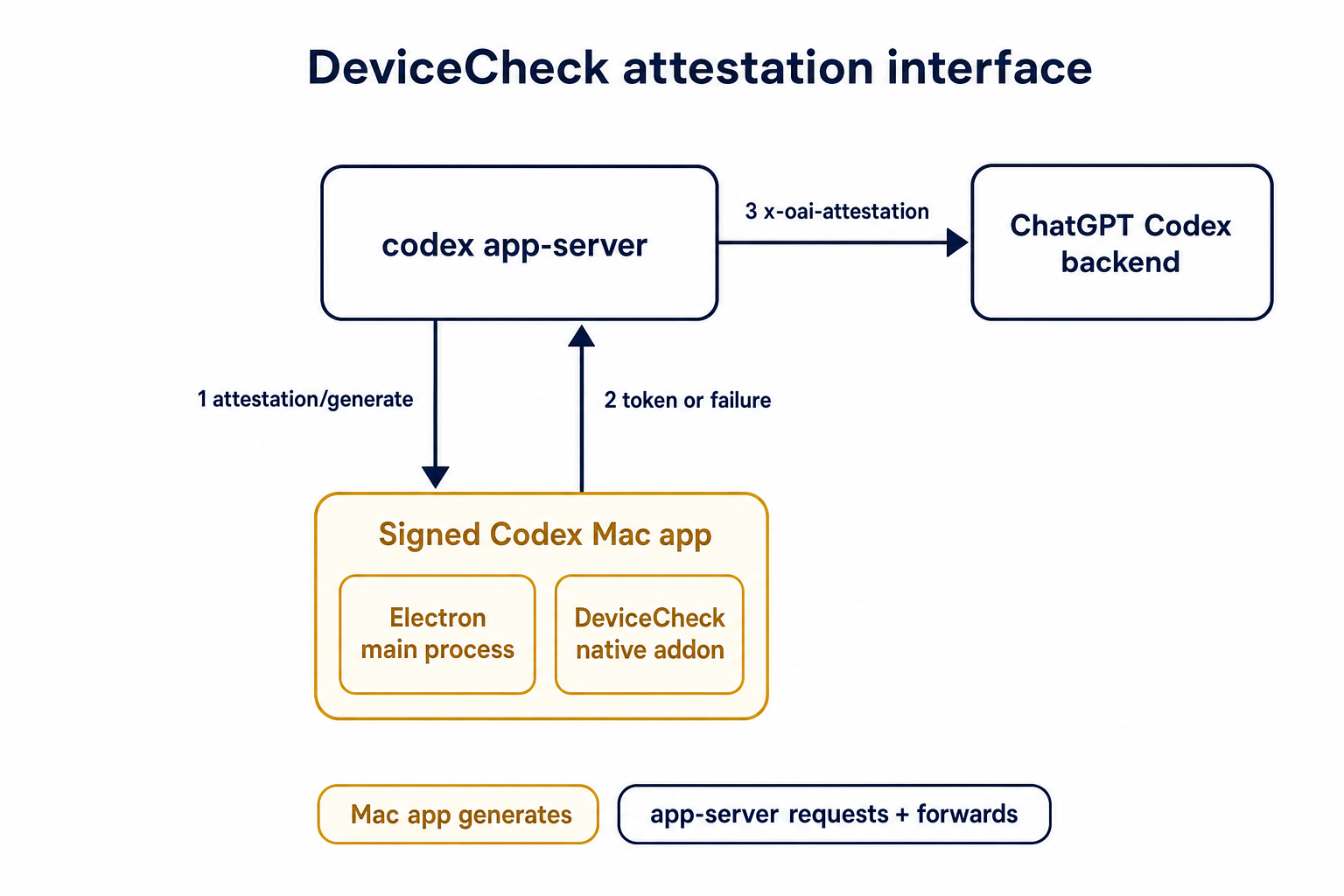
## Details
This PR teaches the Codex app-server runtime how to request and attach
an attestation token. It does not generate DeviceCheck tokens directly;
instead, it relies on the connected desktop app to advertise that it can
generate attestation and then asks that app for a fresh header value
when needed.
The flow is:
1. The Codex desktop app connects to app-server.
2. During `initialize`, the app can advertise that it supports
`requestAttestation`.
3. Before app-server calls selected ChatGPT Codex endpoints, it sends
the internal server request `attestation/generate` to the app.
4. app-server receives a pre-encoded header value back.
5. app-server forwards that value as `x-oai-attestation` on the scoped
outbound requests.
The code in this repo is mostly protocol and runtime plumbing: it adds
the app-server request/response shape, introduces an attestation
provider in core, wires that provider into Responses / compaction /
realtime setup paths, and covers the intended scoping with tests. The
signed macOS DeviceCheck generation remains owned by the desktop app PR.
## Related PR
- Codex desktop app implementation:
https://github.com/openai/openai/pull/878649
## Validation
<details>
<summary>Tests run</summary>
```sh
cargo test -p codex-app-server-protocol
cargo test -p codex-core attestation --lib
cargo test -p codex-app-server --lib attestation
```
Also ran:
```sh
just fix -p codex-core
just fix -p codex-app-server
just fix -p codex-app-server-protocol
just fmt
just write-app-server-schema
```
</details>
<details>
<summary>E2E DeviceCheck validation</summary>
First validated the signed desktop app boundary directly: launched a
packaged signed `Codex.app`, sent `attestation/generate`, decoded the
returned `v1.` attestation header, and validated the extracted
DeviceCheck token with `personal/jm/verify_devicecheck_token.py` using
bundle ID `com.openai.codex`. Apple returned `status_code: 200` and
`is_ok: true`.
Then ran the fuller app + app-server flow. The packaged `Codex.app`
launched a current-branch app-server via `CODEX_CLI_PATH`, and a local
MITM proxy intercepted outbound `chatgpt.com` traffic. The app-server
requested `attestation/generate` from the real Electron app process, and
the intercepted `/backend-api/codex/responses` traffic included
`x-oai-attestation` on both routes:
```text
GET /backend-api/codex/responses Upgrade: websocket x-oai-attestation: present
POST /backend-api/codex/responses Upgrade: none x-oai-attestation: present
```
The captured header decoded to a DeviceCheck token that also validated
with Apple for `com.openai.codex` (`status_code: 200`, `is_ok: true`,
team `2DC432GLL2`).
</details>
---------
Co-authored-by: Codex <noreply@openai.com>
## Why

Reverts #20689 to restore the previous optional state DB plumbing. The
conflict resolution keeps the newer installation ID and session/thread
identity changes that landed after #20689, while removing the mandatory
state DB and agent graph store dependency from ThreadManager
construction.

## What changed

- Restored `Option<StateDbHandle>` through app-server, MCP server,
prompt debug, and test entry points.
- Removed the `codex-core` dependency on `codex-agent-graph-store` and
reverted descendant lookup back to the existing state DB path when
available.
- Kept newer `installation_id` forwarding by passing it beside the
optional DB handle.
- Kept local thread-name updates working when the optional state DB
handle is absent.

## Validation

- `git diff --check`
- `cargo test -p codex-thread-store`
- `cargo test -p codex-state -p codex-rollout -p
codex-app-server-protocol`
- Attempted `env CARGO_INCREMENTAL=0 cargo test -p codex-core -p
codex-app-server -p codex-app-server-client -p codex-mcp-server -p
codex-thread-manager-sample -p codex-tui`; blocked locally by a rustc
ICE while compiling `v8 v146.4.0` with `rustc 1.93.0 (254b59607
2026-01-19)` on `aarch64-apple-darwin`.
## Why

Skills update notifications are app-server API behavior, but the watcher
lived in `codex-core` and surfaced through
`EventMsg::SkillsUpdateAvailable`. Moving the watcher out keeps core
focused on thread execution and lets app-server own both cache
invalidation and the `skills/changed` notification.

## What changed

- Added an app-server-owned skills watcher that watches local skill
roots, clears the shared skills cache, and emits `skills/changed`
directly.
- Registers skill watches from the common app-server thread listener
attach path, including direct starts, resumes, and app-server-observed
child or forked threads.
- Stores the `WatchRegistration` on `ThreadState`, so listener
replacement, thread teardown, idle unload, and app-server shutdown
deregister by dropping the RAII guard.
- Removed `EventMsg::SkillsUpdateAvailable`, the core watcher, and the
old core live-reload test.
- Extended the app-server skills change test to verify a cached skills
list is refreshed after a filesystem change without forcing reload.

## Validation

- `cargo check -p codex-core -p codex-app-server -p codex-mcp-server -p
codex-rollout -p codex-rollout-trace`
- `cargo test -p codex-app-server
skills_changed_notification_is_emitted_after_skill_change`
## Summary

- resolve or inject the installation ID before core startup and pass it
through `ThreadManager`, `CodexSpawnArgs`, and `Session` as a plain
`String`
- keep child sessions on the parent installation ID instead of
rediscovering it inside core
- propagate installation ID startup failures in `mcp-server` instead of
panicking

## Why

Core was still touching the filesystem on the session startup path to
discover `installation_id`. This moves that work to the outer host
boundary so core no longer depends on `codex_home` reads during session
construction.

---------

Co-authored-by: Codex <noreply@openai.com>
 Martin Au-Yeung
