## Why

Desktop uninstall cleanup needs an installation owner even when the user has not signed in or configured the Windows sandbox. Recording ownership only during provisioning leaves those installations unregistered.

## What changed

- Add an authenticated installation registration request and attempt it during Windows desktop stdio initialization, with a five-second timeout before the initialization response.
- Persist ownership independently of provisioning, preserve existing desktop ownership, and prevent another user or home from replacing the registered owner.
- Validate write authority and retain directory handles and guards to protect the registered home against junction conversion through privileged cleanup.
- Preserve existing CLI homes during desktop uninstall while removing their `CodexSandboxUsers` ACL entries. Report ACL revocation errors and avoid propagating unchanged ACLs.
- Grant the owner `WRITE_DAC` on `.sandbox-bin` and allow elevated-helper fallback when older permissions need repair or the service cannot establish an uninstall watcher.

## Testing

Add tests for installation registration without sandbox settings and for preserving a child's null DACL when revoking an absent SID from its parent.

GitOrigin-RevId: fb48923e9d76758d1bf5b50c7305aa60f91629db
## What changed

Allow app-server to advertise `openai/elicitation.userVerification` and route verification requests to local stdio clients named `Codex Desktop` when `experimentalApi` is enabled and the device supports verification. Preserve support for the in-process `codex-tui` client.

Document the experimental verification API, local credential lifecycle, transport restrictions, and GUI requirements for cancellation and late proofs.

## Testing

Extend activation tests to cover desktop capability advertisement and request eligibility, including rejection for other transports, unrecognized client names, missing opt-in, and unsupported devices.

GitOrigin-RevId: ba4fd4b83b9c24541df3a490396d6c715e7b7433
## Why

The existing `userVerification/*` handlers always returned unavailability, leaving local clients unable to use the native verification provider.

## What changed

- Dispatch status, enrollment, deletion, and challenge signing through an account-scoped provider. Enrollment creates or reuses a local key; it does not register credentials with a server.
- Restrict enrollment, deletion, and signing to stdio and in-process connections, rejecting WebSocket and remote-control callers before parameter validation.
- Bound native work to one operation per service with a 120-second timeout, and propagate in-process caller cancellation. Recheck connection, cancellation, and authentication state before delivering results, including after waiting for response queue capacity.
- Add device-gated verification capability wiring for the experimental in-process `codex-tui` client, with automatic activation still disabled by default.

## Testing

Add tests for local key reuse and deletion, decoded challenge signing, cancellation, authentication changes during verification and response queuing, concurrent worker rejection, and stdio/WebSocket RPC behavior.

GitOrigin-RevId: 7eac15a5ffb049d27bf8fedcfbae19a49a3f6a3d
## Why

App-server clients need to advertise structured MCP extension settings, including supported MCP App UI MIME types, rather than only opting into OpenAI form elicitation with a boolean.

## What changed

- Add an `extensions` map to initialize capabilities and preserve `mcpServerOpenaiFormElicitation` as a legacy alias for `openai/form`.
- Capture the declared extension profile when a thread is started, resumed, or forked, propagate it to subagents, and advertise it to downstream MCP servers during initialization.
- Keep the profile stable for the lifetime of the loaded session instead of changing it on later turns or direct tool calls.

## Testing

- Cover extension conversion, downstream MCP initialization, session isolation, legacy form support, and subagent inheritance.

GitOrigin-RevId: fbcedbb74ce788e574b0f884a4c45c4cedb9de54
## Why

Remote control starts by letting `codex-backend` initialize against the
app-server as an infrastructure health/proxy client before the real
remote client connects. App-server initialization also sets the
process-wide `originator` from `client_info.name`, so `codex-backend`
could become the sticky originator for later model/API requests even
after the real client initialized.

## What changed

- Treat `codex-backend` as a non-originating initialize client,
alongside the existing `codex_app_server_daemon` probe client.
- Preserve normal per-connection initialize behavior, including session
metadata and initialize analytics.
- Add regression coverage that verifies `codex-backend` initialize does
not replace the default originator.

## Testing

- `cargo test -p codex-app-server --test all
initialize_codex_backend_does_not_override_originator`
## Why

The app-server daemon work needs two app-server behaviors to be safe
when lifecycle management is driven by a helper process:

- a readiness probe must not become the process-wide client identity
just because it connects first
- a graceful reload signal needs to keep draining active turns even if
it is delivered more than once

## What changed

- Treat `codex_app_server_daemon` initialization as a probe-only client
for process-global originator and user-agent suffix state.
- Distinguish forceable shutdown signals from graceful-only ones, and
treat Unix `SIGHUP` as graceful-only while leaving `SIGTERM` and Ctrl-C
forceable.
- Add regression coverage for daemon probe initialization and repeated
`SIGHUP` delivery while a turn is still running.

## Testing

- `cargo test -p codex-app-server`
  - The new daemon-probe and repeated-`SIGHUP` coverage passed.
- The run still failed in the existing
`suite::conversation_summary::get_conversation_summary_by_relative_rollout_path_resolves_from_codex_home`
and
`suite::conversation_summary::get_conversation_summary_by_thread_id_reads_rollout`
tests because their initialize handshake timed out.
- `cargo test -p codex-app-server --test all
suite::conversation_summary::`
- Reproduced the same two existing initialize-timeout failures in
isolation.
## Summary
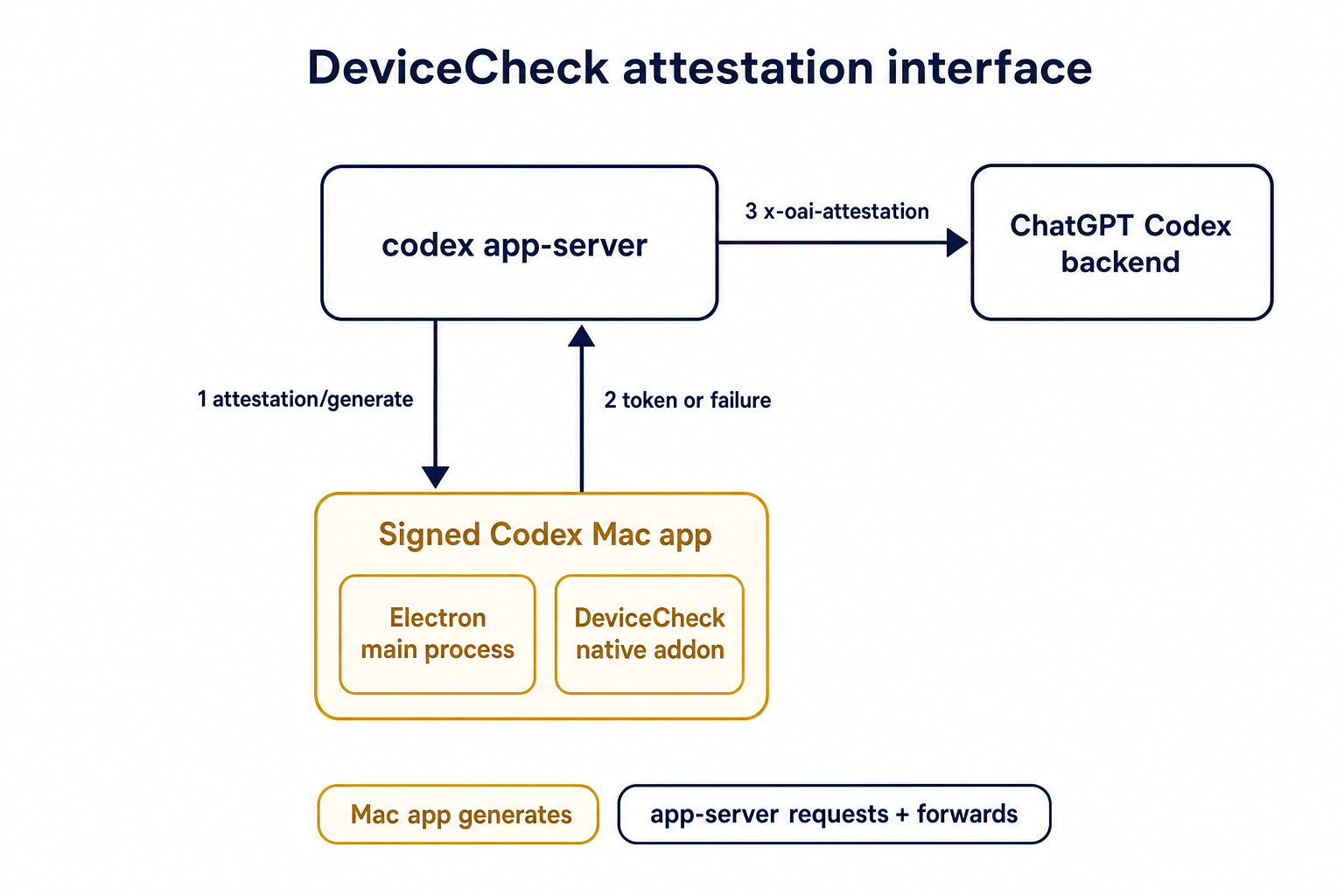
TL;DR: teaches `codex-rs` / app-server to request a desktop-provided
attestation token and attach it as `x-oai-attestation` on the scoped
ChatGPT Codex request paths.
## Details
This PR teaches the Codex app-server runtime how to request and attach
an attestation token. It does not generate DeviceCheck tokens directly;
instead, it relies on the connected desktop app to advertise that it can
generate attestation and then asks that app for a fresh header value
when needed.
The flow is:
1. The Codex desktop app connects to app-server.
2. During `initialize`, the app can advertise that it supports
`requestAttestation`.
3. Before app-server calls selected ChatGPT Codex endpoints, it sends
the internal server request `attestation/generate` to the app.
4. app-server receives a pre-encoded header value back.
5. app-server forwards that value as `x-oai-attestation` on the scoped
outbound requests.
The code in this repo is mostly protocol and runtime plumbing: it adds
the app-server request/response shape, introduces an attestation
provider in core, wires that provider into Responses / compaction /
realtime setup paths, and covers the intended scoping with tests. The
signed macOS DeviceCheck generation remains owned by the desktop app PR.
## Related PR
- Codex desktop app implementation:
https://github.com/openai/openai/pull/878649
## Validation
<details>
<summary>Tests run</summary>
```sh
cargo test -p codex-app-server-protocol
cargo test -p codex-core attestation --lib
cargo test -p codex-app-server --lib attestation
```
Also ran:
```sh
just fix -p codex-core
just fix -p codex-app-server
just fix -p codex-app-server-protocol
just fmt
just write-app-server-schema
```
</details>
<details>
<summary>E2E DeviceCheck validation</summary>
First validated the signed desktop app boundary directly: launched a
packaged signed `Codex.app`, sent `attestation/generate`, decoded the
returned `v1.` attestation header, and validated the extracted
DeviceCheck token with `personal/jm/verify_devicecheck_token.py` using
bundle ID `com.openai.codex`. Apple returned `status_code: 200` and
`is_ok: true`.
Then ran the fuller app + app-server flow. The packaged `Codex.app`
launched a current-branch app-server via `CODEX_CLI_PATH`, and a local
MITM proxy intercepted outbound `chatgpt.com` traffic. The app-server
requested `attestation/generate` from the real Electron app process, and
the intercepted `/backend-api/codex/responses` traffic included
`x-oai-attestation` on both routes:
```text
GET /backend-api/codex/responses Upgrade: websocket x-oai-attestation: present
POST /backend-api/codex/responses Upgrade: none x-oai-attestation: present
```
The captured header decoded to a DeviceCheck token that also validated
with Apple for `com.openai.codex` (`status_code: 200`, `is_ok: true`,
team `2DC432GLL2`).
</details>
---------
Co-authored-by: Codex <noreply@openai.com>
## Why

The app-server request path had grown around a large
`CodexMessageProcessor` plus separate API wrapper/helper modules. That
made the dependency graph hard to see and forced unrelated request
families to share broad processor state.

This PR makes the split mechanical and command-prefix oriented so
request families own only the dependencies they use.

## What changed

- Replaced `CodexMessageProcessor` with command-prefix request
processors under `app-server/src/request_processors/`.
- Removed the old config, device-key, external-agent-config, and fs API
wrapper files by moving their API handling into processors.
- Split apps, plugins, marketplace, catalog, account, MCP, command exec,
fs, git, feedback, thread, turn, thread goals, and Windows sandbox
handling into dedicated processors.
- Kept shared lifecycle, summary conversion, token usage replay, and
shared error mapping only where multiple processors use them; single-use
helpers were inlined into their owning processor.
- Removed the fallback processor path and moved processor tests to
`_tests` files.

## Validation

- `cargo test -p codex-app-server`
- `cargo check -p codex-app-server`
- `just fix -p codex-app-server`

