## Why

Private IP destinations always bypassed inherited upstream proxies, preventing their use for private networks reachable through an upstream VPN proxy.

## What changed

- Add `codex exec-server --proxy-private-ips-via-upstream`, also configurable with `CODEX_EXEC_SERVER_PROXY_PRIVATE_IPS_VIA_UPSTREAM=true`. The setting defaults to disabled.
- Allow permitted RFC 1918, carrier-grade NAT, and IPv6 unique-local destinations to use an applicable upstream proxy. Loopback and link-local destinations retain direct routing, and destination access policy still applies.
- Keep connections direct when no valid upstream proxy applies or `allow_upstream_proxy=false`. Errors after selecting an upstream proxy do not trigger a direct retry.
- Rename `ExecServerRuntimePaths` to `ExecServerRuntimeOptions` and carry the routing setting from executor startup into the managed network proxy.

## Testing

Add routing coverage for private address ranges, special-use addresses, and public targets with the option enabled and disabled. Verify that HTTP and CONNECT requests still enforce destination allowlists and denylists, and update the CLI help snapshot.

GitOrigin-RevId: b7c9cc7da0e0f545694a6521b74c9b36b7b92769
## Why

History recording used the model captured at turn start, so switching models within a turn could apply stale image preparation and tool-output truncation rules.

## What changed

Pass explicit model metadata through conversation recording. Record model responses and tool results using their originating step's settings, and capture the current model for pending input recorded during startup interruption or task completion.

## Testing

Add regression coverage for tool results across a model switch, explicit model selection for plain and annotated history, and image input retained during interruption and completion. Extend model-switching tests to verify that prepared media and item identity survive switching back to a multimodal model in live, resumed, and forked threads.

GitOrigin-RevId: 5bc750c30c334acb9b802cb80fdea01daffa84a1
## What changed

- Add the `codex-attachment-store` crate with storage-neutral attachment metadata, references, errors, and an asynchronous persistence interface.
- Provide an inline implementation that preserves attachment bytes as media-typed base64 data URLs.
- Inject the store into `ThreadManager`, expose it to consumers, and retain inline storage as the default for existing entry points.

## Testing

- Verify inline storage round-trips binary, text, PNG, and JPEG data.
- Verify attachment debug output redacts URLs while retaining file IDs.

GitOrigin-RevId: 7688dcd3c89d7540ed2398f3e7c63881fbfcda97
## Why

Thread settings can change while a turn is running, and delegated review or
compaction steps can select a different model. Each request needs a consistent
set of settings resolved against the model that will execute it.

## What changed

- Capture immutable resolved settings for each model step, including model
  metadata, reasoning options, service tier, approvals, and personality.
- Keep in-flight steps on their captured settings while applying thread updates
  to subsequent work.
- Resolve inherited reasoning summaries and filter service tiers against the
  selected model and feature configuration for review and compaction steps.

## Testing

Added coverage for settings updates during paused turns, model changes,
previous-model compaction, review-model defaults, and service-tier filtering.

GitOrigin-RevId: fca4b3b305379f1bf26a5cac75ee0dd1747ac1f6
## Why

Thread settings can change while a turn is still active, including between sampling requests. Those updates should apply to the next turn instead of changing the model configuration partway through the current turn.

## What changed

- Snapshot the model, reasoning settings, service tier, approval settings, and model-attributed telemetry in `StepContext`.
- Build prompts, model requests, world state, tracing, and startup prewarms from that step-scoped snapshot.
- Share immutable model metadata between turn and step contexts.

## Testing

Added an integration test that pauses an active turn, updates its thread settings, and verifies that all requests in the active turn retain the original settings while the next turn uses the updates.

GitOrigin-RevId: c51352218e463dcc9b7338566d16742292c49fbf
## What changed

- Treat workload identity environment markers as an explicit authentication selection, even when another process credential is present.
- Return initialization errors from `AuthManager` and propagate them through commands and services instead of continuing with an unusable authentication state.
- Make `codex login status` validate workload identity, keep the TUI on an embedded app server for local workload identity, and reject workload identity in `codex mcp-server`, where it is unsupported.

## Testing

- Cover workload identity precedence and partial configuration errors.
- Verify login status reports an unreadable identity assertion and app-server routing enforces the supported workload identity topology.

GitOrigin-RevId: efc6b6b4cd4d61652617de82aaa3d7ffc75d6618
## Why

The `<current_date>` in environment context could diverge from the clock used by current-time features, especially when a host provides an external clock.

## What changed

- Read the current time from the session's time provider whenever world state is built, and render its local date in environment context.
- Use each session's own thread ID for clock reads, including guardian sessions.
- Propagate clock-read failures through turn error events and stop before model inference.

## Testing

- Cover date updates across turns and app-server requests.
- Verify guardian clock reads use the corresponding root or guardian thread ID and do not run during prewarm.
- Verify clock failures emit an error without sending an inference request.

GitOrigin-RevId: bb7f32ccc0229b7bc6f14d7356db00bcce78066d
## Why

The TUI must inspect the default execution environment before loading its final
configuration. Initializing the environment manager at that point can give
startup services the bootstrap HTTP policy instead of the effective policy after
managed requirements are applied.

## What changed

- Split environment discovery from manager construction so callers can inspect
  the default environment without starting remote connections.
- Build the environment manager after final configuration loading and pass its
  resolved `HttpClientFactory` through all construction paths.
- Add shared test support for managers that use the legacy default HTTP policy.

## Testing

- Cover connection-free environment discovery and explicit HTTP policy
  propagation.
- Verify TUI startup services use the final managed `respect_system_proxy` value.

GitOrigin-RevId: 928fa31e6b4bcfbe1a121cade2f351427fdfa0f4
## Why

Interrupting a turn while MCP tools were still starting could abort before the
submitted user input was recorded in conversation history.

## What changed

- Build and retain the MCP tool list and tool router as part of each step
  snapshot, using the turn cancellation token during tool discovery.
- Record turn hooks and submitted input when cancellation occurs during startup
  prewarming, pre-sampling compaction, or first-step capture.
- Reuse the captured router for sampling, compaction, and prompt debugging so
  advertised and executable tools share the same request-scoped view.

## Testing

Add coverage that interrupts each affected MCP startup phase and verifies that
the user prompt remains in history before the turn-aborted marker.

GitOrigin-RevId: 6e96c6814357a55545d69b580e28f35933cfadf7
## What changed

- Install the git attribution extension in the app server, MCP server, and `codex debug prompt-input` so authenticated workspace policy controls the commit and pull request attribution instructions sent to the model.
- Resolve attribution settings from the process-level ChatGPT base URL, independent of per-thread or per-tool configuration overrides.
- Treat git attribution as contextual developer content when mapping model events.

## Testing

- Cover policy fetch retries, workspace switches, rollbacks, cold thread resumes with legacy instructions, MCP tool calls, and prompt-debug output.

GitOrigin-RevId: 57d182c432c20d7c1c6c429057b6163c9f32088d
## What changed

- Add `StartThreadOptions::new` to provide the standard configuration for a new thread.
- Make `ThreadManager::start_thread` the single thread-start entry point and migrate callers from the previous convenience methods.
- Derive default environment selections when `environments` is `None`, while preserving explicit selections, including an empty list.

GitOrigin-RevId: 8977dc11aed54c5e1215a81eaed2b2cf5fc6087a
## What changed

- Replace the combined `Codex` wrapper with an `Arc<Session>` and a dedicated
  `SessionIo` handle for submissions, events, status, and loop termination.
- Make `Session::spawn` return the session and I/O handle separately, and have
  `CodexThread` own both.
- Update thread management, delegated sessions, guardian reviews, and agent
  control to use the appropriate session or I/O interface.

GitOrigin-RevId: 8523bad7e7366e2969fd0cc3849b4247b141427a
## What changed

- Accept a caller-provided `CodexAppsToolsCache` when constructing a `ThreadManager` and pass it through to the MCP manager.
- Add `ConnectorRuntimeManager::new_without_cache()` for an in-memory runtime that neither loads nor persists connector state on disk.
- Re-export `CodexAppsToolsCache` from `codex-core` and `codex-core-api` for embedders.

## Testing

- Verify that a cache-disabled connector runtime ignores existing disk state and publishes live tools without creating cache files.

GitOrigin-RevId: f52f4f27c425a8d84ad0d0987b30a6fc3c14d702
## Why

Embedding callers need to control whether model catalogs are persisted to disk.

## What changed

- Accept a shared models manager when constructing `ThreadManager` instead of always creating a cached manager internally.
- Add provider APIs for creating uncached model managers. OpenAI-compatible providers fetch on each `OnlineIfUncached` refresh without reading or writing `models_cache.json`.
- Keep existing app server, MCP server, sample, and test callers on the standard cached manager.

## Testing

- Verify an uncached manager fetches on every refresh.
- Verify an injected uncached manager controls thread refresh behavior and does not create `models_cache.json`.

GitOrigin-RevId: 8bb646054ecec4ccb865b2bf56249384916ea9db
## Why

Selected plugin metadata is stable, but MCP processes are live runtime
state. They need different lifetimes:

- the MCP extension caches manifest, MCP, and connector declarations for
each stable selected root;
- each model step projects that cached metadata through the roots that
resolved as ready for that exact step;
- the MCP manager is rebuilt only when that availability projection
changes.

This matches executor skills: both features consume the same resolved
step roots instead of inferring readiness from the turn's selected
environments.

## Behavior

```text
E1 not ready for this step
  -> no E1 MCP servers or connectors
  -> cached plugin metadata stays in ext/mcp

E1 becomes ready
  -> reuse cached metadata
  -> publish one MCP runtime containing E1 capabilities

same ready roots on the next step
  -> reuse the exact runtime; no rediscovery and no MCP restart

resume
  -> create new extension thread state and a new MCP runtime
```

All model-facing consumers use the same step snapshot:

```text
resolved selected roots
        |
        v
extension MCP/connector projection
        |
        v
{ MCP config, connector snapshot, MCP manager }
        |
        +-> advertise model tools
        +-> build app/connector tools
        +-> execute MCP calls
```

## Cache contract

The existing MCP extension owns a cache keyed by the full
`SelectedCapabilityRoot`:

```rust
let state = thread_store.get_or_init(SelectedExecutorPluginMcpState::default);
```

The cache lives with extension thread state. Environment availability
filters projection but does not invalidate metadata. Resume creates new
thread state. There is no file watcher or executor generation because
contents behind a stable environment/root are assumed stable.

## What changes

- Keeps executor plugin discovery and cached metadata in `ext/mcp`.
- Caches MCP and connector declarations together per selected root.
- Uses the step's already-resolved capability roots, including lazy
environments that are not turn environments.
- Reuses the current MCP runtime when the ready-root projection is
unchanged.
- Uses the same step MCP manager and connector snapshot for
model-visible tools and execution.
- Resolves direct thread-scoped MCP requests from the current
selected-root projection.

## Deliberately out of scope

- `app/list` remains based on the latest global host-plugin state; this
PR does not make its response or notifications thread-specific.
- `required = true` startup semantics do not apply to delayed executor
MCP activation.
- No filesystem/content invalidation.
- No transport-disconnect watcher.
- No executor generations or environment replacement semantics.
- No client sharing across complete manager replacements.

## Stack

1. Extension-owned World State sections.
2. Project executor skills through World State.
3. Pin one MCP runtime to each model step.
4. **This PR:** project selected MCP and connector state from
extension-owned metadata.
5. Integration coverage for selected capability availability and resume.

## Verification

-
`selected_plugin_servers_use_managed_requirements_for_the_selected_root_id`
- The stacked integration PR covers unavailable to ready activation,
unchanged-runtime reuse, skills, MCP tools, connector attribution, and
cold resume.
## Why

With deferred executors, a turn can begin before a remote environment
attaches. AGENTS.md discovery previously ran only during session setup,
so instructions from a later environment never reached the model or the
session instruction sources.

WorldState persistence has now landed, so this uses the durable
model-visible baseline directly instead of carrying a temporary
resume/fork compatibility path.

## What

- Add an `AgentsMdManager` in `SessionServices` to own host
instructions, loaded state, and refresh caching.
- When `DeferredExecutor` is enabled, refresh AGENTS.md when attached
environment selections change and freeze the result in the corresponding
`StepContext`.
- Represent AGENTS.md as a persisted WorldState section for every
session, with bounded initial, replacement, and removal updates.
- Remove duplicate AGENTS.md state and rendering from
`SessionConfiguration` and `TurnContext`.
- Build initial context, per-request updates, and compaction context
from the same step-scoped value.
- On resume and fork, compare current instructions with the restored
WorldState baseline and inject a replacement exactly once when they
differ.

Builds on #29833, #29835, and #29837.

## Tests

- Covers a remote environment becoming ready mid-turn, with AGENTS.md
appearing on the next request exactly once and updating canonical
instruction sources.
- Covers full, unchanged, replaced, and removed AGENTS.md WorldState
rendering.
- Covers changed instructions across cold resume and fork without
duplicate reinjection.
- Covers remote-v2 compaction retaining creation-time instructions in
the live session and cold resume appending one replacement when the
source changed.
- Ran focused `codex-core` AGENTS.md, WorldState, and context-update
test suites.
Pick up the AgentGraphStore migration.

- Inject an explicit optional agent graph store into `ThreadManager`
- Move all calls to spawn, close, recursive resume, and
subtree/archive/delete/feedback traversal through it
- Keep using  `LocalAgentGraphStore` when SQLite is available

This required some changes to the interface to deal with futures:

- The interface now matches `ThreadStore`'s object-safe pattern by
returning a boxed `AgentGraphStoreFuture` directly, allowing
`ThreadManager` to hold `Arc<dyn AgentGraphStore>`

*Slight behavior change!* Unfiltered subtree enumeration now performs a
single all-status breadth-first traversal, so a closed grandchild
beneath an open edge is included; the previous Open-then-Closed
traversals could not cross mixed-status paths and silently omitted it.
## Why

With deferred executors, an environment can become ready between two
sampling requests in the same turn. The model-visible environment
update, advertised tools, and eventual tool execution must all describe
the same request-time view.

Otherwise, a request built while only environment B is ready can
advertise a tool without an `environment_id`; if higher-priority
environment A becomes ready before execution, that call could silently
run in A instead.

This PR is stacked on #29527.

## Design

`run_turn` captures one `Arc<StepContext>` at each sampling-request
boundary. That step owns the request's `TurnContext` and environment
snapshot.

- World-state environment updates and tool planning borrow that same
step.
- `ToolCallRuntime` retains the `Arc` while asynchronous tool calls
execute.
- `ToolInvocation` carries the step to handlers; its temporary `turn`
compatibility field is derived from the same object.
- `ToolRouter` does not retain `StepContext`; it only uses it while
constructing the request's tool set.
- With `DeferredExecutor` disabled, step capture keeps using the
environments frozen at turn start.

Simply: every sampling request gets one consistent picture of its
environments, from what the model sees through where its tool calls run.

## What changed

- Build environment-dependent tool specs from the current request's
`StepContext`.
- Use that same step for unified exec, legacy shell, `apply_patch`,
`view_image`, and `request_permissions` execution.
- Hide environment-backed tools, including `request_permissions`, while
no environment is attached.
- Resolve legacy shell paths and metadata from the selected step
environment instead of the stale turn-start environment.
- Capture explicit steps at non-turn-loop boundaries such as compaction,
prompt debug, and startup prewarm.
- Reconcile prompt-debug history from the same step used to build its
tools.

## Follow-up

- Bind yielded code-mode cells to the tool runtime that created them, so
nested calls made after yielding continue to use the originating
request's `StepContext`.

## Test plan

- `just test -p codex-core
deferred_executor_updates_context_and_tools_after_startup`
- `just test -p codex-core
environment_count_controls_environment_backed_tools`
- `just test -p codex-core
build_prompt_input_includes_context_and_user_message`
## What

- make Fjord's centralized response-item image preparation unconditional
for new and resumed history
- have local user images and `view_image` outputs always defer decoding
and resizing to that path
- retain `resize_all_images` as an ignored, removed compatibility key
for released clients
- delete the flag-off producer paths and obsolete policy-specific tests

## Why

Centralized preparation is now the intended image path. Keeping the
runtime feature checks also kept two image-processing implementations
alive and allowed client config to select the legacy behavior.

This is a clean replacement for #28975, rebuilt from the latest `main`.

## How

`prepare_response_items` now runs whenever items enter history and
whenever persisted history is reconstructed. Producers emit deferred
image data, so malformed images become the existing model-visible
placeholder instead of failing the session at the producer.

## Test plan

- `just fmt`
- `just fix -p codex-core -p codex-features`
- `just test -p codex-features` — 52 passed
- focused affected `codex-core` set — 20 passed
- `just test -p codex-core handle_accepts_explicit_high_detail` — 1
passed
- full `just test -p codex-core` attempt — 2,723 passed; 88 unrelated
environment failures from read-only `~/.codex` SQLite state and
unavailable integration helper binaries
Stacked on #28822.

## Summary

- add a host-injectable current-time provider with a built-in system
implementation
- record UTC developer reminders in history immediately before due model
requests
- keep cadence state per session and force a refresh after compaction

This does NOT include the app server client <-> server clock logic. This
PR is only for the reminder message & system clock that will be used in
prod.

## Testing

- `just test -p codex-core varlatency_`
- `just clippy -p codex-core -p codex-app-server -p codex-mcp-server -p
codex-thread-manager-sample`
- `just fmt`
## Why

#28152 jumped the gun on moving the rollout format to store URIs, and
would likely break compat with some features that don't go through the
same types as the core logic.

## What

Make `TurnContextItem.cwd` an `AbsolutePathBuf` again, remove test added
for `PathUri` serialization in rollouts. Also drops a bunch of error
paths that are no longer needed.
## Why

Model-visible `<environment_context>` should match the environment of
the executor, not of the app server.

Stacked on #28146.

## What

- Keep selected environment cwd values as `PathUri` while building
environment context.
- Render cwd text using the path convention represented by the URI, with
the canonical URI as a fallback.
- Preserve compatibility with legacy `TurnContextItem.cwd` values when
reconstructing and diffing context.
- Extend the Wine-backed remote Windows test to assert that the model
sees `powershell` and `C:\windows`.
## Why

Multi-agent v2 `send_message` deliveries already reach the receiving
model as typed `agent_message` items with encrypted content.
Child-completion notifications are generated by Codex itself, so their
content is plaintext and previously fell back to a serialized JSON
envelope inside an assistant message.

With plaintext `input_text` supported for `agent_message`, both delivery
paths can use the same model-visible type while preserving explicit
author and recipient metadata.

## What changed

- add plaintext `input_text` support to `AgentMessageInputContent` and
regenerate the affected app-server schemas
- preserve `InterAgentCommunication` as structured mailbox input instead
of converting it to assistant text
- record delivered communications as typed `agent_message` history items
- persist a dedicated rollout item so local delivery metadata such as
`trigger_turn` remains available without leaking into the Responses
request
- reconstruct typed agent messages on resume and preserve fork-turn
truncation behavior
- remove request-time assistant-content parsing
- preserve plaintext and encrypted inter-agent deliveries in stage-one
memory inputs
- normalize and link plaintext and encrypted agent messages in rollout
traces without treating inbound messages as child results
- cover the real MultiAgent V2 child-completion path end to end with
deterministic mailbox synchronization

## Verification

- `just test -p codex-core
plaintext_multi_agent_v2_completion_sends_agent_message`
- `just test -p codex-core input_queue_drains_mailbox_in_delivery_order
record_initial_history_reconstructs_typed_inter_agent_message
fork_turn_positions_use_inter_agent_delivery_metadata`
- `just test -p codex-memories-write
serializes_inter_agent_communications_for_memory`
- `just test -p codex-rollout-trace
agent_messages_preserve_routing_and_content
sub_agent_started_activity_creates_spawn_edge`
- `just test -p codex-rollout-trace
agent_result_edge_falls_back_to_child_thread_without_result_message`
- `just test -p codex-protocol -p codex-rollout -p
codex-app-server-protocol`
## Why

We want to remove implicit use of `$CODEX_HOME` from `codex-core` and
make embedders responsible for supplying user-level instructions. This
also ensures user instructions load when no primary environment is
selected.

## What changed

Stacked on #27415, which makes `codex exec` surface thread-scoped
runtime warnings.

- Added `UserInstructionsProvider` to `codex-extension-api`, with
absolute source attribution and recoverable loading warnings.
- Added `codex-home` with the filesystem-backed provider for
`AGENTS.override.md` and `AGENTS.md`, preserving precedence, fallback,
trimming, lossy UTF-8 handling, and the existing uncapped global
instruction size.
- Removed global instruction loading from `Config` and require
`ThreadManager` callers to inject a provider.
- Load provider instructions once for each fresh root runtime, including
runtimes without a primary environment. Running sessions retain their
snapshot, while child agents inherit the parent snapshot without
invoking the provider.
- Keep provider instructions separate while loading project `AGENTS.md`,
then assemble the model-visible instructions with the existing ordering,
source attribution, warning, and turn-context behavior.
- Wired the Codex home provider through the CLI, app server, MCP server,
core facade, and thread-manager sample.

## Validation

- `just test -p codex-home -p codex-extension-api`
- `just test -p codex-core agents_md`
- `just test -p codex-core guardian`
- `just test -p codex-app-server
thread_start_without_selected_environment_includes_only_global_instruction_source`
- `just test -p codex-exec warning`
- `just bazel-lock-check`
## Summary

Adds complete client-side image preparation behind the default-off
`resize_all_images` feature flag.

When enabled, local image producers defer decoding and resizing. Images
are prepared centrally before insertion into conversation history,
covering user input, `view_image`, and structured tool-output images.

## Behavior

- Processes base64 `data:` images in messages and function/custom tool
outputs.
- Leaves non-data URLs, including HTTP(S) URLs, unchanged.
- Applies image-detail budgets:
  - `high` and omitted: 2048px maximum dimension and 2.5K 32px patches.
  - `original`: 6000px maximum dimension and 10K 32px patches.
  - `auto`: uses the same 2048px / 2.5K-patch budget as high.
  - `low`: unsupported and replaced with an actionable placeholder.
- Preserves original image bytes when no resize or format conversion is
needed.
- Enforces the shared 1 GiB encoded and decoded data-URL sanity limits.
- Replaces only an image that fails preparation, preserving sibling
content and tool-output metadata.
- Uses bounded placeholders distinguishing generic processing failures,
oversized images, and unsupported `low` detail.
- Prepares resumed and forked history before installing it as live
history without modifying persisted rollouts.

## Flag-Off Behavior

When `resize_all_images` is disabled:

- Existing local user-input and `view_image` processing remains
unchanged.
- Existing decoding and error behavior remains unchanged.
- Arbitrary tool-output images are not processed.
- HTTP(S) image URLs continue to be forwarded unchanged.


#### [git stack](https://github.com/magus/git-stack-cli)
- ✅ `1` https://github.com/openai/codex/pull/27245
- 👉 `2` https://github.com/openai/codex/pull/27247
- ⏳ `3` https://github.com/openai/codex/pull/27246
- ⏳ `4` https://github.com/openai/codex/pull/27266
## Why

[#21736](https://github.com/openai/codex/pull/21736) introduces the
typed extension API, but the runtime does not yet carry a registry
through thread/session startup or give contributors host-owned stores to
read from. This PR wires that host-side path so later feature migrations
can move product-specific behavior behind typed contributions without
adding another bespoke seam directly to `codex-core`.

## What changed

- Thread `ExtensionRegistry<Config>` through `ThreadManager`,
`CodexSpawnArgs`, `Session`, and sub-agent spawn paths.
- Wire `ThreadStartContributor` and `ContextContributor`
- Expose the small supporting surface needed by non-core callers that
construct threads directly, including `empty_extension_registry()`
through `codex-core-api`.

This PR lands the host plumbing only: the app-server registry is still
empty, and concrete feature migrations are intended to follow
separately.
## Summary
TL;DR: teaches `codex-rs` / app-server to request a desktop-provided
attestation token and attach it as `x-oai-attestation` on the scoped
ChatGPT Codex request paths.
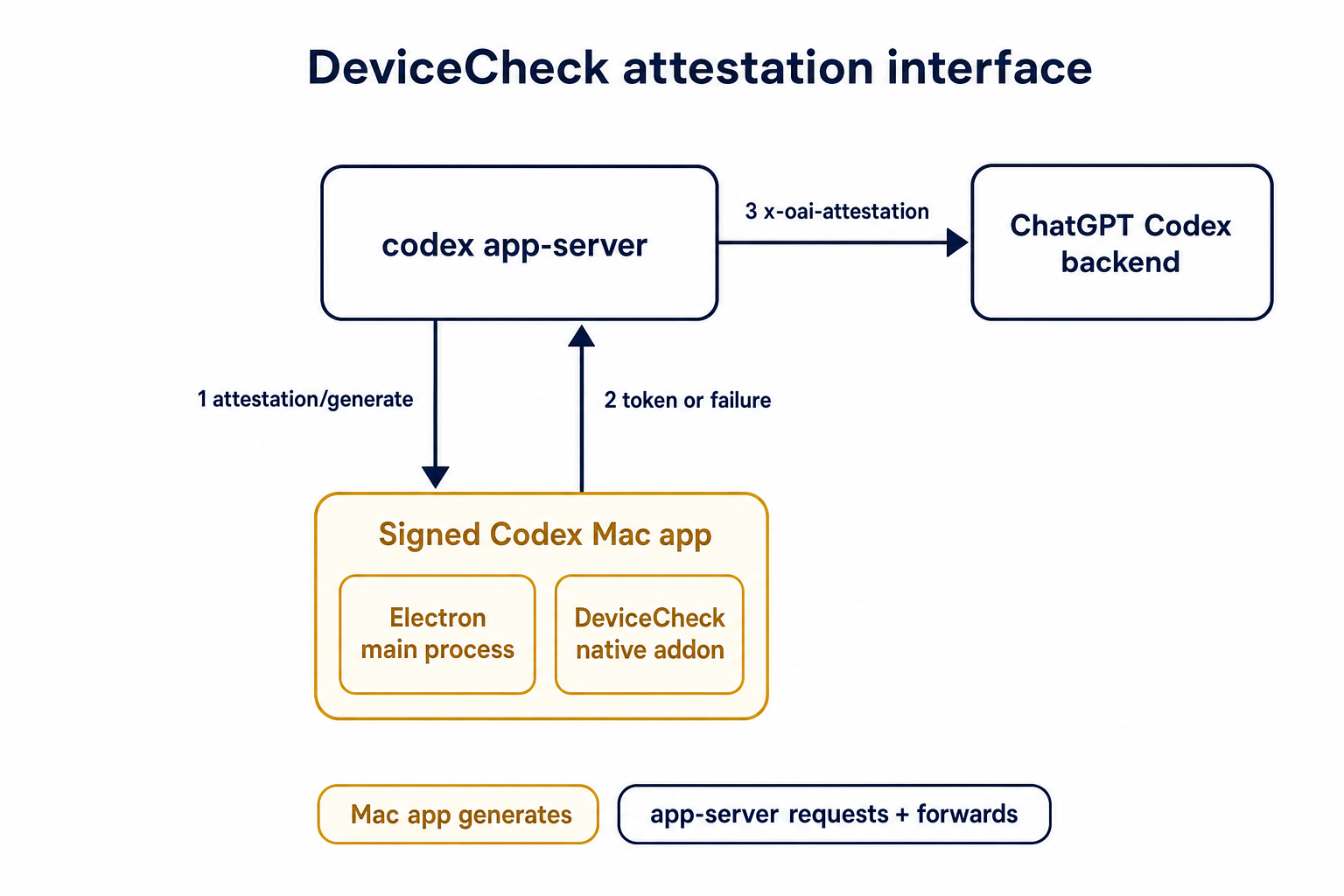
## Details
This PR teaches the Codex app-server runtime how to request and attach
an attestation token. It does not generate DeviceCheck tokens directly;
instead, it relies on the connected desktop app to advertise that it can
generate attestation and then asks that app for a fresh header value
when needed.
The flow is:
1. The Codex desktop app connects to app-server.
2. During `initialize`, the app can advertise that it supports
`requestAttestation`.
3. Before app-server calls selected ChatGPT Codex endpoints, it sends
the internal server request `attestation/generate` to the app.
4. app-server receives a pre-encoded header value back.
5. app-server forwards that value as `x-oai-attestation` on the scoped
outbound requests.
The code in this repo is mostly protocol and runtime plumbing: it adds
the app-server request/response shape, introduces an attestation
provider in core, wires that provider into Responses / compaction /
realtime setup paths, and covers the intended scoping with tests. The
signed macOS DeviceCheck generation remains owned by the desktop app PR.
## Related PR
- Codex desktop app implementation:
https://github.com/openai/openai/pull/878649
## Validation
<details>
<summary>Tests run</summary>
```sh
cargo test -p codex-app-server-protocol
cargo test -p codex-core attestation --lib
cargo test -p codex-app-server --lib attestation
```
Also ran:
```sh
just fix -p codex-core
just fix -p codex-app-server
just fix -p codex-app-server-protocol
just fmt
just write-app-server-schema
```
</details>
<details>
<summary>E2E DeviceCheck validation</summary>
First validated the signed desktop app boundary directly: launched a
packaged signed `Codex.app`, sent `attestation/generate`, decoded the
returned `v1.` attestation header, and validated the extracted
DeviceCheck token with `personal/jm/verify_devicecheck_token.py` using
bundle ID `com.openai.codex`. Apple returned `status_code: 200` and
`is_ok: true`.
Then ran the fuller app + app-server flow. The packaged `Codex.app`
launched a current-branch app-server via `CODEX_CLI_PATH`, and a local
MITM proxy intercepted outbound `chatgpt.com` traffic. The app-server
requested `attestation/generate` from the real Electron app process, and
the intercepted `/backend-api/codex/responses` traffic included
`x-oai-attestation` on both routes:
```text
GET /backend-api/codex/responses Upgrade: websocket x-oai-attestation: present
POST /backend-api/codex/responses Upgrade: none x-oai-attestation: present
```
The captured header decoded to a DeviceCheck token that also validated
with Apple for `com.openai.codex` (`status_code: 200`, `is_ok: true`,
team `2DC432GLL2`).
</details>
---------
Co-authored-by: Codex <noreply@openai.com>
## Why

The earlier PRs add stdio transport support and the config-backed
environment provider, but the feature remains inert until normal Codex
entrypoints construct `EnvironmentManager` with enough context to
discover `CODEX_HOME/environments.toml`. This final stack PR activates
the provider while preserving the legacy `CODEX_EXEC_SERVER_URL`
fallback when no environments file exists.

**Stack position:** this is PR 5 of 5. It is the product wiring PR that
activates the configured environment provider added in PR 4.

## What Changed

- Thread `codex_home` into `EnvironmentManagerArgs`.
- Change `EnvironmentManager::new(...)` to load the provider from
`CODEX_HOME`.
- Preserve legacy behavior by falling back to
`DefaultEnvironmentProvider::from_env()` when `environments.toml` is
absent.
- Make `environments.toml`-backed managers start new threads with all
configured environments, default first, while keeping the legacy env-var
path single-default.
- Update the app-server, TUI, exec, MCP server, connector, prompt-debug,
and thread-manager-sample callsites to pass `codex_home` and handle
provider-loading errors.

## Self-Review Notes

- The multi-environment startup path is intentionally tied to the
`environments.toml` provider. Using `>1` configured environment as the
only signal would also expand the legacy `CODEX_EXEC_SERVER_URL`
provider because it keeps `local` addressable alongside `remote`.
- The startup environment list is still derived inside
`EnvironmentManager`; the provider only says whether its snapshot should
start new threads with all configured environments.
- The thread-manager sample was updated to pass the current
`ThreadManager::new(...)` installation id argument so the stack compiles
under Bazel.

## Stack

- 1. https://github.com/openai/codex/pull/20663 - Add stdio exec-server
listener
- 2. https://github.com/openai/codex/pull/20664 - Add stdio exec-server
client transport
- 3. https://github.com/openai/codex/pull/20665 - Make environment
providers own default selection
- 4. https://github.com/openai/codex/pull/20666 - Add CODEX_HOME
environments TOML provider
- **5. This PR:** https://github.com/openai/codex/pull/20667 - Load
configured environments from CODEX_HOME

Split from original draft: https://github.com/openai/codex/pull/20508

## Validation

- `just fmt`
- `git diff --check`
- `bazel build --config=remote --strategy=remote
--remote_download_toplevel
//codex-rs/thread-manager-sample:codex-thread-manager-sample`
- `bazel test --config=remote --strategy=remote
--remote_download_toplevel
//codex-rs/exec-server:exec-server-unit-tests`
- `bazel test --config=remote --strategy=remote
--remote_download_toplevel --test_sharding_strategy=disabled
--test_arg=default_thread_environment_selections_use_manager_default_id
//codex-rs/core:core-unit-tests`
- `bazel test --config=remote --strategy=remote
--remote_download_toplevel --test_sharding_strategy=disabled
--test_arg=start_thread_uses_all_default_environments_from_codex_home
//codex-rs/core:core-unit-tests`

## Documentation

This activates `CODEX_HOME/environments.toml`; user-facing documentation
should be added before this stack is treated as a documented public
workflow.

---------

Co-authored-by: Codex <noreply@openai.com>
## Why

Reverts #20689 to restore the previous optional state DB plumbing. The
conflict resolution keeps the newer installation ID and session/thread
identity changes that landed after #20689, while removing the mandatory
state DB and agent graph store dependency from ThreadManager
construction.

## What changed

- Restored `Option<StateDbHandle>` through app-server, MCP server,
prompt debug, and test entry points.
- Removed the `codex-core` dependency on `codex-agent-graph-store` and
reverted descendant lookup back to the existing state DB path when
available.
- Kept newer `installation_id` forwarding by passing it beside the
optional DB handle.
- Kept local thread-name updates working when the optional state DB
handle is absent.

## Validation

- `git diff --check`
- `cargo test -p codex-thread-store`
- `cargo test -p codex-state -p codex-rollout -p
codex-app-server-protocol`
- Attempted `env CARGO_INCREMENTAL=0 cargo test -p codex-core -p
codex-app-server -p codex-app-server-client -p codex-mcp-server -p
codex-thread-manager-sample -p codex-tui`; blocked locally by a rustc
ICE while compiling `v8 v146.4.0` with `rustc 1.93.0 (254b59607
2026-01-19)` on `aarch64-apple-darwin`.
## Summary

- resolve or inject the installation ID before core startup and pass it
through `ThreadManager`, `CodexSpawnArgs`, and `Session` as a plain
`String`
- keep child sessions on the parent installation ID instead of
rediscovering it inside core
- propagate installation ID startup failures in `mcp-server` instead of
panicking

## Why

Core was still touching the filesystem on the session startup path to
discover `installation_id`. This moves that work to the outer host
boundary so core no longer depends on `codex_home` reads during session
construction.

---------

Co-authored-by: Codex <noreply@openai.com>
## Why

We want the agent graph store to be passed down the stack as a real
dependency, the same way we already treat the thread store.

This will let us inject the agent graph store as a real dependency and
support implementations other than the local SQLite-backed one. Right
now most code instantiates a state DB and an agent graph store
just-in-time. Ideally, we would not depend on the state DB directly but
only read through the higher-level interfaces.

This change makes the dependency boundaries explicit and moves state DB
initialization to process bootstrap instead of hiding it inside local
store implementations.

## What changed

- `ThreadManager` now requires a `StateDbHandle` and an
`AgentGraphStore` at construction time instead of treating them as
optional internals.
- The local store constructors no longer lazily initialize SQLite.
Callers now initialize the state DB once per process and use that shared
handle to build:
  - `LocalThreadStore`
  - `LocalAgentGraphStore`
- App bootstraps (`app-server`, `mcp-server`, `prompt_debug`, and the
thread-manager sample) now initialize the state DB up front and inject
the resulting handle down the stack.
- `app-server` now consistently uses its process-scoped state DB handle
instead of reopening SQLite or trying to recover it from loaded threads.
- Device-key storage now reuses the shared state DB handle instead of
maintaining its own lazy opener.
- The thread archive / descendant traversal paths now use the injected
`AgentGraphStore` instead of reaching through local
thread-store-specific state.

## Verification

- `cargo check -p codex-core -p codex-thread-store -p codex-app-server
-p codex-mcp-server -p codex-thread-manager-sample --tests`
- `cargo test -p codex-thread-store`
- `cargo test -p codex-core
thread_manager_accepts_separate_agent_graph_store_and_thread_store --
--nocapture`
- `cargo test -p codex-app-server
thread_archive_archives_spawned_descendants -- --nocapture`
## Why

SQLite state was still being opened from consumer paths, including lazy
`OnceCell`-backed thread-store call sites. That let one process
construct multiple state DB connections for the same Codex home, which
makes SQLite lock contention and `database is locked` failures much
easier to hit.

State DB lifetime should be chosen by main-like entrypoints and tests,
then passed through explicitly. Consumers should use the supplied
`Option<StateDbHandle>` or `StateDbHandle` and keep their existing
filesystem fallback or error behavior when no handle is available.

The startup path also needs to keep the rollout crate in charge of
SQLite state initialization. Opening `codex_state::StateRuntime`
directly bypasses rollout metadata backfill, so entrypoints should
initialize through `codex_rollout::state_db` and receive a handle only
after required rollout backfills have completed.

## What Changed

- Initialize the state DB in main-like entrypoints for CLI, TUI,
app-server, exec, MCP server, and the thread-manager sample.
- Pass `Option<StateDbHandle>` through `ThreadManager`,
`LocalThreadStore`, app-server processors, TUI app wiring, rollout
listing/recording, personality migration, shell snapshot cleanup,
session-name lookup, and memory/device-key consumers.
- Remove the lazy local state DB wrapper from the thread store so
non-test consumers use only the supplied handle or their existing
fallback path.
- Make `codex_rollout::state_db::init` the local state startup path: it
opens/migrates SQLite, runs rollout metadata backfill when needed, waits
for concurrent backfill workers up to a bounded timeout, verifies
completion, and then returns the initialized handle.
- Keep optional/non-owning SQLite helpers, such as remote TUI local
reads, as open-only paths that do not run startup backfill.
- Switch app-server startup from direct
`codex_state::StateRuntime::init` to the rollout state initializer so
app-server cannot skip rollout backfill.
- Collapse split rollout lookup/list APIs so callers use the normal
methods with an optional state handle instead of `_with_state_db`
variants.
- Restore `getConversationSummary(ThreadId)` to delegate through
`ThreadStore::read_thread` instead of a LocalThreadStore-specific
rollout path special case.
- Keep DB-backed rollout path lookup keyed on the DB row and file
existence, without imposing the filesystem filename convention on
existing DB rows.
- Verify readable DB-backed rollout paths against `session_meta.id`
before returning them, so a stale SQLite row that points at another
thread's JSONL falls back to filesystem search and read-repairs the DB
row.
- Keep `debug prompt-input` filesystem-only so a one-off debug command
does not initialize or backfill SQLite state just to print prompt input.
- Keep goal-session test Codex homes alive only in the goal-specific
helper, rather than leaking tempdirs from the shared session test
helper.
- Update tests and call sites to pass explicit state handles where DB
behavior is expected and explicit `None` where filesystem-only behavior
is intended.

## Validation

- `CARGO_TARGET_DIR=/tmp/codex-target-state-db cargo check -p
codex-rollout -p codex-thread-store -p codex-app-server -p codex-core -p
codex-tui -p codex-exec -p codex-cli --tests`
- `CARGO_TARGET_DIR=/tmp/codex-target-state-db cargo test -p
codex-rollout state_db_`
- `CARGO_TARGET_DIR=/tmp/codex-target-state-db cargo test -p
codex-rollout find_thread_path`
- `CARGO_TARGET_DIR=/tmp/codex-target-state-db cargo test -p
codex-rollout find_thread_path -- --nocapture`
- `CARGO_TARGET_DIR=/tmp/codex-target-state-db cargo test -p
codex-rollout try_init_ -- --nocapture`
- `CARGO_TARGET_DIR=/tmp/codex-target-state-db cargo test -p
codex-rollout`
- `CARGO_TARGET_DIR=/tmp/codex-target-state-db cargo clippy -p
codex-rollout --lib -- -D warnings`
- `CARGO_TARGET_DIR=/tmp/codex-target-state-db cargo test -p
codex-thread-store
read_thread_falls_back_when_sqlite_path_points_to_another_thread --
--nocapture`
- `CARGO_TARGET_DIR=/tmp/codex-target-state-db cargo test -p
codex-thread-store`
- `CARGO_TARGET_DIR=/tmp/codex-target-state-db cargo test -p codex-core
shell_snapshot`
- `CARGO_TARGET_DIR=/tmp/codex-target-state-db cargo test -p codex-core
--test all personality_migration`
- `CARGO_TARGET_DIR=/tmp/codex-target-state-db cargo test -p codex-core
--test all rollout_list_find`
- `RUST_MIN_STACK=8388608 CODEX_SKIP_VENDORED_BWRAP=1
CARGO_TARGET_DIR=/tmp/codex-target-state-db cargo test -p codex-core
--test all rollout_list_find::find_prefers_sqlite_path_by_id --
--nocapture`
- `RUST_MIN_STACK=8388608 CODEX_SKIP_VENDORED_BWRAP=1
CARGO_TARGET_DIR=/tmp/codex-target-state-db cargo test -p codex-core
--test all rollout_list_find -- --nocapture`
- `CARGO_TARGET_DIR=/tmp/codex-target-state-db cargo test -p codex-core
interrupt_accounts_active_goal_before_pausing`
- `CARGO_TARGET_DIR=/tmp/codex-target-state-db cargo test -p
codex-app-server get_auth_status -- --test-threads=1`
- `CODEX_SKIP_VENDORED_BWRAP=1
CARGO_TARGET_DIR=/tmp/codex-target-state-db cargo test -p
codex-app-server --lib`
- `CODEX_SKIP_VENDORED_BWRAP=1
CARGO_TARGET_DIR=/tmp/codex-target-state-db cargo check -p codex-rollout
-p codex-app-server --tests`
- `CARGO_TARGET_DIR=/tmp/codex-target-state-db just fix -p codex-rollout
-p codex-thread-store -p codex-core -p codex-app-server -p codex-tui -p
codex-exec -p codex-cli`
- `CODEX_SKIP_VENDORED_BWRAP=1
CARGO_TARGET_DIR=/tmp/codex-target-state-db just fix -p codex-rollout -p
codex-app-server`
- `CARGO_TARGET_DIR=/tmp/codex-target-state-db just fix -p
codex-rollout`
- `CODEX_SKIP_VENDORED_BWRAP=1
CARGO_TARGET_DIR=/tmp/codex-target-state-db just fix -p codex-core`
- `just argument-comment-lint -p codex-core`
- `just argument-comment-lint -p codex-rollout`

Focused coverage added in `codex-rollout`:

- `recorder::tests::state_db_init_backfills_before_returning` verifies
the rollout metadata row exists before startup init returns.
- `state_db::tests::try_init_waits_for_concurrent_startup_backfill`
verifies startup waits for another worker to finish backfill instead of
disabling the handle for the process.
-
`state_db::tests::try_init_times_out_waiting_for_stuck_startup_backfill`
verifies startup does not hang indefinitely on a stuck backfill lease.
-
`tests::find_thread_path_accepts_existing_state_db_path_without_canonical_filename`
verifies DB-backed lookup accepts valid existing rollout paths even when
the filename does not include the thread UUID.
-
`tests::find_thread_path_falls_back_when_db_path_points_to_another_thread`
verifies DB-backed lookup ignores a stale row whose existing path
belongs to another thread and read-repairs the row after filesystem
fallback.

Focused coverage updated in `codex-core`:

- `rollout_list_find::find_prefers_sqlite_path_by_id` now uses a
DB-preferred rollout file with matching `session_meta.id`, so it still
verifies that valid SQLite paths win without depending on stale/empty
rollout contents.

`cargo test -p codex-app-server thread_list_respects_search_term_filter
-- --test-threads=1 --nocapture` was attempted locally but timed out
waiting for the app-server test harness `initialize` response before
reaching the changed thread-list code path.

`bazel test //codex-rs/thread-store:thread-store-unit-tests
--test_output=errors` was attempted locally after the thread-store fix,
but this container failed before target analysis while fetching `v8+`
through BuildBuddy/direct GitHub. The equivalent local crate coverage,
including `cargo test -p codex-thread-store`, passes.

A plain local `cargo check -p codex-rollout -p codex-app-server --tests`
also requires system `libcap.pc` for `codex-linux-sandbox`; the
follow-up app-server check above used `CODEX_SKIP_VENDORED_BWRAP=1` in
this container.
- Build one app-server process ThreadStore from startup config and share
it with ThreadManager and CodexMessageProcessor.
- Remove per-thread/fork store reconstruction so effective thread config
cannot switch the persistence backend.
- Add params to ThreadStore create/resume for specifying thread
metadata, since otherwise the metadata from store creation would be used
(incorrectly).
Summary:
- Add codex-thread-manager-sample, a one-shot binary that starts a
ThreadManager thread, submits a prompt, and prints the final assistant
output.
- Pass ThreadStore into ThreadManager::new and expose
thread_store_from_config for existing callsites.
- Build the sample Config directly with only --model and prompt inputs.

Verification:
- just fmt
- cargo check -p codex-thread-manager-sample -p codex-app-server -p
codex-mcp-server
- git diff --check

Tests: Not run per request.
## Summary
- Change `EnvironmentProvider` to return concrete `Environment`
instances instead of `EnvironmentConfigurations`.
- Make `DefaultEnvironmentProvider` provide the provider-visible `local`
environment plus optional `remote` environment from
`CODEX_EXEC_SERVER_URL`.
- Keep `EnvironmentManager` as the concrete cache while exposing its own
explicit local environment for `local_environment()` fallback paths.

## Validation
- `just fmt`
- `git diff --check`

---------

Co-authored-by: Codex <noreply@openai.com>
## Summary

Auth loading used to expose synchronous construction helpers in several
places even though some auth sources now need async work. This PR makes
the auth-loading surface async and updates the callers to await it.

This is intentionally only plumbing. It does not change how
AgentIdentity tokens are decoded, how task runtime ids are allocated, or
how JWT signatures are verified.

## Stack

1. **This PR:** [refactor: make auth loading
async](https://github.com/openai/codex/pull/19762)
2. [refactor: load AgentIdentity runtime
eagerly](https://github.com/openai/codex/pull/19763)
3. [feat: verify AgentIdentity JWTs with
JWKS](https://github.com/openai/codex/pull/19764)

## Important call sites

| Area | Change |
| --- | --- |
| `codex-login` auth loading | `CodexAuth` and `AuthManager`
construction paths now await auth loading. |
| app-server startup | Auth manager construction is awaited during
initialization. |
| CLI/TUI/exec/MCP/chatgpt callers | Existing auth-loading calls now
await the same behavior. |
| cloud requirements storage loader | The loader becomes async so it can
share the same auth construction path. |
| auth tests | Tests that load auth now run in async contexts. |

## Testing

Tests: targeted Rust auth test compilation, formatter, scoped Clippy
fix, and Bazel lock check.
## Why

`build_prompt_input` now initializes `ExecServerRuntimePaths`, which
requires a configured Codex executable path. The previous inline unit
test in `core/src/prompt_debug.rs` built a bare `test_config()` and then
failed before it could assert anything useful:

```text
Codex executable path is not configured
```

This coverage is also integration-shaped: it drives the public
`build_prompt_input` entry point through config, thread, and session
setup rather than testing a small internal helper in isolation.

Bazel CI did not catch this earlier because the affected test was behind
the same wrapped Rust unit-test path fixed by #18913. Before that
launcher/sharding fix, the outer `workspace_root_test` changed the
working directory for Insta compatibility while the inner `rules_rust`
sharding wrapper still expected its runfiles working directory. In
practice, Bazel could report success without executing the Rust test
cases in that shard. Once #18913 makes the wrapper run the Rust test
binary directly and shard with libtest arguments, this stale unit test
actually runs and exposes the missing `codex_self_exe` setup.

## What Changed

- Moved `build_prompt_input_includes_context_and_user_message` out of
`core/src/prompt_debug.rs`.
- Added `core/tests/suite/prompt_debug_tests.rs` and registered it from
`core/tests/suite/mod.rs`.
- Builds the test config with `ConfigBuilder` and provides
`codex_self_exe` using the current test executable, matching the
runtime-path invariant required by prompt debug setup.
- Preserves the existing assertions that the generated prompt input
includes both the debug user message and project-specific user
instructions.

## Verification

- `cargo test -p codex-core --test all
prompt_debug_tests::build_prompt_input_includes_context_and_user_message`
- `bazel test //codex-rs/core:core-all-test
--test_arg=prompt_debug_tests::build_prompt_input_includes_context_and_user_message
--test_output=errors`

---
[//]: # (BEGIN SAPLING FOOTER)
Stack created with [Sapling](https://sapling-scm.com). Best reviewed
with [ReviewStack](https://reviewstack.dev/openai/codex/pull/18916).
* #18913
* __->__ #18916
Extract a shared helper that builds AuthManager from Config and applies
the forced ChatGPT workspace override in one place.

Create the shared AuthManager at MessageProcessor call sites so that
upcoming new transport's initialization can reuse the same handle, and
keep only external auth refresher wiring inside `MessageProcessor`.

Remove the now-unused `AuthManager::shared_with_external_auth` helper.
This PR adds root and profile config switches to omit the generated
`<permissions instructions>` and `<apps_instructions>` prompt blocks
while keeping both enabled by default, and it gates both the initial
developer-context injection and later permissions diff injection so
turning the permissions block off stays effective across turn-context
overrides.

Also added a prompt debug tool that can be used as `codex debug
prompt-input "hello"` and dumps the constructed items list.
 open-matt
