## Why

App-server clients need to advertise structured MCP extension settings, including supported MCP App UI MIME types, rather than only opting into OpenAI form elicitation with a boolean.

## What changed

- Add an `extensions` map to initialize capabilities and preserve `mcpServerOpenaiFormElicitation` as a legacy alias for `openai/form`.
- Capture the declared extension profile when a thread is started, resumed, or forked, propagate it to subagents, and advertise it to downstream MCP servers during initialization.
- Keep the profile stable for the lifetime of the loaded session instead of changing it on later turns or direct tool calls.

## Testing

- Cover extension conversion, downstream MCP initialization, session isolation, legacy form support, and subagent inheritance.

GitOrigin-RevId: fbcedbb74ce788e574b0f884a4c45c4cedb9de54
## Why

Legacy thread histories did not use the cross-process writer ownership guard already applied to paginated histories.

## What changed

- Acquire and retain a writer lock whenever a legacy or paginated thread is created or resumed.
- Apply the same ownership checks when archiving or deleting either history mode.
- Release ownership when initialization fails or the active thread shuts down, allowing another process to resume it.

## Testing

- Cover competing create and resume operations for both history modes.
- Cover archive and deletion conflicts for legacy and paginated descendants.

GitOrigin-RevId: 1be79b01966ad2634ed79eb96c0aa0db8eafe2fa
## What changed

- Add optional `default` and `plan` collaboration-mode messages to model catalog metadata.
- Prefer the active mode's catalog message, including an explicit empty value, while falling back to the existing developer instructions when the catalog variant is absent.
- Track the model in collaboration-mode world state so mode and model changes append the appropriate instructions, and clear prior instructions when no current message exists.
- Preserve catalog collaboration messages when instruction overrides remove other model instruction fields.

## Testing

- Cover catalog deserialization, variant selection, fallback and empty-message behavior, legacy snapshot migration, mode changes, and model changes.

GitOrigin-RevId: d4c6c0028423bc50b0e8175e55586f3e7bc1c3a8
## What changed

- Allow `features.code_mode_host` to use a configuration table with
  `disable_in_process_fallback`. When enabled, failure to start the standalone
  host is returned as tool output instead of falling back to embedded V8.
- Preserve the existing fallback behavior by default and continue accepting the
  boolean feature toggle.
- Limit displayed host paths in spawn errors to 512 bytes while retaining the
  executable-bearing suffix and valid UTF-8 boundaries.

## Testing

- Cover boolean and table-based feature configuration, fallback-disabled host
  failures, and bounded ASCII and UTF-8 error paths.

GitOrigin-RevId: ab3d014e79054c2f8beef9a658915f01cca197b2
## What changed

- Add `StartThreadOptions::new` to provide the standard configuration for a new thread.
- Make `ThreadManager::start_thread` the single thread-start entry point and migrate callers from the previous convenience methods.
- Derive default environment selections when `environments` is `None`, while preserving explicit selections, including an empty list.

GitOrigin-RevId: 8977dc11aed54c5e1215a81eaed2b2cf5fc6087a
## What changed

- Remove unused APIs and test helpers across the Rust workspace.
- Route Linux sandbox test setup through the shared exec request path.
- Drop dependencies that became unnecessary after the cleanup.

GitOrigin-RevId: 48fd9b2b1575bad7add0819786b4d8ec88d8486f
## Why

The shared core test harness does not need to spawn a login shell for every
test, and approval scenarios exercise tool behavior rather than rollout
persistence.

## What changed

- Disable `ShellSnapshot` by default in `test_codex()`; snapshot-specific tests
  can continue to opt in explicitly.
- Give each approval scenario a named in-memory thread store so it does not use
  durable rollout storage.

GitOrigin-RevId: 787670857aa4f77d5fc442ec1e0bfe6d22314f63
## What changed

- Inherit paginated history mode when spawning or forking a subagent from a paginated parent.
- Load the parent's model context when forking and persist it as an inherited rollout prefix, while excluding that prefix from the child's projected turns, items, and metadata.
- Record the boundary between inherited context and child history, and reject partially initialized paginated subagent rollouts on resume.
- Resume paginated subagents from their stored model context instead of legacy rollout history.

## Testing

Added coverage for fresh and forked paginated subagents, compacted-history forks, model-context resume, inherited-prefix projection, metadata isolation, and incomplete-prefix detection.

GitOrigin-RevId: e57dc37c29aa4aaaf57b052b991be591d730e5ba
## What changed

- Accept a caller-provided `CodexAppsToolsCache` when constructing a `ThreadManager` and pass it through to the MCP manager.
- Add `ConnectorRuntimeManager::new_without_cache()` for an in-memory runtime that neither loads nor persists connector state on disk.
- Re-export `CodexAppsToolsCache` from `codex-core` and `codex-core-api` for embedders.

## Testing

- Verify that a cache-disabled connector runtime ignores existing disk state and publishes live tools without creating cache files.

GitOrigin-RevId: f52f4f27c425a8d84ad0d0987b30a6fc3c14d702
## Why

Multi-environment turns can run against different filesystems, so a single
thread-wide workspace-root list cannot accurately describe every selected
environment.

## What changed

- Add optional `runtimeWorkspaceRoots` to each app-server environment selection.
  Omitted roots default to that environment's `cwd`, while an empty list selects
  no roots.
- Carry environment-native roots through turn selection, model-visible context,
  permission materialization, and tool sandboxing.
- Keep the top-level `runtimeWorkspaceRoots` field as a compatibility input when
  constructing default environment selections; explicit selections use their
  own roots.

## Testing

- Cover thread and turn API defaults, overrides, empty roots, and schema
  round-tripping.
- Verify foreign roots remain model-visible and remote execution applies the
  target environment's roots before sandbox selection.

GitOrigin-RevId: c6e7a62883c45c676c153055f46a55ee15a323a4
## Why

Embedding callers need to control whether model catalogs are persisted to disk.

## What changed

- Accept a shared models manager when constructing `ThreadManager` instead of always creating a cached manager internally.
- Add provider APIs for creating uncached model managers. OpenAI-compatible providers fetch on each `OnlineIfUncached` refresh without reading or writing `models_cache.json`.
- Keep existing app server, MCP server, sample, and test callers on the standard cached manager.

## Testing

- Verify an uncached manager fetches on every refresh.
- Verify an injected uncached manager controls thread refresh behavior and does not create `models_cache.json`.

GitOrigin-RevId: 8bb646054ecec4ccb865b2bf56249384916ea9db
## Why

Remote environment provisioning can finish after a thread starts, before an
exec-server WebSocket URL is available.

## What changed

- Add `EnvironmentManager::register_pending_environment` and a one-shot
  `PendingEnvironmentRegistration` handle that resolves to either a validated
  WebSocket URL or a terminal provisioning error.
- Let lazy remote exec-server clients wait for that result, while preserving
  reconnection behavior after a successful registration.
- Keep replacement registrations isolated so completing an older handle does
  not resolve the current environment with the same ID.

## Testing

Add coverage for successful connection and reconnection, provisioning and
dropped-registration failures, invalid URLs, replacement isolation, and the
deferred-executor startup flow.

GitOrigin-RevId: 5c05be2b72291b77a1f71176d7075b1ad63332a5
## Why

Macrobenchmarks benefit from having a way to exercise remote-executor
latency without depending on Docker.

This is a very minimal first cut, if we find that simulating network
conditions is useful we can always expand this scope or switch to a more
robust network shaping approach.

## What

- add a package-local exec-server binary for Cargo and Bazel test
fixtures
- add a host-local WebSocket exec-server fixture and fixed-delay
interposer
- let TestAppServer route its auto environment through that delayed
WebSocket transport
- cover the delayed thread/start path through the public app-server API

## Stack

1. [#31425 test: add TestAppServer
builder](https://github.com/openai/codex/pull/31425)
2. [#31427 test: add delayed exec-server
transport](https://github.com/openai/codex/pull/31427)
3. [#31295 bench: add cold skill load
macrobenchmark](https://github.com/openai/codex/pull/31295)
4. [#31428 bench: add e2e benchmark
entrypoints](https://github.com/openai/codex/pull/31428)
5. [#31429 ci: smoke Bazel e2e
benchmarks](https://github.com/openai/codex/pull/31429)
## Summary

  - Promote code_mode_host to stable and enable it by default.
- Preserve features.code_mode_host = false as an opt-out to the
in-process runtime.
  - Run core code-mode tests through the standalone host.
  - Keep explicit coverage for missing-host failures.
## Description

This PR adds a new `historyMode = "legacy" | "paginated"` to `Thread`.
This will be stored in `SessionMeta` in the JSONL rollout file and as a
new column in the SQLite thread_metadata table, and exposed on
`thread/start` and on the `Thread` object in app-server.

## What changed

- Added canonical `ThreadHistoryMode` with `legacy` and `paginated`,
defaulting old and new SessionMeta to `legacy`.
- Carried `history_mode` through core session config, ThreadStore stored
metadata, local/in-memory stores, rollout metadata extraction, and the
existing SQLite `threads` table.
- Added experimental `historyMode` to app-server v2 `Thread` and
`thread/start`.
- Made paginated stored threads metadata-discoverable but unsupported
for legacy full-history reads, `load_history`, live resume, and create
paths.
- Regenerated app-server schema fixtures and added
protocol/state/thread-store/app-server coverage for persistence and
fail-closed behavior.

## Compatibility floor
Because users may be running various versions of Codex binaries on the
same machine (TUI, Codex App, etc.), we will need to establish a
compatibility floor for upcoming paginated threads, which will change
how thread storage reads and writes work.

The overall plan here:
```
Release N:
- Add historyMode to SessionMeta / Thread / SQLite metadata.
- Teach binaries to understand paginated threads.
- If a binary sees `historyMode="paginated"` but does not support the paginated contract, it refuses to resume/mutate the thread.
- Default remains `"legacy"`.

Release N+1:
- First-party clients start opting into paginated threads where appropriate.
- Internal dogfood / staged rollout.
- Measure old-client usage and paginated-thread unsupported errors.

Release N+2:
- Only after Release N+ is overwhelmingly deployed, make paginated the default.
- Accept that a small tail of N-1-or-older binaries may not understand paginated threads.
```

The important behavior change is fail-closed handling for a binary that
encounters a persisted `paginated` thread before it knows how to fully
support paginated history. In app-server, if a thread is `paginated`, we
will:

- allow metadata-only discovery paths like `thread/list` and
`thread/read(includeTurns=false)`, so clients can still see the thread
and inspect its `historyMode`
- reject legacy full-history/live-thread paths like
`thread/read(includeTurns=true)` and `thread/resume` with an unsupported
JSON-RPC error
- avoid silently treating an unknown or future `historyMode` as `legacy`

Under the hood, the ThreadStore layer also rejects legacy operations
that would need to load or replay the full thread history for a
paginated thread. That gives us the behavior we want for Release N:
future paginated threads are visible, but this binary fails closed
instead of trying to operate on them as if they were legacy threads.
## Why
Helper threads such as task title generation can request a model ID that
is valid for the default OpenAI provider but unavailable from the active
provider. With Amazon Bedrock, `gpt-5.4-mini` is rejected while the
provider static catalog exposes Bedrock model IDs such as
`openai.gpt-5.5` and `openai.gpt-5.4`. This causes repeated background
404s and can surface a misleading turn error even when the main turn
succeeds.
Clients need an explicit way to ask app-server to resolve an unavailable
helper model to the active provider default. That fallback must remain
limited to providers with an authoritative static catalog so custom or
dynamically discovered model IDs are not rewritten based on an
incomplete catalog.
Fixes#28741.
## What changed
- Add the experimental `allowProviderModelFallback` option to
`thread/start`, defaulting to `false` to preserve existing behavior.
- Thread the option through thread creation and model selection.
- When enabled for a static model manager, preserve requested models
present in the catalog and replace unavailable models with the provider
default.
- Continue preserving explicit model IDs for dynamic model managers
without fetching a catalog solely to validate them.
- Document the new `thread/start` behavior in the app-server API
overview.
## Test
Temporary test-client harness:
```
ThreadStartParams {
model: Some("gpt-5.4-mini".to_string()),
allow_provider_model_fallback: true,
..Default::default()
}
```
Command:
```
CODEX_HOME=/tmp/codex-bedrock-thread-start-home \
CODEX_E2E_BEDROCK_THREAD_START_ONLY=1 \
./target/debug/codex-app-server-test-client \
--codex-bin ./target/debug/codex \
-c 'model_provider="amazon-bedrock"' \
send-message-v2 --experimental-api ignored
```
Relevant output:
```
> "method": "thread/start",
> "params": {
> "model": "gpt-5.4-mini",
> "modelProvider": null,
> "allowProviderModelFallback": true,
> ...
> }
< "result": {
< "model": "openai.gpt-5.5",
< "modelProvider": "amazon-bedrock",
< ...
< }
```
## Why

Ultra should be one user-facing reasoning selection for work that
benefits from both maximum reasoning and proactive multi-agent
delegation. Without it, clients must coordinate maximum reasoning with
the experimental `multiAgentMode` setting, even though the inference
backend still expects its existing `max` effort value.

This change makes reasoning effort the source of truth: clients select
`ultra`, core derives proactive multi-agent behavior when the turn is
eligible for multi-agent V2, and inference requests continue to use the
backend-compatible `max` value.

## What changed

- Add `ultra` as a first-class reasoning effort and preserve
model-catalog ordering when exposing it to clients.
- Convert `ultra` to `max` at the inference request boundary, including
Responses HTTP/WebSocket requests, startup prewarm, compaction, and
memory summarization.
- Derive effective multi-agent mode per turn from effective reasoning
effort:
  - eligible multi-agent V2 + `ultra` → `proactive`
  - eligible multi-agent V2 + any other effort → `explicitRequestOnly`
- V1 or otherwise ineligible sessions → no multi-agent mode instruction
- Keep the derived effective mode in turn context history so successive
turns can emit a developer-message update only when the effective mode
changes.
- Remove selected multi-agent mode from core session configuration, turn
construction, thread settings, resume/fork restoration, and subagent
spawn plumbing. Subagents inherit reasoning effort and derive their own
effective mode.
- Retain the experimental app-server `multiAgentMode` fields for wire
compatibility while marking them deprecated. Request values are accepted
but ignored; compatibility response fields report `explicitRequestOnly`.
- Display Ultra in the TUI using the order supplied by `model/list`.

## Validation

- `just test -p codex-core ultra_reasoning_uses_max_for_requests`
- `just test -p codex-tui model_reasoning_selection_popup`
Pick up the AgentGraphStore migration.

- Inject an explicit optional agent graph store into `ThreadManager`
- Move all calls to spawn, close, recursive resume, and
subtree/archive/delete/feedback traversal through it
- Keep using  `LocalAgentGraphStore` when SQLite is available

This required some changes to the interface to deal with futures:

- The interface now matches `ThreadStore`'s object-safe pattern by
returning a boxed `AgentGraphStoreFuture` directly, allowing
`ThreadManager` to hold `Arc<dyn AgentGraphStore>`

*Slight behavior change!* Unfiltered subtree enumeration now performs a
single all-status breadth-first traversal, so a closed grandchild
beneath an open edge is included; the previous Open-then-Closed
traversals could not cross mixed-status paths and silently omitted it.
## Why

Start moving towards app-server tests defaulting to running against
remote & foreign OS executors. To do so we need a point of indirection
similar to core integration tests' `build_with_auto_env`, but with the
flexibility of letting tests control environment registration if they
need to.

## What

This adds:

- `TestAppServer::new_with_auto_env()` for constructing an app server
with a default environment defined by the test runner (e.g. bazel)
- `TestAppServer::auto_env_params()` for tests to easily acquire turn
env params tailored to the automatic environment
- `TestAppServer::send_thread_start_request_with_auto_env()` to make it
easy for tests to start a thread using the automatic environment

The above methods all fail if the test calling them has set up an
environment where the automatic environment configuration conflicts with
test-created state.

## Validation

Adds a couple of basic smoke tests to the app-server test suite.
Follow-ups will migrate more tests to use it.
## Why

Use a clearer name for what happens when this helper sets up a test
environment.

## What

- Rename the builder and its harness wrapper to use `auto_env` instead
of `remote_env` because the helper will set up a local environment if
configured by the build system.
## Why

Core tests should branch on the executor's operating system, not on
runner details such as Docker or Wine. This keeps platform behavior
stable as new test backends are added and reserves Wine-specific skips
for actual runner debt.

## What

- Add `TestTargetOs` and target/host-aware skip helpers while keeping
`TestEnvironment` internal.
- Replace topology enum access with remote predicates and a narrow
Docker accessor.
- Migrate OS-semantic Wine skips, preserve runner-specific gaps, and
document the skip taxonomy.

## Validation

- `just test -p core_test_support`
- `just test -p codex-core
remote_test_env_can_connect_and_use_filesystem`
- `bazel test //codex-rs/core:core-all-wine-exec-test
--test_output=errors` reached test execution; unrelated existing
view-image, path, and timing failures remain.
- `just test -p codex-core` and `just test` reached broad test
execution; this checkout has unrelated helper, sandbox, and timing
failures.
## Why

Downstream refactors are producing confusing code with this
functionality having a very generic name. Encoding the specific
conversion approach in the method name makes it clearer.

## What

Rename `PathUri::from_path` to `PathUri::from_host_native_path` and
update its Rust call sites.
## Why

Once multi-agent mode can be selected per turn, clients also need to
choose the initial selection when creating a thread and observe that
selection through lifecycle and settings APIs.

The selected value is intentionally distinct from the effective
model-visible value: no client selection is represented as `null`, even
though an eligible multi-agent v2 turn derives `explicitRequestOnly` as
its effective default.

## What changed

- Add the optional experimental `thread/start.multiAgentMode` parameter
and pass it through thread creation.
- Preserve an omitted initial value as an unset selection rather than
eagerly storing `explicitRequestOnly`.
- Apply an explicit `thread/start` selection to the first turn through
the session configuration established at thread creation.
- Restore the latest persisted effective mode as the selected baseline
on cold resume when rollout history contains one.
- Inherit the optional selected mode from a loaded parent when creating
related runtime threads.
- Return the current selected `multiAgentMode` from `thread/start`,
`thread/resume`, `thread/fork`, and thread settings, using `null` when
no mode is selected.
- Keep lifecycle reporting independent from model capability and feature
eligibility; core turn construction remains responsible for calculating
and persisting the effective mode.

## Not covered

- Clearing an existing loaded-session selection back to unset through
`turn/start`; omitted or `null` currently retains the session's
selection.
- A TUI control, slash command, or `config.toml` preference.

## Verification

- `CARGO_INCREMENTAL=0 just test -p codex-app-server-protocol`
- `CARGO_INCREMENTAL=0 just test -p codex-app-server multi_agent_mode`

The focused app-server coverage verifies explicit `thread/start`
initialization, first-turn prompting, nullable reporting for an omitted
selection, and retention of selections that are not currently
runtime-eligible.

## Stack

Stacked on #28685. This PR contains only the thread initialization and
lifecycle/settings API layer.
## Why

Make it possible to load AGENTS.md from remote exec-servers whose OS is
different than app-server.

## What

- keep `AGENTS.md` discovery and provenance as `PathUri`, with
root-aware parent and ancestor traversal
- expose lifecycle instruction sources as legacy app-server path strings
in events while retaining `PathUri` internally
- preserve and test mixed POSIX and Windows paths in model context and
TUI status output
- cover remote Windows loading end to end by seeding the Wine prefix
through host filesystem APIs
- fix bug in `PathUri`'s parent() implementation that would erase
Windows drive letters
Stacked on #28822.

## Summary

- add a host-injectable current-time provider with a built-in system
implementation
- record UTC developer reminders in history immediately before due model
requests
- keep cadence state per session and force a refresh after compaction

This does NOT include the app server client <-> server clock logic. This
PR is only for the reminder message & system clock that will be used in
prod.

## Testing

- `just test -p codex-core varlatency_`
- `just clippy -p codex-core -p codex-app-server -p codex-mcp-server -p
codex-thread-manager-sample`
- `just fmt`
## Summary

- disable the stable Apps feature in the generic `test_codex()`
integration-test harness
- keep Apps-specific tests explicit: their builders re-enable Apps and
point it at a local mock server

## Why

Generic tests that use dummy ChatGPT auth were also enabling the
host-owned `codex_apps` MCP server. That made unrelated tests contact
`chatgpt.com` and wait for MCP startup, causing the Bazel timeouts
observed on #28368.

The generic harness should be hermetic and should not start an external
service that the test did not request. This is test-only; production
Apps behavior is unchanged. The broader optional-MCP startup behavior is
being handled separately in #28407.

## Testing

- `just test -p codex-core -E
'test(pre_sampling_compact_runs_when_comp_hash_changes) |
test(model_switch_to_smaller_model_updates_token_context_window) |
test(codex_apps_file_params_upload_local_paths_before_mcp_tool_call)'`
- `just fix -p codex-core`
- `just fmt`
The workspace denies `clippy::expect_used` in production. Although
`clippy.toml` allows `expect` in tests, Bazel Clippy compiles
integration-test helper code in a way that does not receive that
exemption, which encouraged verbose `unwrap_or_else(... panic!(...))`
and equivalent `match`/`let else` forms.

This allows `clippy::expect_used` once at each integration-test crate
root (including aggregated suites and test-support libraries), then
replaces manual panic-based Result and Option unwraps with
`expect`/`expect_err`. Standalone `tests/*.rs` files remain their own
crate roots. Intentional assertion and unexpected-variant panics remain
unchanged, and the production `expect_used = "deny"` lint remains in
place.

The cleanup is mechanical and net-negative in line count.
## Why

We want to exercise a linux app-server against a windows exec-server
without having to repeat every test case. This approach has slight
precedent in the remote docker test setup.

## What

Run the shared `codex-core` integration suite against Windows
exec-server behavior from Linux. This makes cross-OS path and shell
regressions visible while keeping unsupported cases owned by individual
tests.

- Add `local`, `docker`, and `wine-exec` test environment selection with
legacy Docker compatibility.
- Extend `codex_rust_crate` to generate a sharded Wine-exec variant
using a cross-built Windows server and pinned Bazel Wine/PowerShell
runtimes.
- Teach remote-aware helpers about Windows paths and track temporary
incompatibilities with source-local `skip_if_wine_exec!` calls and
follow-up reasons.
## Why

Next slice needed to make progress on the `remote_env_windows` test is
to support passing a Windows cwd for the remote environment and using
that environment's native shell. This lets the test run a real Windows
process instead of only recording an early path or shell mismatch.

## What

- change `TurnEnvironmentSelection.cwd` from `AbsolutePathBuf` to
`PathUri`
- convert local cwd values to URIs when constructing selections
- preserve a remote primary cwd instead of replacing it with the local
legacy fallback
- prefer the selected environment's discovered shell for unified exec,
falling back to the session shell when unavailable
- convert back to a host-native absolute path at current native-only
consumer boundaries
- reject or deny unsupported foreign cwd values at the existing
request-permissions boundary, with TODOs for its future migration
- extend the hermetic Wine test to execute Windows PowerShell in
`C:\windows` and verify successful process completion
- record the current app-server rejection against the same Wine-backed
remote Windows fixture when its cwd is supplied as a native Windows path
## Why

`PathUri::from_abs_path` can fail for absolute paths that do not have a
normal `file:` URI representation, forcing filesystem call sites to
handle a conversion error even though the original path can be preserved
losslessly.

## What

Make `from_abs_path` infallible and migrate its callers. Unrepresentable
paths use `file:///%00/bad/path/<base64>`, encoding Unix bytes or
Windows UTF-16LE; `to_abs_path` validates and decodes that fallback. The
leading encoded null reserves a namespace that cannot collide with a
real Unix or Windows path, and fallback URIs remain opaque to lexical
path operations.

## Validation

Added path-URI coverage for Unix null and non-UTF-8 paths, Windows
device/verbatim and non-Unicode paths, serialization, malformed
fallbacks, opaque lexical operations, invalid native payloads, and
literal `/bad/path` collision resistance.
## Why

We want to remove implicit use of `$CODEX_HOME` from `codex-core` and
make embedders responsible for supplying user-level instructions. This
also ensures user instructions load when no primary environment is
selected.

## What changed

Stacked on #27415, which makes `codex exec` surface thread-scoped
runtime warnings.

- Added `UserInstructionsProvider` to `codex-extension-api`, with
absolute source attribution and recoverable loading warnings.
- Added `codex-home` with the filesystem-backed provider for
`AGENTS.override.md` and `AGENTS.md`, preserving precedence, fallback,
trimming, lossy UTF-8 handling, and the existing uncapped global
instruction size.
- Removed global instruction loading from `Config` and require
`ThreadManager` callers to inject a provider.
- Load provider instructions once for each fresh root runtime, including
runtimes without a primary environment. Running sessions retain their
snapshot, while child agents inherit the parent snapshot without
invoking the provider.
- Keep provider instructions separate while loading project `AGENTS.md`,
then assemble the model-visible instructions with the existing ordering,
source attribution, warning, and turn-context behavior.
- Wired the Codex home provider through the CLI, app server, MCP server,
core facade, and thread-manager sample.

## Validation

- `just test -p codex-home -p codex-extension-api`
- `just test -p codex-core agents_md`
- `just test -p codex-core guardian`
- `just test -p codex-app-server
thread_start_without_selected_environment_includes_only_global_instruction_source`
- `just test -p codex-exec warning`
- `just bazel-lock-check`
## Why

We're moving exec-server to use PathUri for its internal path
representations.

## What

Move `ExecutorFileSystem` APIs to use `PathUri` instead of
`AbsolutePathBuf`. Future changes will convert higher-level parts of
exec-server.
## Why

Thread cwd and environment selections are a single logical setting in
core: updating one without the other can silently desynchronize the
next-turn execution context. This change makes that relationship
explicit in the internal thread settings flow while preserving the
existing app-server public API shape.

## What changed

- Moved the cwd/environment pair through internal
`ThreadSettingsOverrides.environment_settings` instead of a top-level
internal `cwd` field.
- Kept `thread/settings/update` public params unchanged, with app-server
translating top-level `cwd` into the paired internal settings shape.
- Moved `Op::UserInput` environment overrides into thread settings so
user turns and settings updates use the same core path.
- Updated core, app-server, MCP, memories, sample, and test callsites to
construct the paired settings shape.

## Verification

- `git diff --check`
- Local test run starting after PR creation.
## Summary

Responses Lite does not execute hosted Responses tools, so models using
it must route web search and image generation through Codex-owned
executors & standalone Response's API endpoints.

This PR is stacked on #26487.

## Validation

- `cargo test -p codex-core responses_lite_ --lib`
- `cargo test -p codex-core
standalone_executors_remain_hidden_without_flags_or_responses_lite
--lib`
- `cargo test -p codex-core
hosted_tools_follow_provider_auth_model_and_config_gates --lib`
- `cargo test -p codex-web-search-extension -p
codex-image-generation-extension`
- `cargo test -p codex-app-server --test all standalone_`
- `cargo fmt --all -- --check`
## Why

Thread settings cwd overrides are expected to be resolved before they
enter core. Keeping this boundary as a plain `PathBuf` made it easy for
core/session code to keep fallback normalization and relative-path
resolution logic in places that should only receive an already-resolved
cwd.

This is intentionally the absolute-cwd-only slice: it does not change
environment selection stickiness or cwd-to-default-environment fallback
behavior.

## What changed

- Changes `ThreadSettingsOverrides.cwd`,
`CodexThreadSettingsOverrides.cwd`, and `SessionSettingsUpdate.cwd` to
use `AbsolutePathBuf`.
- Removes core-side cwd normalization/resolution from session settings
updates.
- Updates affected core/app-server test helpers and callsites to pass
existing absolute cwd values or use `abs()` helpers.

## Validation

Opening as draft so CI can start while local validation continues.
## Summary

- Adapts the moved `codex-cloud-config` crate from the legacy cloud
requirements endpoint to the new config bundle endpoint.
- Switches runtime consumers from `CloudRequirementsLoader` to
`CloudConfigBundleLoader` so one shared bundle supplies cloud-delivered
config and requirements.
- Removes the legacy cloud requirements domain loader path.

## Details

This intentionally keeps `codex-cloud-config` monolithic for review
lineage: the previous PR establishes the crate move, and this PR shows
the behavior change against that moved implementation. A follow-up PR
splits the module back into focused files.

The new bundle path preserves the important cloud requirements loader
semantics where intended: account-scoped signed cache, 30 minute TTL, 5
minute refresh cadence, retry/backoff, auth recovery, and fail-closed
startup loading. The cached payload changes from a single requirements
TOML string to the backend-delivered bundle, and validation rejects
malformed config or requirements fragments before cache write/use.
## Summary

Adds experimental `additionalContext` support to `turn/start` and
`turn/steer` so clients can provide ephemeral external context, such as
browser or automation state, without turning that plumbing into a
visible user prompt or triggering user-prompt lifecycle behavior.

## API Shape

The parameter shape is:

```ts
additionalContext?: Record<string, {
  value: string
  kind: "untrusted" | "application"
}> | null
```

Example:

```json
{
  "additionalContext": {
    "browser_info": {
      "value": "Active tab is CI failures.",
      "kind": "untrusted"
    },
    "automation_info": {
      "value": "CI rerun is in progress.",
      "kind": "application"
    }
  }
}
```

The keys are opaque and caller-defined.

## Context Injection

When provided, accepted entries are inserted into model context as
hidden contextual message items, not as visible thread user-message
items.

`kind: "untrusted"` entries are inserted with role `user`:

```text
<external_${key}>${value}</external_${key}>
```

`kind: "application"` entries are inserted with role `developer`:

```text
<${key}>${value}</${key}>
```

Values are not escaped. Each value is truncated to 1k approximate tokens
before wrapping.

For `turn/start`, accepted additional context is inserted before normal
user input. For `turn/steer`, additional context is merged only when the
steer includes non-empty user input; context-only steers still reject as
empty input.

## Dedupe Strategy

`AdditionalContextStore` lives on session state and stores the latest
complete additional-context map.

Each `turn/start` or non-empty `turn/steer` treats its
`additionalContext` as the current complete set of values. Entries are
injected only when the key is new or the exact entry for that key
changed, including `value` or `kind`. After merging, the store is
replaced with the provided map, so omitted keys are removed from the
retained set and can be injected again later if reintroduced.

Omitting `additionalContext`, passing `null`, or passing an empty object
resets the store to empty and injects nothing.

## What Changed

- Threads experimental v2 `additionalContext` through app-server into
core turn start and steer handling.
- Adds separate contextual fragment types for untrusted user-role
context and application developer-role context.
- Uses pending response input items so additional context can be
combined with normal user input without treating it as prompt text.
- Adds integration coverage for start/steer flow, role routing,
dedupe/reset behavior, deletion/re-add behavior, hook-blocked input
behavior, empty context-only steer rejection, external-fragment marker
matching, and truncation.
## Why

Model catalog responses can now advertise a nullable
`default_service_tier` for each model. Codex needs to preserve three
distinct states all the way from config/app-server inputs to inference:

- no explicit service tier, so the client may apply the current model
catalog default when FastMode is enabled
- explicit `default`, meaning the user intentionally wants standard
routing
- explicit catalog tier ids such as `priority`, `flex`, or future tiers

Keeping those states distinct prevents the UI from showing one tier
while core sends another, especially after model switches or app-server
`thread/start` / `turn/start` updates.

## What Changed

- Plumbed `default_service_tier` through model catalog protocol types,
app-server model responses, generated schemas, model cache fixtures, and
provider/model-manager conversions.
- Added the request-only `default` service tier sentinel and normalized
legacy config spelling so `fast` in `config.toml` still materializes as
the runtime/request id `priority`.
- Moved catalog default resolution to the TUI/client side, including
recomputing the effective service tier when model/FastMode-dependent
surfaces change.
- Updated app-server thread lifecycle config construction so
`serviceTier: null` preserves explicit standard-routing intent by
mapping to `default` instead of internal `None`.
- Kept core responsible for validating explicit tiers against the
current model and stripping `default` before `/v1/responses`, without
applying catalog defaults itself.

## Validation

- `CARGO_INCREMENTAL=0 cargo build -p codex-cli`
- `CARGO_INCREMENTAL=0 cargo test -p codex-app-server model_list`
- `cargo test -p codex-tui service_tier`
- `cargo test -p codex-protocol service_tier_for_request`
- `cargo test -p codex-core get_service_tier`
- `RUST_MIN_STACK=8388608 CARGO_INCREMENTAL=0 cargo test -p codex-core
service_tier`
## Why

The client and tool pipeline still carried compatibility code for legacy
structured shell output. Current shell and apply_patch responses are
already plain text for model consumption, so keeping a
JSON-serialization path plus shell-item rewrite logic makes the request
formatter and tests preserve a format we do not need anymore.

## What Changed

- Removed the client-side shell output rewrite from
`core/src/client_common.rs`.
- Removed the structured exec-output formatter and the shell `freeform`
switch so tool emitters use one model-facing formatter.
- Collapsed apply_patch/shell serialization tests around the remaining
plain-text output expectations and removed duplicate one-variant
parameterized cases.
- Kept the `ApplyPatchModelOutput::ShellCommandViaHeredoc` compatibility
input shape, but no longer treats it as a separate output-format mode.

## Validation

- `cargo test -p codex-core client_common`
- `cargo test -p codex-core shell_serialization`
- `cargo test -p codex-core apply_patch_cli`
- `just fix -p codex-core`

## Documentation

No external Codex documentation update is needed.
## Summary
Removes the feature since this is effectively on by default in all cases
where we should use it, or can be configured via models.json.

## Testing
- [x] unit tests pass
## Why
The Docker remote-env coverage was failing before it reached the
behavior those tests are meant to exercise. The remote-aware test
fixture only registered the remote environment, so tests that
intentionally select both `local` and `remote` could not start a turn.
After that was fixed, two tests exposed stale fixtures: the approval
test was auto-approving under workspace-write, and the remote
`view_image` test was writing invalid PNG bytes.

## What Changed
- Added `EnvironmentManager::create_for_tests_with_local(...)` so tests
can keep the provider default while also selecting `local` explicitly.
- Updated `build_remote_aware()` to use that test-only manager when a
remote exec-server URL is present.
- Changed the remote apply-patch approval helper to use
`SandboxPolicy::new_read_only_policy()` so the test actually exercises
approval caching per environment.
- Replaced the hardcoded remote `view_image` PNG blob with the existing
`png_bytes(...)` helper so the test uses a valid image fixture.

## Validation
Ran these isolated Docker remote-env tests on the devbox with
`$remote-tests` setup:
-
`suite::remote_env::apply_patch_freeform_routes_to_selected_remote_environment`
-
`suite::remote_env::apply_patch_approvals_are_remembered_per_environment`
-
`suite::remote_env::apply_patch_intercepted_exec_command_routes_to_selected_remote_environment`
-
`suite::remote_env::exec_command_routes_to_selected_remote_environment`
- `suite::view_image::view_image_routes_to_selected_remote_environment`

All five pass.
## Why

Recent session history showed no active use of the raw `shell`,
`local_shell`, or `container.exec` execution surfaces. Keeping those
handlers/specs wired into core leaves duplicate shell execution paths
alongside the supported `shell_command` and unified exec tools.

## What changed

- Removed the raw `shell` handler/spec and its `ShellToolCallParams`
protocol helper.
- Removed the legacy `local_shell` and `container.exec` handler/spec
plumbing while preserving persisted-history compatibility for old
response items.
- Normalized model/config `default` and `local` shell selections to
`shell_command`.
- Pruned tests that exercised removed raw-shell/local-shell/apply-patch
variants and kept coverage on `shell_command`, unified exec, and
freeform `apply_patch`.

## Verification

- `git diff --check`
- `cargo test -p codex-protocol`
- `cargo test -p codex-tools`
- `cargo test -p codex-core tools::handlers::shell`
- `cargo test -p codex-core tools::spec`
- `cargo test -p codex-core tools::router`
- `cargo test -p codex-core
active_call_preserves_triggering_command_context`
- `cargo test -p codex-core guardian_tests`
- `cargo test -p codex-core --test all shell_serialization`
- `cargo test -p codex-core --test all apply_patch_cli`
- `cargo test -p codex-core --test all shell_command_`
- `cargo test -p codex-core --test all local_shell`
- `cargo test -p codex-core --test all otel::`
- `cargo test -p codex-core --test all hooks::`
- `just fix -p codex-core`
- `just fix -p codex-tools`
## Why

[#21736](https://github.com/openai/codex/pull/21736) introduces the
typed extension API, but the runtime does not yet carry a registry
through thread/session startup or give contributors host-owned stores to
read from. This PR wires that host-side path so later feature migrations
can move product-specific behavior behind typed contributions without
adding another bespoke seam directly to `codex-core`.

## What changed

- Thread `ExtensionRegistry<Config>` through `ThreadManager`,
`CodexSpawnArgs`, `Session`, and sub-agent spawn paths.
- Wire `ThreadStartContributor` and `ContextContributor`
- Expose the small supporting surface needed by non-core callers that
construct threads directly, including `empty_extension_registry()`
through `codex-core-api`.

This PR lands the host plumbing only: the app-server registry is still
empty, and concrete feature migrations are intended to follow
separately.
## Why

[PR #1705](https://github.com/openai/codex/pull/1705) moved
`apply_patch` execution under the configured sandbox and called out the
need for integration coverage. We already covered textual `../` escapes,
but did not have coverage for link aliases that live inside a writable
workspace while pointing at, or aliasing, files visible outside it.

This PR locks in the current sandbox boundary without changing
production write semantics. Symlink escapes into a read-only outside
root should fail and leave the outside file unchanged. Existing hard
links are characterized separately: if a user-created hard link already
exists inside the writable root, sandboxed writes preserve normal
hard-link semantics rather than replacing the link and silently breaking
that relationship.

## What Changed

- Added
`apply_patch_cli_does_not_write_through_symlink_escape_outside_workspace`
to verify `apply_patch` cannot update a symlink that targets a file
outside the writable workspace.
- Added `apply_patch_cli_preserves_existing_hard_link_outside_workspace`
to verify `apply_patch` intentionally writes through an existing hard
link and does not unlink or replace it.
- Added `file_system_sandboxed_write_preserves_existing_hard_link` to
verify sandboxed `fs/writeFile` preserves an existing hard link and
writes the shared inode.

## Testing

- `cargo test -p codex-exec-server file_system_sandboxed_write`
- `cargo test -p codex-core
apply_patch_cli_does_not_write_through_symlink_escape_outside_workspace`
- `cargo test -p codex-core
apply_patch_cli_preserves_existing_hard_link_outside_workspace`
- `just fix -p codex-exec-server -p codex-core`
- `just fix -p codex-core`


---
[//]: # (BEGIN SAPLING FOOTER)
Stack created with [Sapling](https://sapling-scm.com). Best reviewed
with [ReviewStack](https://reviewstack.dev/openai/codex/pull/21819).
* #21845
* __->__ #21819
## Why

`apply_patch` is now a freeform/custom tool. Keeping the old
JSON/function-style registration and parsing path left another way for
models and tests to invoke `apply_patch`, which made the tool surface
harder to reason about.

## What changed

- Removed the `ApplyPatchToolType::Function` variant, JSON `apply_patch`
spec, and handler support for function payloads.
- Kept `apply_patch_tool_type = freeform` as the supported model
metadata path, including Bedrock catalog metadata.
- Migrated `apply_patch` tests and SSE fixtures to custom/freeform tool
calls.

## Verification

- `cargo test -p codex-tools -p codex-protocol -p codex-model-provider`
- `cargo test -p codex-core tools::handlers::apply_patch --lib`
- `cargo test -p codex-core --test all
apply_patch_tool_executes_and_emits_patch_events`
- `cargo test -p codex-core --test all
apply_patch_reports_parse_diagnostics`
- `cargo test -p codex-exec test_apply_patch_tool`
- `just fix -p codex-core`
- `just fix -p codex-tools -p codex-protocol -p codex-model-provider -p
codex-exec`
## Summary
TL;DR: teaches `codex-rs` / app-server to request a desktop-provided
attestation token and attach it as `x-oai-attestation` on the scoped
ChatGPT Codex request paths.
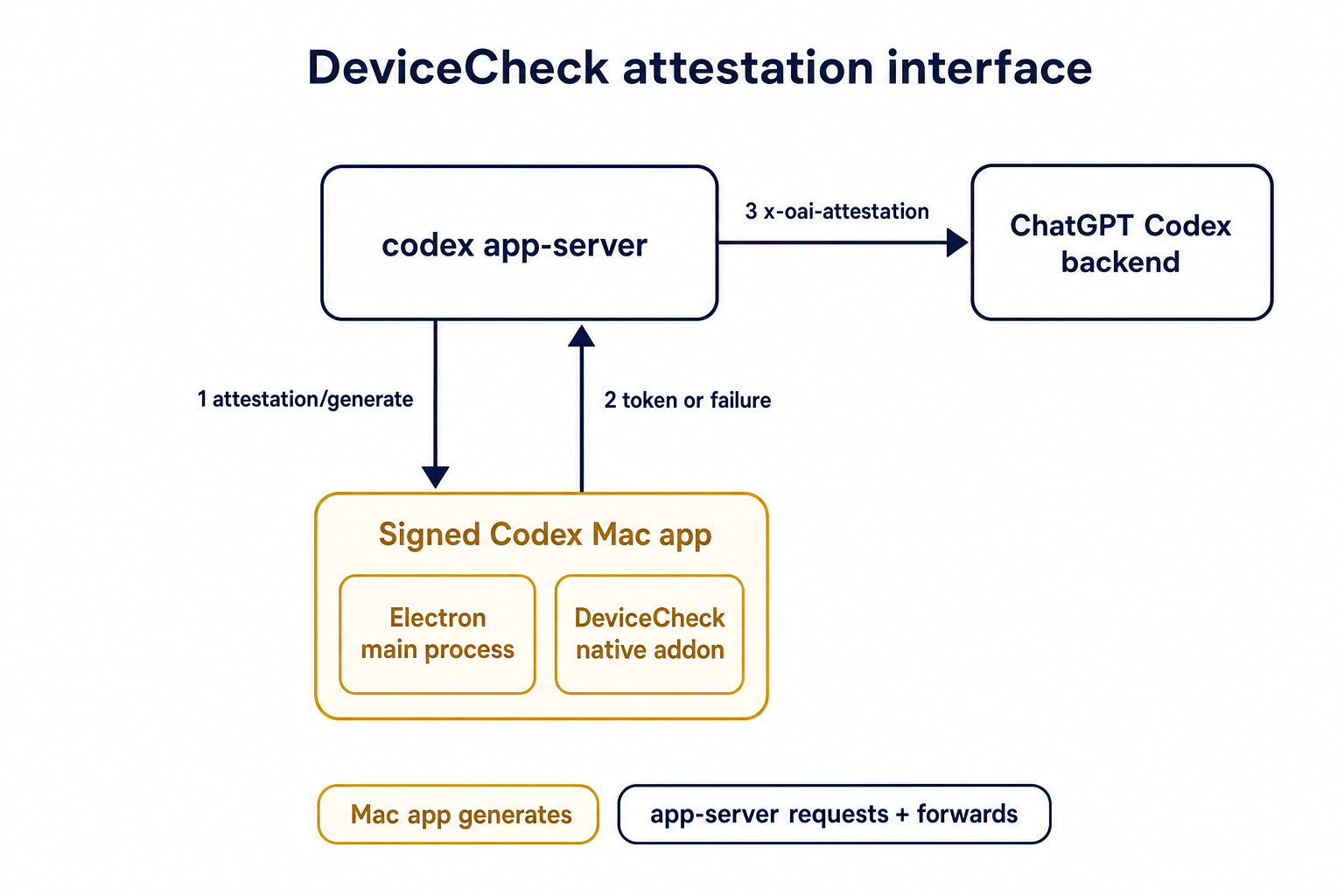
## Details
This PR teaches the Codex app-server runtime how to request and attach
an attestation token. It does not generate DeviceCheck tokens directly;
instead, it relies on the connected desktop app to advertise that it can
generate attestation and then asks that app for a fresh header value
when needed.
The flow is:
1. The Codex desktop app connects to app-server.
2. During `initialize`, the app can advertise that it supports
`requestAttestation`.
3. Before app-server calls selected ChatGPT Codex endpoints, it sends
the internal server request `attestation/generate` to the app.
4. app-server receives a pre-encoded header value back.
5. app-server forwards that value as `x-oai-attestation` on the scoped
outbound requests.
The code in this repo is mostly protocol and runtime plumbing: it adds
the app-server request/response shape, introduces an attestation
provider in core, wires that provider into Responses / compaction /
realtime setup paths, and covers the intended scoping with tests. The
signed macOS DeviceCheck generation remains owned by the desktop app PR.
## Related PR
- Codex desktop app implementation:
https://github.com/openai/openai/pull/878649
## Validation
<details>
<summary>Tests run</summary>
```sh
cargo test -p codex-app-server-protocol
cargo test -p codex-core attestation --lib
cargo test -p codex-app-server --lib attestation
```
Also ran:
```sh
just fix -p codex-core
just fix -p codex-app-server
just fix -p codex-app-server-protocol
just fmt
just write-app-server-schema
```
</details>
<details>
<summary>E2E DeviceCheck validation</summary>
First validated the signed desktop app boundary directly: launched a
packaged signed `Codex.app`, sent `attestation/generate`, decoded the
returned `v1.` attestation header, and validated the extracted
DeviceCheck token with `personal/jm/verify_devicecheck_token.py` using
bundle ID `com.openai.codex`. Apple returned `status_code: 200` and
`is_ok: true`.
Then ran the fuller app + app-server flow. The packaged `Codex.app`
launched a current-branch app-server via `CODEX_CLI_PATH`, and a local
MITM proxy intercepted outbound `chatgpt.com` traffic. The app-server
requested `attestation/generate` from the real Electron app process, and
the intercepted `/backend-api/codex/responses` traffic included
`x-oai-attestation` on both routes:
```text
GET /backend-api/codex/responses Upgrade: websocket x-oai-attestation: present
POST /backend-api/codex/responses Upgrade: none x-oai-attestation: present
```
The captured header decoded to a DeviceCheck token that also validated
with Apple for `com.openai.codex` (`status_code: 200`, `is_ok: true`,
team `2DC432GLL2`).
</details>
---------
Co-authored-by: Codex <noreply@openai.com>

