## Why

App-server logs can be persisted or included in submitted diagnostics, so credentials used by model providers, authentication refreshes, and attestation requests must not appear in diagnostic output.

## What changed

- Add `RedactedString`, which preserves serialization and string access while replacing debug output with `<redacted>`.
- Use it for model-provider bearer tokens, header and query values, authentication command arguments, and attestation tokens.
- Avoid logging JSON-RPC error payloads and parser or authentication errors that may echo credentials; retain safe context such as error codes and categories.

## Testing

- Add an app-server regression test that exercises provider credentials, refreshed authentication tokens, and attestation tokens, then verifies none appear in persisted SQLite or submitted diagnostic logs.

GitOrigin-RevId: 8c50408adf94d93847658b1320682cf3b637d2cc
## Why

Bedrock sessions that use the AWS SDK credential chain need a way to recover when credentials expire during a request.

## What changed

- Add `aws.auth_refresh` provider configuration with an `aws` command, arguments, and a configurable timeout.
- Run the command for refreshable Bedrock authentication failures, reload the SDK credentials, re-sign the request, and retry it.
- Share refresh state across matching provider configurations so concurrent failures invoke the command only once. Bearer tokens, command auth, and static environment credentials do not use this recovery path.

## Testing

- Add coverage for configuration validation, refreshable error classification, concurrent refresh sharing, and an end-to-end retry signed with refreshed credentials.

GitOrigin-RevId: 0302fe3aabdbc1097e7bd62a74d407ba38a3cc57
## What changed

- Add the built-in `amazon-bedrock-runtime` provider for regional
  `bedrock-runtime` OpenAI-compatible endpoints.
- Use endpoint-specific SigV4 service configuration while preserving bearer
  token auth and per-provider AWS profile, region, and transport overrides.
- Provide global and US cross-region GPT-5.6 model variants, prefer global
  routing for fallback and background tasks, and disable unsupported web search.

## Testing

- Cover provider configuration and capabilities, endpoint and auth selection,
  runtime catalog ordering, model fallback, and web search omission.

GitOrigin-RevId: d158ab74a5768e1b4c61063365a0c06735313322
## What changed

- Add provider-owned remote compaction capabilities for unsupported, v1, and v2 protocols.
- Mark Amazon Bedrock as v1-only so manual and automatic compaction use `/v1/responses/compact`, even when the v2 feature is enabled.
- Preserve v2 support for OpenAI and Azure Responses providers and local compaction for unsupported providers.

## Testing

- Cover Amazon Bedrock manual and automatic remote compaction, including endpoint selection, authentication headers, model selection, and reuse of the compacted summary.

GitOrigin-RevId: d58093178605d1f8155b93d9a161408177f6ac72
## What changed

- Add the `supports_standalone_web_search` model-provider setting, defaulting to `false`, and preserve it in remote thread configuration.
- Enable the standalone `web.run` tool for opted-in custom Responses providers when web search is enabled and the runtime provider supports it.
- Send standalone search requests through the custom provider's endpoint and authentication.

## Testing

- Cover opt-in, default-off, disabled-search, and unsupported-provider behavior.
- Verify custom-provider search request routing and authorization through the app server.

GitOrigin-RevId: 7c5f96b0ce924ad2b9715c45bfc635e89fc39cff
## What changed

- Allow the built-in `amazon-bedrock` provider to override `base_url`, `auth`,
  and `http_headers` in addition to its AWS profile and region.
- Use command-based bearer authentication and configured endpoints without
  applying AWS request signing, while retaining regional endpoint resolution
  for the default Bedrock configuration.
- Replace the Bedrock account `credentialSource` enum with the
  `usesCodexManagedCredentials` boolean so command-authenticated and other
  externally managed configurations are reported consistently.

## Testing

- Cover configuration merging and validation, command-authenticated proxy
  requests with custom headers, and account reporting for managed and external
  credentials.

GitOrigin-RevId: d1acbe602060470583b5e12f8d304bee5be46f4c
## Summary

- add Sol (`openai.gpt-5.6-sol`), Terra (`openai.gpt-5.6-terra`), and
Luna (`openai.gpt-5.6-luna`) to the Amazon Bedrock static model catalog
- derive all three entries from the bundled GPT-5.5 metadata and add the
Bedrock-only `max` reasoning effort
- keep the new entries below the current GPT-5.5 and GPT-5.4 models at
priorities 2, 3, and 4, preserving GPT-5.5 as the default
- add deep-equality coverage for inherited model configuration, catalog
ordering, context windows, and service-tier behavior
## Summary

- allow the standalone image-generation and web-search extensions for
the actor-authorized provider shape used by CCA
- preserve builtin `image_generation` and `web_search` for older models
and existing flows
- keep ordinary non-OpenAI providers excluded from both extensions
- remove only the image extension local managed-AuthManager requirement
that CCA cannot satisfy
- share actor-authorization detection through `ModelProviderInfo`
- keep Core tests focused on routing behavior and cover header-shape
edge cases in `model-provider-info`
- add a Responses Lite regression that verifies both
`image_gen.imagegen` and `web.run`

## Why

CCA uses a provider named `local` with `requires_openai_auth: false` and
a non-empty `x-openai-actor-authorization` header. Core accepts that
provider shape, but both extension provider-name gates rejected it;
image generation additionally required a Codex-managed login.

The standalone paths must coexist with existing builtin tools. New
Responses Lite models can receive `image_gen.imagegen` and `web.run`,
while older models continue using builtin tools.

## Impact

This enables both standalone extensions for CCA once installed
downstream, without removing or changing builtin-tool compatibility for
older models.

## Validation

- `just test -p codex-core
responses_lite_exposes_standalone_tools_for_actor_authorized_provider`
- `just test -p codex-core
responses_lite_uses_standalone_web_search_and_image_generation`
- `just test -p codex-core
hosted_tools_follow_provider_auth_model_and_config_gates`
- `just test -p codex-image-generation-extension`
- `just test -p codex-web-search-extension`
- `just test -p codex-model-provider-info`
- `just fmt`
- `git diff --check`
## Why

Authentication mode is a domain concept used by login, model selection,
telemetry, and transports. Keeping the canonical type in app-server
protocol forces those lower-level crates to depend on an unrelated wire
API.

## What changed

- Added canonical `codex_protocol::auth::AuthMode` domain values.
- Kept the app-server wire DTO unchanged and added an explicit app-side
conversion.
- Removed production app-server-protocol dependencies from login,
model-provider-info, models-manager, and otel call paths.

## Stack

This is PR 2 of 6, stacked on [PR
#29714](https://github.com/openai/codex/pull/29714). Review only the
delta from `codex/split-json-rpc-protocols`. Next: [PR
#29722](https://github.com/openai/codex/pull/29722).

## Validation

- Auth and login coverage passed in the focused protocol/domain test
run.
- App-server account and auth conversion coverage passed.
## Summary

- add v2 personal access token support for `codex login
--with-access-token` and `CODEX_ACCESS_TOKEN`
- classify opaque `at-` tokens separately from legacy Agent Identity
JWTs
- hydrate required ChatGPT account metadata through AuthAPI
`/v1/user-auth-credential/whoami`
- use PATs directly as bearer tokens while preserving existing ChatGPT
account surfaces
- expose PAT-backed auth as the explicit `personalAccessToken`
app-server auth mode

## Implementation

PAT auth is intentionally small and stateless. Loading a PAT performs
one AuthAPI metadata request, stores the hydrated metadata in the
in-memory auth object, and redacts the secret from debug output. Legacy
Agent Identity JWT handling remains unchanged. The shared access-token
classifier lives in a private neutral module because it dispatches
between both credential types.

PAT hydration fails closed when AuthAPI omits any required metadata,
including email. Hydrated metadata is intentionally not persisted:
startup performs a live `whoami` preflight so revoked tokens or changed
account metadata are not accepted from a stale cache.

## Workspace restriction scope

This change intentionally does **not** apply
`forced_chatgpt_workspace_id` to PAT authentication. The setting is a
client-side config guardrail, not an authorization boundary, and PAT
does not currently require workspace-ID parity. The PAT login and
`CODEX_ACCESS_TOKEN` paths therefore validate through AuthAPI without
threading workspace-restriction state through access-token loading.
Existing workspace checks for non-PAT auth remain on their established
paths.

## App-server compatibility

The public app-server `AuthMode` is shared across v1 and v2, and
PAT-backed auth reports `personalAccessToken` through both APIs.
Following human review, this intentionally removes the temporary v1
compatibility mapping that reported PATs as `chatgpt`; the deprecated v1
API is kept in parity with v2 rather than maintaining a separate closed
enum. Clients with exhaustive auth-mode handling in either API version
must add the new case and should generally treat it as ChatGPT-backed
unless they need PAT-specific behavior.

The v1 auth-status response still omits the raw PAT when `includeToken`
is requested because that response cannot carry the account metadata
needed to reuse the credential safely. Persisted PAT auth also omits the
new enum value so older Codex builds can deserialize `auth.json` and
infer PAT auth from the credential field after a rollback.

## Validation

Latest review-fix validation:

- `CARGO_INCREMENTAL=0 just test -p codex-login` (126 passed)
- `CARGO_INCREMENTAL=0 just test -p codex-cli` (263 passed)
- `CARGO_INCREMENTAL=0 just test -p codex-cli
stored_auth_validation_handles_personal_access_token`
- `CARGO_INCREMENTAL=0 just test -p codex-app-server-protocol` (226
passed)
- `CARGO_INCREMENTAL=0 just test -p codex-models-manager
refresh_available_models_uses_remote_only_catalog_for_chatgpt_auth`
- `CARGO_INCREMENTAL=0 just test -p codex-tui
existing_non_oauth_chatgpt_login_counts_as_signed_in`
- `CARGO_INCREMENTAL=0 just fix -p codex-login -p
codex-app-server-protocol -p codex-models-manager -p codex-tui -p
codex-cli`
- `just fmt`
- `git diff --check`

The broader `codex-tui` suite previously compiled and ran 2,834 tests.
Three unrelated environment-sensitive guardian/IDE-socket tests failed
after retries; the PAT-relevant TUI coverage passed.
## Summary

Amazon Bedrock should expose GPT-5.5 alongside GPT-5.4, and the Bedrock
GPT entries should stay aligned with the canonical bundled OpenAI model
metadata instead of carrying a separate hand-written copy that can drift
over time. This change will be merged when the model is online.

This change:

- Adds the Bedrock Mantle model id for `openai.gpt-5.5`.
- Builds the Bedrock GPT-5.5 and GPT-5.4 catalog entries from the
bundled OpenAI model catalog, then overrides the Bedrock-facing slug,
explicit priority, and Bedrock-specific context windows.
- Hardcodes both `context_window` and `max_context_window` to `272000`
for Bedrock GPT-5.5 and GPT-5.4.
- Keeps `openai.gpt-5.5` as the default Bedrock model ahead of
`openai.gpt-5.4` and the Bedrock OSS models.
## Why

Guardian review selection was hard-coded in `core`, which worked for the
default OpenAI path but did not give provider implementations a way to
choose backend-specific reviewer model IDs. That matters for Amazon
Bedrock: guardian review should run through the Bedrock/Mantle provider
using Bedrock's `openai.gpt-5.4` model ID, instead of accidentally
selecting a reviewer model that implies the OpenAI backend.

## What Changed

- Added provider-owned approval review model selection via
`ModelProvider::approval_review_model_selection`.
- Moved the existing default selection policy into the provider
abstraction: prefer the requested reviewer model when it is available,
otherwise fall back to the active turn model, preferring `Low` reasoning
when supported.
- Added an Amazon Bedrock override that pins guardian review to
`openai.gpt-5.4` with `Low` reasoning.
## Why

Amazon Bedrock Mantle needs a stable client-agent header so requests
from the built-in Bedrock provider can be identified as coming from
Codex for safety stack.

## What changed

- Added `x-amzn-mantle-client-agent: codex` to the built-in Amazon
Bedrock provider default HTTP headers.
## Summary
TL;DR: teaches `codex-rs` / app-server to request a desktop-provided
attestation token and attach it as `x-oai-attestation` on the scoped
ChatGPT Codex request paths.
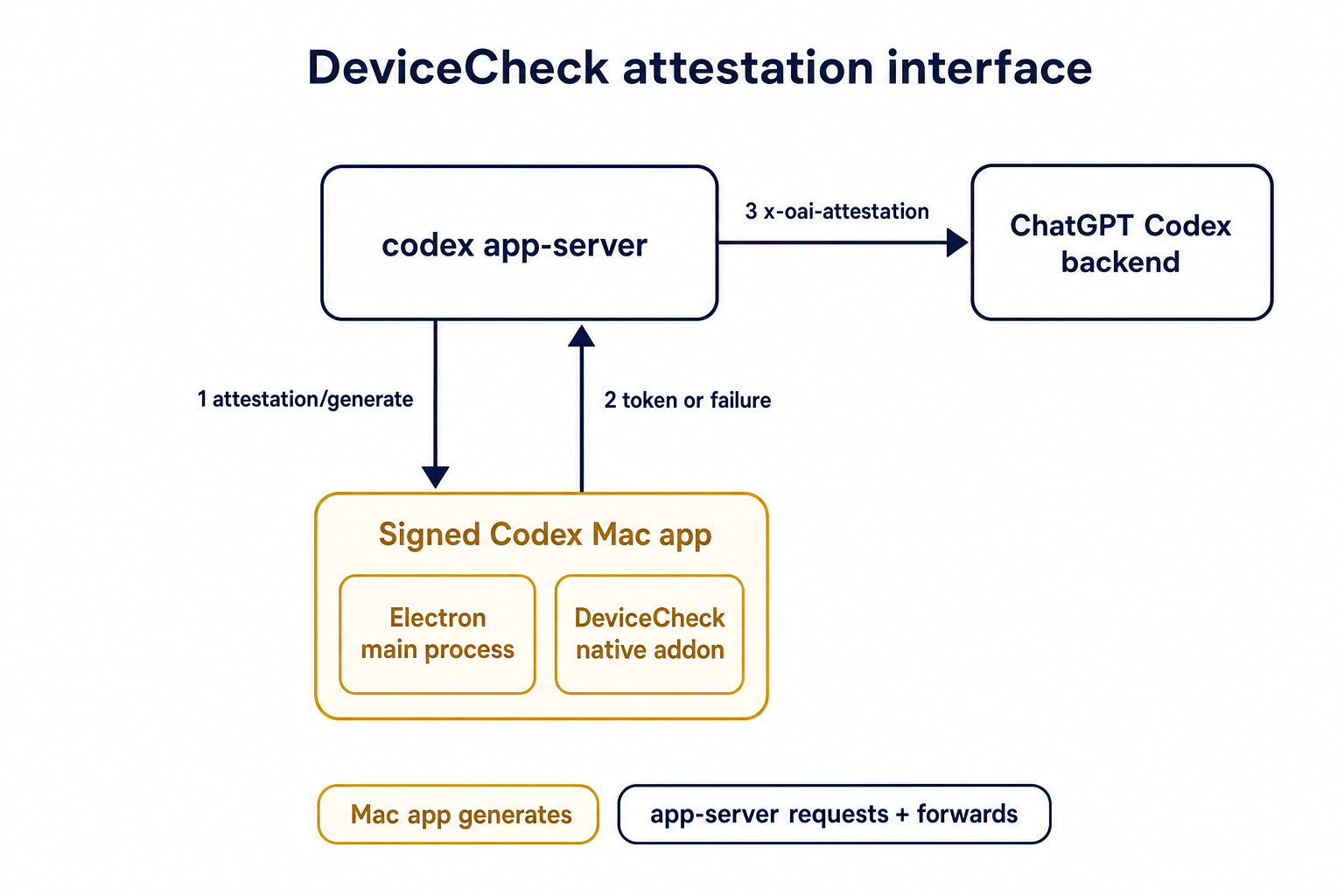
## Details
This PR teaches the Codex app-server runtime how to request and attach
an attestation token. It does not generate DeviceCheck tokens directly;
instead, it relies on the connected desktop app to advertise that it can
generate attestation and then asks that app for a fresh header value
when needed.
The flow is:
1. The Codex desktop app connects to app-server.
2. During `initialize`, the app can advertise that it supports
`requestAttestation`.
3. Before app-server calls selected ChatGPT Codex endpoints, it sends
the internal server request `attestation/generate` to the app.
4. app-server receives a pre-encoded header value back.
5. app-server forwards that value as `x-oai-attestation` on the scoped
outbound requests.
The code in this repo is mostly protocol and runtime plumbing: it adds
the app-server request/response shape, introduces an attestation
provider in core, wires that provider into Responses / compaction /
realtime setup paths, and covers the intended scoping with tests. The
signed macOS DeviceCheck generation remains owned by the desktop app PR.
## Related PR
- Codex desktop app implementation:
https://github.com/openai/openai/pull/878649
## Validation
<details>
<summary>Tests run</summary>
```sh
cargo test -p codex-app-server-protocol
cargo test -p codex-core attestation --lib
cargo test -p codex-app-server --lib attestation
```
Also ran:
```sh
just fix -p codex-core
just fix -p codex-app-server
just fix -p codex-app-server-protocol
just fmt
just write-app-server-schema
```
</details>
<details>
<summary>E2E DeviceCheck validation</summary>
First validated the signed desktop app boundary directly: launched a
packaged signed `Codex.app`, sent `attestation/generate`, decoded the
returned `v1.` attestation header, and validated the extracted
DeviceCheck token with `personal/jm/verify_devicecheck_token.py` using
bundle ID `com.openai.codex`. Apple returned `status_code: 200` and
`is_ok: true`.
Then ran the fuller app + app-server flow. The packaged `Codex.app`
launched a current-branch app-server via `CODEX_CLI_PATH`, and a local
MITM proxy intercepted outbound `chatgpt.com` traffic. The app-server
requested `attestation/generate` from the real Electron app process, and
the intercepted `/backend-api/codex/responses` traffic included
`x-oai-attestation` on both routes:
```text
GET /backend-api/codex/responses Upgrade: websocket x-oai-attestation: present
POST /backend-api/codex/responses Upgrade: none x-oai-attestation: present
```
The captured header decoded to a DeviceCheck token that also validated
with Apple for `com.openai.codex` (`status_code: 200`, `is_ok: true`,
team `2DC432GLL2`).
</details>
---------
Co-authored-by: Codex <noreply@openai.com>
## Summary

Amazon Bedrock Mantle's OpenAI-compatible endpoint now lives under
`/openai/v1`, and the GPT-5.4 Mantle model ID no longer uses the `-cmb`
suffix. This updates Codex's built-in Bedrock provider configuration so
generated providers and the static Bedrock catalog use the current
endpoint and model ID.

## Changes

- Update the Bedrock Mantle base URL from
`https://bedrock-mantle.{region}.api.aws/v1` to
`https://bedrock-mantle.{region}.api.aws/openai/v1`.
- Update the Amazon Bedrock default base URL in
`codex-model-provider-info`.
- Change the Bedrock GPT-5.4 catalog slug from `openai.gpt-5.4-cmb` to
`openai.gpt-5.4`.
- Align provider and catalog tests with the new URL and model ID.

## Test Plan

- Manual smoke test:

  ```shell
  target/debug/codex \
      -m openai.gpt-5.4 \
      -c 'model_provider="amazon-bedrock"' \
      -c 'model_providers.amazon-bedrock.aws.region="us-west-2"'
  ```
## Summary

This PR adds `CodexAuth::AgentIdentity` as an explicit auth mode.

An AgentIdentity auth record is a standalone `auth.json` mode. When
`AuthManager::auth().await` loads that mode, it registers one
process-scoped task and stores it in runtime-only state on the auth
value. Header creation stays synchronous after that because the task is
initialized before callers receive the auth object.

This PR also removes the old feature flag path. AgentIdentity is
selected by explicit auth mode, not by a hidden flag or lazy mutation of
ChatGPT auth records.

Reference old stack: https://github.com/openai/codex/pull/17387/changes

## Design Decisions

- AgentIdentity is a real auth enum variant because it can be the only
credential in `auth.json`.
- The process task is ephemeral runtime state. It is not serialized and
is not stored in rollout/session data.
- Account/user metadata needed by existing Codex backend checks lives on
the AgentIdentity record for now.
- `is_chatgpt_auth()` remains token-specific.
- `uses_codex_backend()` is the broader predicate for ChatGPT-token auth
and AgentIdentity auth.

## Stack

1. https://github.com/openai/codex/pull/18757: full revert
2. https://github.com/openai/codex/pull/18871: isolated Agent Identity
crate
3. This PR: explicit AgentIdentity auth mode and startup task allocation
4. https://github.com/openai/codex/pull/18811: migrate Codex backend
auth callsites through AuthProvider
5. https://github.com/openai/codex/pull/18904: accept AgentIdentity JWTs
and load `CODEX_AGENT_IDENTITY`

## Testing

Tests: targeted Rust checks, cargo-shear, Bazel lock check, and CI.
## Summary

Add first-class Amazon Bedrock Mantle provider support so Codex can keep
using its existing Responses API transport with OpenAI-compatible
AWS-hosted endpoints such as AOA/Mantle.

This is needed for the AWS launch path, where provider traffic should
authenticate with AWS credentials instead of OpenAI bearer credentials.
Requests are authenticated immediately before transport send, so SigV4
signs the final method, URL, headers, and body bytes that `reqwest` will
send.

## What Changed

- Added a new `codex-aws-auth` crate for loading AWS SDK config,
resolving credentials, and signing finalized HTTP requests with AWS
SigV4.
- Added a built-in `amazon-bedrock` provider that targets Bedrock Mantle
Responses endpoints, defaults to `us-east-1`, supports region/profile
overrides, disables WebSockets, and does not require OpenAI auth.
- Added Amazon Bedrock auth resolution in `codex-model-provider`: prefer
`AWS_BEARER_TOKEN_BEDROCK` when set, otherwise use AWS SDK credentials
and SigV4 signing.
- Added `AuthProvider::apply_auth` and `Request::prepare_body_for_send`
so request-signing providers can sign the exact outbound request after
JSON serialization/compression.
- Determine the region by taking the `aws.region` config first (required
for bearer token codepath), and fallback to SDK default region.

## Testing
Amazon Bedrock Mantle Responses paths:

- Built the local Codex binary with `cargo build`.
- Verified the custom proxy-backed `aws` provider using `env_key =
"AWS_BEARER_TOKEN_BEDROCK"` streamed raw `responses` output with
`response.output_text.delta`, `response.completed`, and `mantle-env-ok`.
- Verified a full `codex exec --profile aws` turn returned
`mantle-env-ok`.
- Confirmed the custom provider used the bearer env var, not AWS profile
auth: bogus `AWS_PROFILE` still passed, empty env var failed locally,
and malformed env var reached Mantle and failed with `401
invalid_api_key`.
- Verified built-in `amazon-bedrock` with `AWS_BEARER_TOKEN_BEDROCK` set
passed despite bogus AWS profiles, returning `amazon-bedrock-env-ok`.
- Verified built-in `amazon-bedrock` SDK/SigV4 auth passed with
`AWS_BEARER_TOKEN_BEDROCK` unset and temporary AWS session env
credentials, returning `amazon-bedrock-sdk-env-ok`.
## Why

Codex needs a first-class `amazon-bedrock` model provider so users can
select Bedrock without copying a full provider definition into
`config.toml`. The provider has Codex-owned defaults for the pieces that
should stay consistent across users: the display `name`, Bedrock
`base_url`, and `wire_api`.

At the same time, users still need a way to choose the AWS credential
profile used by their local environment. This change makes
`amazon-bedrock` a partially modifiable built-in provider: code owns the
provider identity and endpoint defaults, while user config can set
`model_providers.amazon-bedrock.aws.profile`.

For example:

```toml
model_provider = "amazon-bedrock"

[model_providers.amazon-bedrock.aws]
profile = "codex-bedrock"
```

## What Changed

- Added `amazon-bedrock` to the built-in model provider map with:
  - `name = "Amazon Bedrock"`
  - `base_url = "https://bedrock-mantle.us-east-1.api.aws/v1"`
  - `wire_api = "responses"`
- Added AWS provider auth config with a profile-only shape:
`model_providers.<id>.aws.profile`.
- Kept AWS auth config restricted to `amazon-bedrock`; custom providers
that set `aws` are rejected.
- Allowed `model_providers.amazon-bedrock` through reserved-provider
validation so it can act as a partial override.
- During config loading, only `aws.profile` is copied from the
user-provided `amazon-bedrock` entry onto the built-in provider. Other
Bedrock provider fields remain hard-coded by the built-in definition.
- Updated the generated config schema for the new provider AWS profile
config.
Azure Responses providers were still falling back to local compaction
because the compaction gate only checked
`ModelProviderInfo::is_openai()`.
Move the capability check onto `ModelProviderInfo` with
`supports_remote_compaction()`, backed by the existing Azure Responses
endpoint detection used in `codex-api`, and have `core::compact`
delegate to that helper.
Add regression coverage for:
- OpenAI providers using remote compaction
- Azure providers using remote compaction
- non-OpenAI/non-Azure providers staying on the local path
resolves#17773
---------
Co-authored-by: Michael Bolin <mbolin@openai.com>
## Summary
- reduce public module visibility across Rust crates, preferring private
or crate-private modules with explicit crate-root public exports
- update external call sites and tests to use the intended public crate
APIs instead of reaching through module trees
- add the module visibility guideline to AGENTS.md

## Validation
- `cargo check --workspace --all-targets --message-format=short` passed
before the final fix/format pass
- `just fix` completed successfully
- `just fmt` completed successfully
- `git diff --check` passed
## Summary
- split `models-manager` out of `core` and add `ModelsManagerConfig`
plus `Config::to_models_manager_config()` so model metadata paths stop
depending on `core::Config`
- move login-owned/auth-owned code out of `core` into `codex-login`,
move model provider config into `codex-model-provider-info`, move API
bridge mapping into `codex-api`, move protocol-owned types/impls into
`codex-protocol`, and move response debug helpers into a dedicated
`response-debug-context` crate
- move feedback tag emission into `codex-feedback`, relocate tests to
the crates that now own the code, and keep broad temporary re-exports so
this PR avoids a giant import-only rewrite

## Major moves and decisions
- created `codex-models-manager` as the owner for model
cache/catalog/config/model info logic, including the new
`ModelsManagerConfig` struct
- created `codex-model-provider-info` as the owner for provider config
parsing/defaults and kept temporary `codex-login`/`codex-core`
re-exports for old import paths
- moved `api_bridge` error mapping + `CoreAuthProvider` into
`codex-api`, while `codex-login::api_bridge` temporarily re-exports
those symbols and keeps the `auth_provider_from_auth` wrapper
- moved `auth_env_telemetry` and `provider_auth` ownership to
`codex-login`
- moved `CodexErr` ownership to `codex-protocol::error`, plus
`StreamOutput`, `bytes_to_string_smart`, and network policy helpers to
protocol-owned modules
- created `codex-response-debug-context` for
`extract_response_debug_context`, `telemetry_transport_error_message`,
and related response-debug plumbing instead of leaving that behavior in
`core`
- moved `FeedbackRequestTags`, `emit_feedback_request_tags`, and
`emit_feedback_request_tags_with_auth_env` to `codex-feedback`
- deferred removal of temporary re-exports and the mechanical import
rewrites to a stacked follow-up PR so this PR stays reviewable

## Test moves
- moved auth refresh coverage from `core/tests/suite/auth_refresh.rs` to
`login/tests/suite/auth_refresh.rs`
- moved text encoding coverage from
`core/tests/suite/text_encoding_fix.rs` to
`protocol/src/exec_output_tests.rs`
- moved model info override coverage from
`core/tests/suite/model_info_overrides.rs` to
`models-manager/src/model_info_overrides_tests.rs`

---------

Co-authored-by: Codex <noreply@openai.com>

