## Why

This finishes the config-type move out of `codex-core` by removing the
temporary compatibility shim in `codex_core::config::types`. Callers now
depend on `codex-config` directly, which keeps these config model types
owned by the config crate instead of re-expanding `codex-core` as a
transitive API surface.

## What Changed

- Removed the `codex-rs/core/src/config/types.rs` re-export shim and the
`core::config::ApprovalsReviewer` re-export.
- Updated `codex-core`, `codex-cli`, `codex-tui`, `codex-app-server`,
`codex-mcp-server`, and `codex-linux-sandbox` call sites to import
`codex_config::types` directly.
- Added explicit `codex-config` dependencies to downstream crates that
previously relied on the `codex-core` re-export.
- Regenerated `codex-rs/core/config.schema.json` after updating the
config docs path reference.
## Why

`codex-core` was re-exporting APIs owned by sibling `codex-*` crates,
which made downstream crates depend on `codex-core` as a proxy module
instead of the actual owner crate.

Removing those forwards makes crate boundaries explicit and lets leaf
crates drop unnecessary `codex-core` dependencies. In this PR, this
reduces the dependency on `codex-core` to `codex-login` in the following
files:

```
codex-rs/backend-client/Cargo.toml
codex-rs/mcp-server/tests/common/Cargo.toml
```

## What

- Remove `codex-rs/core/src/lib.rs` re-exports for symbols owned by
`codex-login`, `codex-mcp`, `codex-rollout`, `codex-analytics`,
`codex-protocol`, `codex-shell-command`, `codex-sandboxing`,
`codex-tools`, and `codex-utils-path`.
- Delete the `default_client` forwarding shim in `codex-rs/core`.
- Update in-crate and downstream callsites to import directly from the
owning `codex-*` crate.
- Add direct Cargo dependencies where callsites now target the owner
crate, and remove `codex-core` from `codex-rs/backend-client`.
Preserve the watchdog runtime and prompt behavior on top of the refreshed inbox branch and collapse the branch back to a single commit for easier future restacks.

Co-authored-by: Codex <noreply@openai.com>
Preserve the auto-unarchive-on-resume behavior while keeping archived-session lookup safe. This carries the rollout lookup hardening, the resume path updates, and the cross-platform guardian/TUI test fixes needed for current CI.
## Why

`argument-comment-lint` was green in CI even though the repo still had
many uncommented literal arguments. The main gap was target coverage:
the repo wrapper did not force Cargo to inspect test-only call sites, so
examples like the `latest_session_lookup_params(true, ...)` tests in
`codex-rs/tui_app_server/src/lib.rs` never entered the blocking CI path.

This change cleans up the existing backlog, makes the default repo lint
path cover all Cargo targets, and starts rolling that stricter CI
enforcement out on the platform where it is currently validated.

## What changed

- mechanically fixed existing `argument-comment-lint` violations across
the `codex-rs` workspace, including tests, examples, and benches
- updated `tools/argument-comment-lint/run-prebuilt-linter.sh` and
`tools/argument-comment-lint/run.sh` so non-`--fix` runs default to
`--all-targets` unless the caller explicitly narrows the target set
- fixed both wrappers so forwarded cargo arguments after `--` are
preserved with a single separator
- documented the new default behavior in
`tools/argument-comment-lint/README.md`
- updated `rust-ci` so the macOS lint lane keeps the plain wrapper
invocation and therefore enforces `--all-targets`, while Linux and
Windows temporarily pass `-- --lib --bins`

That temporary CI split keeps the stricter all-targets check where it is
already cleaned up, while leaving room to finish the remaining Linux-
and Windows-specific target-gated cleanup before enabling
`--all-targets` on those runners. The Linux and Windows failures on the
intermediate revision were caused by the wrapper forwarding bug, not by
additional lint findings in those lanes.

## Validation

- `bash -n tools/argument-comment-lint/run.sh`
- `bash -n tools/argument-comment-lint/run-prebuilt-linter.sh`
- shell-level wrapper forwarding check for `-- --lib --bins`
- shell-level wrapper forwarding check for `-- --tests`
- `just argument-comment-lint`
- `cargo test` in `tools/argument-comment-lint`
- `cargo test -p codex-terminal-detection`

## Follow-up

- Clean up remaining Linux-only target-gated callsites, then switch the
Linux lint lane back to the plain wrapper invocation.
- Clean up remaining Windows-only target-gated callsites, then switch
the Windows lint lane back to the plain wrapper invocation.
## Problem

App-server clients could only initiate ChatGPT login through the browser
callback flow, even though the shared login crate already supports
device-code auth. That left VS Code, Codex App, and other app-server
clients without a first-class way to use the existing device-code
backend when browser redirects are brittle or when the client UX wants
to own the login ceremony.

## Mental model

This change adds a second ChatGPT login start path to app-server:
clients can now call `account/login/start` with `type:
"chatgptDeviceCode"`. App-server immediately returns a `loginId` plus
the device-code UX payload (`verificationUrl` and `userCode`), then
completes the login asynchronously in the background using the existing
`codex_login` polling flow. Successful device-code login still resolves
to ordinary `chatgpt` auth, and completion continues to flow through the
existing `account/login/completed` and `account/updated` notifications.

## Non-goals

This does not introduce a new auth mode, a new account shape, or a
device-code eligibility discovery API. It also does not add automatic
fallback to browser login in core; clients remain responsible for
choosing when to request device code and whether to retry with a
different UX if the backend/admin policy rejects it.

## Tradeoffs

We intentionally keep `login_chatgpt_common` as a local validation
helper instead of turning it into a capability probe. Device-code
eligibility is checked by actually calling `request_device_code`, which
means policy-disabled cases surface as an immediate request error rather
than an async completion event. We also keep the active-login state
machine minimal: browser and device-code logins share the same public
cancel contract, but device-code cancellation is implemented with a
local cancel token rather than a larger cross-crate refactor.

## Architecture

The protocol grows a new `chatgptDeviceCode` request/response variant in
app-server v2. On the server side, the new handler reuses the existing
ChatGPT login precondition checks, calls `request_device_code`, returns
the device-code payload, and then spawns a background task that waits on
either cancellation or `complete_device_code_login`. On success, it
reuses the existing auth reload and cloud-requirements refresh path
before emitting `account/login/completed` success and `account/updated`.
On failure or cancellation, it emits only `account/login/completed`
failure. The existing `account/login/cancel { loginId }` contract
remains unchanged and now works for both browser and device-code
attempts.


## Tests

Added protocol serialization coverage for the new request/response
variant, plus app-server tests for device-code success, failure, cancel,
and start-time rejection behavior. Existing browser ChatGPT login
coverage remains in place to show that the callback-based flow is
unchanged.
## Summary
This change adds websocket authentication at the app-server transport
boundary and enforces it before JSON-RPC `initialize`, so authenticated
deployments reject unauthenticated clients during the websocket
handshake rather than after a connection has already been admitted.

During rollout, websocket auth is opt-in for non-loopback listeners so
we do not break existing remote clients. If `--ws-auth ...` is
configured, the server enforces auth during websocket upgrade. If auth
is not configured, non-loopback listeners still start, but app-server
logs a warning and the startup banner calls out that auth should be
configured before real remote use.

The server supports two auth modes: a file-backed capability token, and
a standard HMAC-signed JWT/JWS bearer token verified with the
`jsonwebtoken` crate, with optional issuer, audience, and clock-skew
validation. Capability tokens are normalized, hashed, and compared in
constant time. Short shared secrets for signed bearer tokens are
rejected at startup. Requests carrying an `Origin` header are rejected
with `403` by transport middleware, and authenticated clients present
credentials as `Authorization: Bearer <token>` during websocket upgrade.

## Validation
- `cargo test -p codex-app-server transport::auth`
- `cargo test -p codex-cli app_server_`
- `cargo clippy -p codex-app-server --all-targets -- -D warnings`
- `just bazel-lock-check`

Note: in the broad `cargo test -p codex-app-server
connection_handling_websocket` run, the touched websocket auth cases
passed, but unrelated Unix shutdown tests failed with a timeout in this
environment.

---------

Co-authored-by: Eric Traut <etraut@openai.com>
### Summary
Add the v2 app-server filesystem watch RPCs and notifications, wire them
through the message processor, and implement connection-scoped watches
with notify-backed change delivery. This also updates the schema
fixtures, app-server documentation, and the v2 integration coverage for
watch and unwatch behavior.

This allows clients to efficiently watch for filesystem updates, e.g. to
react on branch changes.

### Testing
- exercise watch lifecycles for directory changes, atomic file
replacement, missing-file targets, and unwatch cleanup
- create `codex-git-utils` and move the shared git helpers into it with
file moves preserved for diff readability
- move the `GitInfo` helpers out of `core` so stacked rollout work can
depend on the shared crate without carrying its own git info module

---------

Co-authored-by: Ahmed Ibrahim <219906144+aibrahim-oai@users.noreply.github.com>
Co-authored-by: Codex <noreply@openai.com>
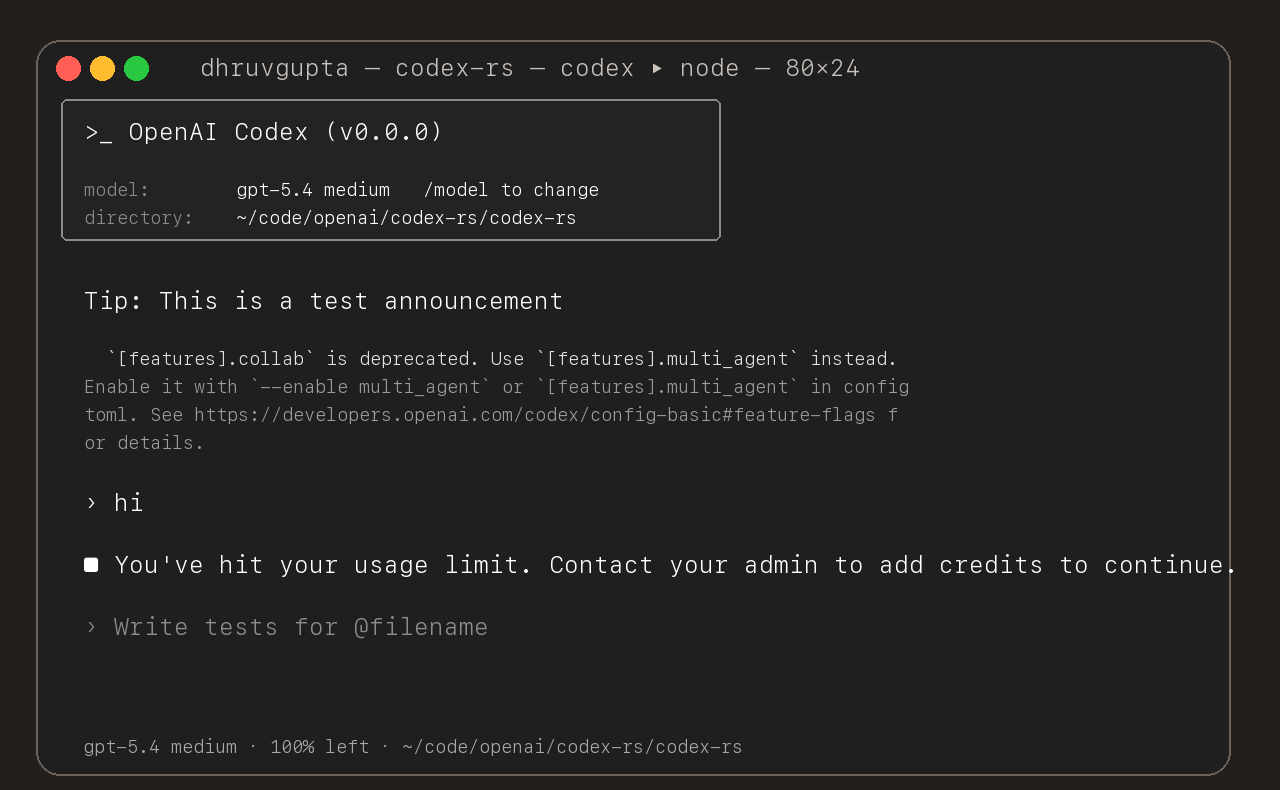
## Summary
- update the self-serve business usage-based limit message to direct
users to their admin for additional credits
- add a focused unit test for the self_serve_business_usage_based plan
branch
Added also:
If you are at a rate limit but you still have credits, codex cli would
tell you to switch the model. We shouldnt do this if you have credits so
fixed this.
## Test
- launched the source-built CLI and verified the updated message is
shown for the self-serve business usage-based plan
## Summary
- add `ForkSnapshotMode` to `ThreadManager::fork_thread` so callers can
request either a committed snapshot or an interrupted snapshot
- share the model-visible `<turn_aborted>` history marker between the
live interrupt path and interrupted forks
- update the small set of direct fork callsites to pass
`ForkSnapshotMode::Committed`

Note: this enables /btw to work similarly as Esc to interrupt (hopefully
somewhat in distribution)

---------

Co-authored-by: Codex <noreply@openai.com>
- emit a typed `thread/realtime/transcriptUpdated` notification from
live realtime transcript deltas
- expose that notification as flat `threadId`, `role`, and `text` fields
instead of a nested transcript array
- continue forwarding raw `handoff_request` items on
`thread/realtime/itemAdded`, including the accumulated
`active_transcript`
- update app-server docs, tests, and generated protocol schema artifacts
to match the delta-based payloads

---------

Co-authored-by: Codex <noreply@openai.com>
This PR add an URI-based system to reference agents within a tree. This
comes from a sync between research and engineering.

The main agent (the one manually spawned by a user) is always called
`/root`. Any sub-agent spawned by it will be `/root/agent_1` for example
where `agent_1` is chosen by the model.

Any agent can contact any agents using the path.

Paths can be used either in absolute or relative to the calling agents

Resume is not supported for now on this new path
- Split the feature system into a new `codex-features` crate.
- Cut `codex-core` and workspace consumers over to the new config and
warning APIs.

Co-authored-by: Ahmed Ibrahim <219906144+aibrahim-oai@users.noreply.github.com>
Co-authored-by: Codex <noreply@openai.com>

