## Description

This PR adds a new `historyMode = "legacy" | "paginated"` to `Thread`.
This will be stored in `SessionMeta` in the JSONL rollout file and as a
new column in the SQLite thread_metadata table, and exposed on
`thread/start` and on the `Thread` object in app-server.

## What changed

- Added canonical `ThreadHistoryMode` with `legacy` and `paginated`,
defaulting old and new SessionMeta to `legacy`.
- Carried `history_mode` through core session config, ThreadStore stored
metadata, local/in-memory stores, rollout metadata extraction, and the
existing SQLite `threads` table.
- Added experimental `historyMode` to app-server v2 `Thread` and
`thread/start`.
- Made paginated stored threads metadata-discoverable but unsupported
for legacy full-history reads, `load_history`, live resume, and create
paths.
- Regenerated app-server schema fixtures and added
protocol/state/thread-store/app-server coverage for persistence and
fail-closed behavior.

## Compatibility floor
Because users may be running various versions of Codex binaries on the
same machine (TUI, Codex App, etc.), we will need to establish a
compatibility floor for upcoming paginated threads, which will change
how thread storage reads and writes work.

The overall plan here:
```
Release N:
- Add historyMode to SessionMeta / Thread / SQLite metadata.
- Teach binaries to understand paginated threads.
- If a binary sees `historyMode="paginated"` but does not support the paginated contract, it refuses to resume/mutate the thread.
- Default remains `"legacy"`.

Release N+1:
- First-party clients start opting into paginated threads where appropriate.
- Internal dogfood / staged rollout.
- Measure old-client usage and paginated-thread unsupported errors.

Release N+2:
- Only after Release N+ is overwhelmingly deployed, make paginated the default.
- Accept that a small tail of N-1-or-older binaries may not understand paginated threads.
```

The important behavior change is fail-closed handling for a binary that
encounters a persisted `paginated` thread before it knows how to fully
support paginated history. In app-server, if a thread is `paginated`, we
will:

- allow metadata-only discovery paths like `thread/list` and
`thread/read(includeTurns=false)`, so clients can still see the thread
and inspect its `historyMode`
- reject legacy full-history/live-thread paths like
`thread/read(includeTurns=true)` and `thread/resume` with an unsupported
JSON-RPC error
- avoid silently treating an unknown or future `historyMode` as `legacy`

Under the hood, the ThreadStore layer also rejects legacy operations
that would need to load or replay the full thread history for a
paginated thread. That gives us the behavior we want for Release N:
future paginated threads are visible, but this binary fails closed
instead of trying to operate on them as if they were legacy threads.
## Summary

- add the `code_mode_host` feature flag and select
`ProcessOwnedCodeModeSessionProvider` in `CodeModeService` when enabled
- initialize code-mode sessions lazily so a missing host reports a tool
error without failing thread startup
- resolve `codex-code-mode-host` beside the running Codex binary by
default while preserving `CODEX_CODE_MODE_HOST_PATH` as an override
- add unit and end-to-end coverage for host resolution and graceful
missing-host behavior

## Why

This wires the process-owned session client from #30112 into the core
service behind an opt-in rollout gate. Packaged Codex installations can
place the helper in the same `bin` directory as the main executable
without relying on `PATH`, while development and custom installations
can continue to override the helper path.

## Stack

- Depends on #30112
- Base branch: `cconger/process-owned-session-runtime-4-client`

## Validation

Build `codex` and `codex-code-mode-host`
`CODEX_CODE_MODE_HOST_PATH="$PWD/target/debug/codex-code-mode-host"
./target/debug/codex --enable code_mode_host`
## Summary

- recognize `codex_work_web` and `codex_work_mobile` as supported
`thread/start.serviceName` values
- use the recognized value as the thread-scoped originator, with the
same persistence and request propagation added for `codex_work_desktop`
- cover precedence over persisted and inherited originators

This is the Codex consumer for the service names introduced by
[openai/openai#1073178](https://github.com/openai/openai/pull/1073178).

## Rollout / Compatibility

The producer is ChatGPT's app-server integration in
openai/openai#1073178. This PR is the Codex app-server consumer that
converts those service names into the outgoing per-thread `originator`.

Until this change is deployed, the new service names are ignored and
Codex continues using its fallback originator. Deploy this mapper and
the matching codex-backend compatibility change in
[openai/openai#1073594](https://github.com/openai/openai/pull/1073594)
while the existing Flora egress overwrite remains in place. Remove that
overwrite in
[openai/openai#1073197](https://github.com/openai/openai/pull/1073197)
only after both consumers are deployed.

## Validation

- `just test -p codex-core
effective_originator_prefers_thread_scoped_sources_before_env_originator`
- `just fix -p codex-core`
- `just fmt`
## Why
Helper threads such as task title generation can request a model ID that
is valid for the default OpenAI provider but unavailable from the active
provider. With Amazon Bedrock, `gpt-5.4-mini` is rejected while the
provider static catalog exposes Bedrock model IDs such as
`openai.gpt-5.5` and `openai.gpt-5.4`. This causes repeated background
404s and can surface a misleading turn error even when the main turn
succeeds.
Clients need an explicit way to ask app-server to resolve an unavailable
helper model to the active provider default. That fallback must remain
limited to providers with an authoritative static catalog so custom or
dynamically discovered model IDs are not rewritten based on an
incomplete catalog.
Fixes#28741.
## What changed
- Add the experimental `allowProviderModelFallback` option to
`thread/start`, defaulting to `false` to preserve existing behavior.
- Thread the option through thread creation and model selection.
- When enabled for a static model manager, preserve requested models
present in the catalog and replace unavailable models with the provider
default.
- Continue preserving explicit model IDs for dynamic model managers
without fetching a catalog solely to validate them.
- Document the new `thread/start` behavior in the app-server API
overview.
## Test
Temporary test-client harness:
```
ThreadStartParams {
model: Some("gpt-5.4-mini".to_string()),
allow_provider_model_fallback: true,
..Default::default()
}
```
Command:
```
CODEX_HOME=/tmp/codex-bedrock-thread-start-home \
CODEX_E2E_BEDROCK_THREAD_START_ONLY=1 \
./target/debug/codex-app-server-test-client \
--codex-bin ./target/debug/codex \
-c 'model_provider="amazon-bedrock"' \
send-message-v2 --experimental-api ignored
```
Relevant output:
```
> "method": "thread/start",
> "params": {
> "model": "gpt-5.4-mini",
> "modelProvider": null,
> "allowProviderModelFallback": true,
> ...
> }
< "result": {
< "model": "openai.gpt-5.5",
< "modelProvider": "amazon-bedrock",
< ...
< }
```
## Why

`selectedCapabilityRoots` is durable thread intent: “use this capability
root from environment `worker`.”

The important product assumption is:

> One environment ID always names the same logical executor and stable
contents.

`worker` does not silently change from executor A to an unrelated
executor B. The process-local connection handle for `worker` can still
be replaced while Codex is running, though, for example when
`environment/add` registers a fresh handle for the same logical
environment.

The thread should persist only the stable selection. Each model step
should pair that selection with the exact ready handle captured for that
step.

## The boundary

```text
persisted thread intent
  plugin@1 -> environment "worker"
                |
                | capture the current step
                v
model-step view
  unavailable, or
  plugin@1 + worker's exact captured ready handle
```

The environment ID is the stable identity and cache key. The
`Arc<Environment>` is only a process-local handle retained so consumers
of one model step use the same captured environment. It is never
persisted and it does not imply different environment contents.

## What changes

### Persist the stable selection

Selected roots are written into `SessionMeta` and restored with the
thread. Forked subagents inherit the same selections, including
bounded-history forks.

Only stable data is persisted: root ID, environment ID, and root path.

### Capture readiness together with the exact handle

The environment snapshot records:

```rust
environment_id -> Some(Arc<Environment>) // ready in this step
environment_id -> None                   // still starting in this step
```

This prevents readiness and execution from coming from different
registry snapshots.

For example:

```text
step snapshot: worker -> handle A, ready
environment/add: worker -> fresh handle B for the same logical environment
current step: plugin@1 still uses captured handle A
```

Without carrying handle A in the snapshot, the resolver could combine “A
was ready” with handle B and treat B as ready before it had finished
starting.

This does not change cache invalidation. Stable capability metadata
remains identified by environment ID and capability root. Replacing a
process-local handle under the same stable environment ID does not
invalidate or rediscover that metadata.

### Resolve availability per model step

- A ready captured environment produces resolved roots using its
captured handle.
- A starting, missing, or failed environment is omitted from that step.
- A selected lazy environment that is outside the turn's captured
environment set is asked to start, and a later step can observe it as
ready.
- No capability files are scanned here.

Transient transport disconnects remain the remote client's reconnect
concern. This PR models initial attachment/readiness; it does not add
live socket-connectivity state.

## Example

```text
thread selection: plugin@1 -> environment "worker"

step 1: worker is starting -> plugin@1 unavailable
step 2: worker is ready    -> plugin@1 resolves through worker's captured handle
step 3: fresh local handle -> current step remains pinned; a later step captures its own view
```

Temporary unavailability does not discard the durable selection. Later
PRs can retain stable metadata caches while projecting only currently
available capabilities into model-visible World State.

## Compatibility

The app-server request shape does not change. Older rollouts without
`selected_capability_roots` deserialize to an empty list.

## Stack

1. **This PR:** persist stable selected roots and resolve them through
an exact model-step handle.
2. #29960: cache stable skill metadata and project available skills into
World State.
3. #29946: cache stable plugin declarations and manage the separate live
MCP runtime.
## Why

Ultra should be one user-facing reasoning selection for work that
benefits from both maximum reasoning and proactive multi-agent
delegation. Without it, clients must coordinate maximum reasoning with
the experimental `multiAgentMode` setting, even though the inference
backend still expects its existing `max` effort value.

This change makes reasoning effort the source of truth: clients select
`ultra`, core derives proactive multi-agent behavior when the turn is
eligible for multi-agent V2, and inference requests continue to use the
backend-compatible `max` value.

## What changed

- Add `ultra` as a first-class reasoning effort and preserve
model-catalog ordering when exposing it to clients.
- Convert `ultra` to `max` at the inference request boundary, including
Responses HTTP/WebSocket requests, startup prewarm, compaction, and
memory summarization.
- Derive effective multi-agent mode per turn from effective reasoning
effort:
  - eligible multi-agent V2 + `ultra` → `proactive`
  - eligible multi-agent V2 + any other effort → `explicitRequestOnly`
- V1 or otherwise ineligible sessions → no multi-agent mode instruction
- Keep the derived effective mode in turn context history so successive
turns can emit a developer-message update only when the effective mode
changes.
- Remove selected multi-agent mode from core session configuration, turn
construction, thread settings, resume/fork restoration, and subagent
spawn plumbing. Subagents inherit reasoning effort and derive their own
effective mode.
- Retain the experimental app-server `multiAgentMode` fields for wire
compatibility while marking them deprecated. Request values are accepted
but ignored; compatibility response fields report `explicitRequestOnly`.
- Display Ultra in the TUI using the order supplied by `model/list`.

## Validation

- `just test -p codex-core ultra_reasoning_uses_max_for_requests`
- `just test -p codex-tui model_reasoning_selection_popup`
Pick up the AgentGraphStore migration.

- Inject an explicit optional agent graph store into `ThreadManager`
- Move all calls to spawn, close, recursive resume, and
subtree/archive/delete/feedback traversal through it
- Keep using  `LocalAgentGraphStore` when SQLite is available

This required some changes to the interface to deal with futures:

- The interface now matches `ThreadStore`'s object-safe pattern by
returning a boxed `AgentGraphStoreFuture` directly, allowing
`ThreadManager` to hold `Arc<dyn AgentGraphStore>`

*Slight behavior change!* Unfiltered subtree enumeration now performs a
single all-status breadth-first traversal, so a closed grandchild
beneath an open edge is included; the previous Open-then-Closed
traversals could not cross mixed-status paths and silently omitted it.
## Why

Work(TPP) threads can be launched from the Desktop app, but if they all
keep the Desktop app's default originator then downstream attribution
cannot distinguish local Work launches from cloud-backed Work launches.
`thread/start.serviceName` already carries that launch signal, while
`SessionMeta.originator` is the durable thread-level value that survives
resume and fork.

This change converts the Desktop Work service names into an effective
originator at thread creation time, persists that originator with the
thread, and keeps using it for later model requests and memory writes.

## What changed

- Map `CODEX_WORK_LOCAL` and `CODEX_WORK_CLOUD` service names to
per-thread originators, while preserving
`CODEX_INTERNAL_ORIGINATOR_OVERRIDE` as the highest-precedence override.
- Persist the effective originator in `SessionMeta.originator`, read it
back on resume/fork, and inherit the parent originator for subagent
spawns when there is no persisted session metadata.
- Handle truncated `SpawnAgentForkMode::LastNTurns` forks by falling
back to the live parent originator when the forked history no longer
includes `SessionMeta`.
- Thread the per-thread originator through Responses headers,
websocket/compaction request paths, thread-store creation, rollout
metadata, and memory stage-one telemetry.

## Verification

- `just test -p codex-core
agent::control::tests::spawn_thread_subagent_inherits_parent_originator_without_fork
agent::control::tests::spawn_thread_subagent_fork_last_n_turns_inherits_parent_originator_without_session_meta
thread_manager::tests::originator_override_precedes_service_name_remapping`
- `just test -p codex-core
agent::control::tests::resume_thread_subagent_restores_stored_metadata_and_effective_multi_agent_mode`
- `just test -p codex-memories-write`
- `just fix -p codex-core -p codex-memories-write`
- `git diff --check`
## Summary

Resuming a persisted thread currently deep-clones its complete rollout
history several times. `InitialHistory` is retained for the app-server
response, copied into thread persistence, and copied again by read-only
accessors. These copies scale with the complete rollout rather than the
bounded model context and add measurable latency for large sessions.

This change stores resumed rollout history in `Arc<Vec<RolloutItem>>`.
Rollout loading wraps the parsed vector once, while app-server response
construction, session initialization, and thread persistence share it
through inexpensive `Arc` clones. Read-only history access now returns a
borrowed slice, and fork paths use `Arc::unwrap_or_clone` where they
genuinely need mutable ownership. Rollout reconstruction also consumes
its temporary context instead of cloning the reconstructed model
history.

The serialized representation remains unchanged. In an artificial 123 MB
rollout benchmark, sharing resumed history reduced cold resume latency
by roughly 9–10%. The affected crates compile with their test targets,
all 80 thread-store tests pass, and the Bazel dependency lock remains
valid.
## Why

Multi-agent delegation policy was split across `multiAgentMode`,
`features.multi_agent_mode`, and `usage_hint_enabled`. These controls
could disagree: a requested mode could be downgraded by the feature
flag, and disabling usage hints also disabled mode instructions.

Some clients also need multi-agent tools without adding
delegation-policy text to model context. The previous two-mode API could
not express that directly.

## What changed

`multiAgentMode` is now the only live delegation-policy control:

| Mode | Behavior |
| --- | --- |
| `none` | Keep multi-agent tools available without adding mode
instructions. |
| `explicitRequestOnly` | Only delegate after an explicit user request.
|
| `proactive` | Delegate when parallel work materially improves speed or
quality. |

- new threads default to `explicitRequestOnly`; omitting the mode on
later turns keeps the current value
- thread start, resume, fork, and settings responses always report the
concrete current mode instead of `null`
- mode selection remains sticky across turns and resume
- usage-hint text no longer controls whether mode instructions apply
- `features.multi_agent_mode` and `usage_hint_enabled` remain accepted
as ignored compatibility settings so existing configs continue to load
- app-server documentation and generated schemas describe the three-mode
API

## Tests

- `just test -p codex-core multi_agent_mode`
- `just test -p codex-core multi_agent_v2_config_from_feature_table`
- `just test -p codex-core spawn_agent_description`
- `just test -p codex-features`
- `just test -p codex-app-server-protocol`
- `just test -p codex-app-server multi_agent_mode`
## Why

Once multi-agent mode can be selected per turn, clients also need to
choose the initial selection when creating a thread and observe that
selection through lifecycle and settings APIs.

The selected value is intentionally distinct from the effective
model-visible value: no client selection is represented as `null`, even
though an eligible multi-agent v2 turn derives `explicitRequestOnly` as
its effective default.

## What changed

- Add the optional experimental `thread/start.multiAgentMode` parameter
and pass it through thread creation.
- Preserve an omitted initial value as an unset selection rather than
eagerly storing `explicitRequestOnly`.
- Apply an explicit `thread/start` selection to the first turn through
the session configuration established at thread creation.
- Restore the latest persisted effective mode as the selected baseline
on cold resume when rollout history contains one.
- Inherit the optional selected mode from a loaded parent when creating
related runtime threads.
- Return the current selected `multiAgentMode` from `thread/start`,
`thread/resume`, `thread/fork`, and thread settings, using `null` when
no mode is selected.
- Keep lifecycle reporting independent from model capability and feature
eligibility; core turn construction remains responsible for calculating
and persisting the effective mode.

## Not covered

- Clearing an existing loaded-session selection back to unset through
`turn/start`; omitted or `null` currently retains the session's
selection.
- A TUI control, slash command, or `config.toml` preference.

## Verification

- `CARGO_INCREMENTAL=0 just test -p codex-app-server-protocol`
- `CARGO_INCREMENTAL=0 just test -p codex-app-server multi_agent_mode`

The focused app-server coverage verifies explicit `thread/start`
initialization, first-turn prompting, nullable reporting for an omitted
selection, and retention of selections that are not currently
runtime-eligible.

## Stack

Stacked on #28685. This PR contains only the thread initialization and
lifecycle/settings API layer.
Stacked on #28822.

## Summary

- add a host-injectable current-time provider with a built-in system
implementation
- record UTC developer reminders in history immediately before due model
requests
- keep cadence state per session and force a refresh after compaction

This does NOT include the app server client <-> server clock logic. This
PR is only for the reminder message & system clock that will be used in
prod.

## Testing

- `just test -p codex-core varlatency_`
- `just clippy -p codex-core -p codex-app-server -p codex-mcp-server -p
codex-thread-manager-sample`
- `just fmt`
## Stack

Depends on #28746. This PR implements shared rollout-budget accounting
and model-visible reminders using the configuration defined in #28746.

# Description / Main changes to Core:

`AgentControl` will now be the area where "rollout level" features &
accounting will have to live. It is incorrectly named for this
responsibility, but I think it can hold all the necessary shared state &
features (rollout token budget, mutliple thread interruption
responsibilitym etc)

In this PR, we have one "token ledger" that each thread will subtract
from when sampling. The "charge" will occur when response.completed() is
done and the calculation will be done on the responses api usage
carrier. The calculation will weigh sampling and pre-fill tokens as
specified.

Every time the budget crosses the configured reminder threshold, a
developer message is appended before the thread's next request

This remaining budget will _always_ be restated/reminded after a
compaction event.

Expiration and fan-out interruption will be in the stacked follow-up
(and also live in Agent Control).

## Reminders

"You have weighted {session_tokens_left} tokens left in the shared
session token budget."

The first request in each thread context receives the current remainder.
Later reminders are emitted after aggregate weighted usage crosses a
configured interval. If several intervals are crossed before a thread
sends another request, Core inserts one reminder with the latest
remainder.

Compaction response usage is charged before the next context starts. The
next reminder is appended after the compaction summary, leaving the
initial context content stable.

## Tests

Integration coverage verifies:

- weighted output and non-cached input accounting
- initial and periodic reminders
- shared accounting between a root and sub-agent
- post-compaction remainder and message placement

Local checks:

- `just fmt`
- `just test -p codex-core rollout_budget`
- `git diff --check`

The full workspace test suite was not run locally.
## Why

Host skill discovery was still exposed as a manager even though it is a
process-owned service shared by sessions, the app-server catalog, and
file-watcher invalidation. The skills extension also consumed an ad hoc
loaded-skills wrapper instead of a named immutable snapshot.

## What changed

- replace `SkillsManager` with concrete `SkillsService`
- make the service cache and return immutable `HostSkillsSnapshot`
values
- migrate the skills extension host provider to the snapshot boundary
- migrate app-server catalog, watcher, and invalidation paths to the
service

This keeps the service limited to host discovery, caching, roots, and
invalidation. Catalog rendering and invocation remain extension
responsibilities for the next stacked change.
## Why

Shell snapshots are currently session-scoped even though shell and cwd
are properties of a selected turn environment. That makes snapshot
refresh depend on separate session-cwd plumbing, prevents retained
environments from retaining their snapshot work, and can make snapshot
construction use a different shell than command execution.

This follows #27955 by making the retained thread-environment service
own environment snapshot lifecycles. Session configuration remains the
requested selection state, while `ThreadEnvironments` remains the source
of successfully resolved environments.

## What changed

- Configure the shell-snapshot builder before initial environment
resolution.
- Start each local environment snapshot task when its `TurnEnvironment`
is built and retain that shared task while environment ID and cwd still
match.
- Inherit retained environment snapshots into spawned child threads.
- Carry the selected `TurnEnvironment` through shell runtimes so
snapshot construction and command execution use the same
environment-specific shell and cwd.
- Load project instructions and warm plugins/skills after initial
environment resolution.
- Continue decoding invalid UTF-8 instruction files lossily without
emitting a startup warning.
- Keep requested selections in `SessionConfiguration`; failed or
duplicate resolutions only affect the resolved environment snapshot.

## Validation

- `cargo check -p codex-core --tests`
- `just test -p codex-home instructions` (6 passed)
- Focused environment, instruction, shell-snapshot, and user-shell tests
(84 passed)
- Focused shell-snapshot, user-shell, and unified-exec tests (126
passed; two event-timing tests passed on retry)
## Why

Selected execution environments are thread-scoped resources, but startup
and turn construction repeatedly resolved their IDs and working
directories. That discarded existing environment handles and shell
metadata even when a selection had not changed.

Session configuration updates also need to affect future turns without
changing the resolved environment set already captured by a running
turn.

## What changed

- Create a `ThreadEnvironments` service inside `Codex` from the spawned
`EnvironmentManager` and raw environment selections, then store it on
`SessionServices`.
- Split service construction from `update_selections`, allowing session
configuration updates to mutate the resolved set in place.
- Retain an existing `TurnEnvironment` when its environment ID and
working directory match; resolve only added or changed selections and
remove selections that are no longer present.
- Normalize duplicate IDs by keeping the first selection and skip
individual selections that fail to resolve instead of rejecting the
entire update.
- Give each `TurnContext` a cloned `TurnEnvironmentSnapshot`, so later
session configuration updates affect future turns without rewriting an
active turn.
- Reuse the service-owned environment manager and resolved snapshot for
startup work, MCP initialization, and child-thread spawning instead of
flowing resolved environments through spawn arguments.

## Test plan

- `cargo check -p codex-core --tests`
- `just test -p codex-core environment_selection`
- `just test -p codex-core turn_environments`
- `just test -p codex-core
session_update_settings_does_not_rewrite_sticky_environment_cwds`
- `just test -p codex-core
default_turn_does_not_overlay_legacy_fallback_cwd_onto_stored_thread_environments`
## Context

Plugins can expose more than one way for Codex to use them: App
connectors for ChatGPT/SIWC-backed sessions and MCP servers for API key
login sessions. The broader goal is to make `PluginsManager` the place
that understands which plugin surfaces should be visible for the current
auth route, so callers do not each have to make that decision
themselves.

This PR is the small setup step for that work. It lets the plugin
manager be created with the current `AuthMode`, which gives the followup
auth routing PRs the information they need without relying on setter
injection.

## Stack

- PR1: #27652 seed plugin manager auth at construction.
- PR2: #27459 route plugin surfaces by auth mode.
- PR3: #27607 dedupe plugin MCP servers by App declaration name.
- PR4: #27602 preserve plugin Apps in connector listings.
- PR5: #27461 skip install-time plugin MCP OAuth for matching App
routes.

## Summary

- Let `PluginsManager::new_with_restriction_product` accept an initial
`AuthMode`.
- Keep `PluginsManager::new` behavior unchanged for ordinary callers.

## Validation

```bash
cargo test -p codex-core-plugins plugins_manager_tracks_auth_mode
cargo test -p codex-core list_tool_suggest_discoverable_plugins
git diff --check
```

---------

Co-authored-by: Xin Lin <xl@openai.com>
## Why

We have some large gaps in our thread start, resume, and pre-sampling
traces that make it hard to tell where latency is coming from.

## What Changed

- Added coarse spans around thread start/resume, turn context
construction, rollout reconstruction, skill/plugin loading, and tool
preparation.
- Added a breakdown of discoverable-tool preparation across connector
loading, plugin discovery, and local plugin details.

## Testing

- `cargo check -p codex-app-server -p codex-core -p codex-core-skills -p
codex-core-plugins`
- Built the app-server locally and exercised thread start, first turn,
follow-up turn, server restart, thread resume, and a resumed turn.
## Why

Turn construction passed resolved environments through several layers
while leaving the environment shell unresolved. As a result,
model-visible environment context could fall back to the session shell
instead of reporting the selected remote environment's shell.

Resolve environment metadata at the turn-context boundary so each turn
carries the shell that belongs to its selected environment. Keep request
validation in app-server, where invalid selections can be returned as
straightforward JSON-RPC errors without coupling core turn construction
to that policy.

## What changed

- resolve environment selections eagerly in
`new_turn_context_from_configuration`
- store the full resolved `Shell` on each `TurnEnvironment`
- simplify the now-redundant resolved-environment constructor plumbing
- keep duplicate and unknown-environment validation as a small
app-server preflight
- add a remote-environment integration test that runs a full
`test_codex` turn and verifies the model-visible environment message
reports `bash`

## Testing

- `cargo check -p codex-core --test all -p codex-app-server`
- `remote_test_env_exposes_bash_shell_to_model` on the Linux
remote-executor harness
## Why

We want to remove implicit use of `$CODEX_HOME` from `codex-core` and
make embedders responsible for supplying user-level instructions. This
also ensures user instructions load when no primary environment is
selected.

## What changed

Stacked on #27415, which makes `codex exec` surface thread-scoped
runtime warnings.

- Added `UserInstructionsProvider` to `codex-extension-api`, with
absolute source attribution and recoverable loading warnings.
- Added `codex-home` with the filesystem-backed provider for
`AGENTS.override.md` and `AGENTS.md`, preserving precedence, fallback,
trimming, lossy UTF-8 handling, and the existing uncapped global
instruction size.
- Removed global instruction loading from `Config` and require
`ThreadManager` callers to inject a provider.
- Load provider instructions once for each fresh root runtime, including
runtimes without a primary environment. Running sessions retain their
snapshot, while child agents inherit the parent snapshot without
invoking the provider.
- Keep provider instructions separate while loading project `AGENTS.md`,
then assemble the model-visible instructions with the existing ordering,
source attribution, warning, and turn-context behavior.
- Wired the Codex home provider through the CLI, app server, MCP server,
core facade, and thread-manager sample.

## Validation

- `just test -p codex-home -p codex-extension-api`
- `just test -p codex-core agents_md`
- `just test -p codex-core guardian`
- `just test -p codex-app-server
thread_start_without_selected_environment_includes_only_global_instruction_source`
- `just test -p codex-exec warning`
- `just bazel-lock-check`
## Summary
- Add auth mode state to `PluginsManager`.
- Sync the plugin manager auth mode when `ThreadManager` is created and
when account auth changes.
- Route plugin load outcomes through an auth-aware projection hook so
follow-up plugin filtering can stay inside `core-plugins`.

## Motivation
This prepares plugin capability loading to be configured by auth mode,
such as hiding or exposing app/MCP-backed plugin surfaces based on
whether the user is using ChatGPT auth or API-key auth, without leaking
those details outside the plugin manager.

## Tests
- `just fmt`
- `just test -p codex-core-plugins`
- `env -u CODEX_SANDBOX_NETWORK_DISABLED -u CODEX_SANDBOX just test -p
codex-core thread_manager::tests`
- `env -u CODEX_SANDBOX_NETWORK_DISABLED -u CODEX_SANDBOX just test -p
codex-app-server`
## Why

Clients can archive and unarchive threads today, but there is no
app-server API for permanently removing a thread. Deletion also needs to
cover the full session tree: deleting a main thread should remove
spawned subagent threads and the related local metadata instead of
leaving orphaned rollout files, goals, or subagent state behind.

## What

- Adds the v2 `thread/delete` request and `thread/deleted` notification,
with the response shape kept consistent with `thread/archive`.
- Implements local hard delete for active and archived rollout files.
- Deletes the requested thread's state DB row as the commit point, then
best-effort cleans associated state including spawned descendants,
goals, spawn edges, logs, dynamic tools, and agent job assignments.
- Updates app-server API docs and generated protocol schema/TypeScript
fixtures.
## Stack

- Base: #27184
- This PR is the second vertical and should be reviewed against
`jif/external-plugins-1`, not `main`.

## Why

CCA is moving toward a split runtime where the orchestrator may have no
filesystem or executor, but it still needs to activate remotely hosted
plugin components. HTTP MCP servers are the simplest complete example:
they need configuration and host authentication, but they do not need an
executor process.

The Apps MCP endpoint is currently synthesized by a special-purpose
loader inside the MCP runtime. That works locally, but it leaves hosted
MCP activation outside the extension model being established in #27184.
It also makes the Apps path a poor foundation for plugins whose skills,
MCP servers, connectors, and hooks may come from different sources or
execute in different places.

This PR moves that one behavior behind an extension-owned contribution
while preserving the existing local fallback. It deliberately does not
introduce a generic plugin activation framework.

## What changed

### MCP extension contribution

`codex-extension-api` gains an ordered `McpServerContributor` contract.
A contributor returns typed `Set` or `Remove` overlays for MCP server
configuration; later contributors win for the names they own.

The contract stays at the existing MCP configuration boundary.
Extensions do not create a second connection manager or transport
abstraction.

### Hosted Apps MCP extension

A new `codex-mcp-extension` contributes the reserved `codex_apps` server
from the existing Apps feature, ChatGPT base URL, path override, and
product SKU configuration.

When `apps_mcp_path_override` is enabled for `https://chatgpt.com`, the
resulting streamable HTTP endpoint is
`https://chatgpt.com/backend-api/ps/mcp`. The existing ChatGPT-auth gate
remains authoritative, so this server can run in an orchestrator-only
process without being exposed for API-key sessions.

### One resolved runtime view

`McpManager` now distinguishes three views:

- **configured:** config- and plugin-backed servers before extension
overlays;
- **runtime:** configured servers plus host-installed extension
contributions;
- **effective:** runtime servers after auth gating and compatibility
built-ins.

App-server installs the hosted MCP extension and uses the runtime view
for thread startup, refresh, status, threadless resource reads,
connector discovery, and MCP OAuth lookup. This keeps
`mcpServer/oauth/login` consistent with the servers exposed by the other
MCP APIs. The hosted Apps server itself continues to use existing
ChatGPT host authentication rather than MCP OAuth.

## Compatibility

Hosts that do not install the MCP extension retain the existing Apps MCP
synthesis path. This preserves current local-only, CLI, and
standalone-host behavior while app-server exercises the extension path.

Disabling Apps removes the reserved `codex_apps` entry, and losing
ChatGPT auth removes it from the effective runtime view. Executor
availability is not consulted for this HTTP transport.

## Follow-ups

The next vertical will resolve a manifest-declared stdio MCP server from
an executor-selected plugin root and execute it in the environment that
owns that root. Later verticals can add backend-owned skills, connector
metadata, hooks, durable selection semantics, and incremental local
convergence without changing the component-specific runtime boundaries
introduced here.

## Verification

Focused coverage was added for:

- contributing the hosted Apps MCP at `/backend-api/ps/mcp` without an
executor;
- requiring ChatGPT auth in the effective runtime view;
- removing a reserved configured Apps server when the Apps feature is
disabled.

`cargo check -p codex-app-server -p codex-mcp-extension -p
codex-extension-api -p codex-mcp` passed. Tests and Clippy were not run
locally under the current development instruction; CI provides the full
validation pass.
## Why

CCA is moving toward a split runtime where the orchestrator may not have
a filesystem, while executors can expose preinstalled plugins and
skills. A thread therefore needs to select capabilities without asking
app-server or core to interpret executor-owned paths through the
orchestrator's filesystem.

The longer-term model is broader than executor skills:

- A plugin is a bundle of skills, MCP servers, connectors/apps, and
hooks.
- A plugin root can be local, executor-owned, or hosted by a backend.
- Components inside one plugin can use different access and execution
mechanisms. A skill may be read from a filesystem or through backend
tools; an HTTP MCP server can run without an executor; a stdio MCP
server or hook needs an execution environment.
- Core should carry generic extension initialization data. The extension
that owns a component should discover it, expose it to the model, and
invoke it through the appropriate runtime.

This PR establishes that architecture through one complete vertical:
selecting a root on an executor, discovering the skills beneath it,
exposing those skills to the model, and reading an explicitly invoked
`SKILL.md` through the same executor.

## Contract

`thread/start` gains an experimental `selectedCapabilityRoots` field:

```json
{
  "selectedCapabilityRoots": [
    {
      "id": "deploy-plugin@1",
      "location": {
        "type": "environment",
        "environmentId": "workspace",
        "path": "/opt/codex/plugins/deploy"
      }
    }
  ]
}
```

The root is intentionally not classified as a "plugin" or "skill" in the
API. It can point at a standalone skill, a directory containing several
skills, or a plugin containing skills and other components. This PR only
teaches the skills extension how to consume it; later extensions can
resolve MCP, connector, and hook components from the same selection.

The platform-supplied `id` is stable selection identity. The location
says which runtime owns the root and gives that runtime an opaque path.
App-server does not inspect or canonicalize the path.

## What changed

### Generic thread extension initialization

App-server converts selected roots into `ExtensionDataInit`. Core
carries that generic initialization value until the final thread ID is
known, then creates thread-scoped `ExtensionData` before lifecycle
contributors run.

This keeps `Session` and core independent of the capability-selection
contract. The initialization value is consumed during construction; it
is not retained as another long-lived `Session` field.

### Executor-backed skills

The skills extension now owns an `ExecutorSkillProvider` that:

- resolves the selected environment through `EnvironmentManager`
- discovers, canonicalizes, and reads skills through that environment's
`ExecutorFileSystem`
- contributes the bounded selected-skill catalog as stable developer
context
- reads an explicitly invoked skill body through the authority that
listed it
- warns when an environment or root is unavailable
- never falls back to the orchestrator filesystem for an executor-owned
root

Skill catalog and instruction fragments have hard byte bounds, which
also bound them below the 10K-token per-item context limit. If a
selected executor skill has the same name as a legacy local skill, the
executor selection owns that invocation and the local body is not
injected a second time.

Existing local and bundled skill loading remains in place. Omitting
`selectedCapabilityRoots` therefore preserves current local-only
behavior.

## Current semantics

- Only environment-owned locations are represented in this first
contract.
- Roots are resolved by the destination extension, not by app-server or
core.
- An unavailable executor or invalid root produces a warning and no
capabilities from that root; it does not trigger a local-filesystem
fallback.
- Selection applies to a newly started active thread.
- MCP servers, connectors, and hooks beneath a selected plugin root are
not activated yet.
- Selection is not yet persisted or inherited across resume, fork, or
subagent creation. Existing local capabilities continue to behave as
they do today in those flows.

## Planned vertical follow-ups

1. **Hosted HTTP MCP:** add an extension-backed HTTP MCP source that
works without an executor, then replace the special-purpose MCP plugins
loader with that implementation.
2. **Executor MCP:** register and execute stdio MCP servers through the
environment that owns the selected plugin root.
3. **Backend skills:** add a hosted skill source whose catalog and
bodies are accessed through extension tools rather than a filesystem.
4. **Connectors and hooks:** activate those components through their
owning extensions, using the same selected-root boundary and
component-specific runtime.
5. **Durable selection:** define the desired-selection lifecycle,
persist it, and make resume, fork, and subagent inheritance explicit
rather than accidental.
6. **Local convergence:** incrementally route existing local plugin,
skill, and MCP loading through the same extension model while preserving
current local behavior.

Each follow-up remains reviewable as an end-to-end capability. The
platform selects roots, generic thread extension data carries the
selection, and the owning extension resolves and operates its component.

## Verification

Coverage added for:

- app-server end-to-end discovery and explicit invocation of a skill
inside an executor-selected plugin root
- exclusive invocation when a selected executor skill collides with a
local skill name
- executor filesystem authority for discovery, canonicalization, and
reads
- thread extension initialization before lifecycle contributors run
- stable executor catalog context, explicit invocation, context
rebuilding, hidden skills, and preserved host/remote catalog behavior

Targeted protocol, core-skills, skills-extension, core lifecycle, and
app-server executor-skill tests were run during development.
## Stack

1. [#26547](https://github.com/openai/codex/pull/26547) - [1 of 2] Align
goal extension with core behavior
2. [#26548](https://github.com/openai/codex/pull/26548) - [2 of 2] Move
goal runtime to extension

## Why

This PR completes the switch of the goal behavior to the
extension-backed runtime and removes the old core goal implementation.

## What Changed

- Installs the goal extension for app-server `ThreadManager` sessions.
- Routes app-server thread goal `get`, `set`, and `clear` through
`GoalService`.
- Uses thread-idle lifecycle emission after goal resume and snapshot
ordering so the extension can decide whether to continue the goal.
- Forwards extension goal updates through a FIFO async app-server
notification path so backpressure does not drop them or reorder updates.
- Keeps review turns from enabling goal runtime behavior.
- Plans extension tools before dynamic tools so built-in goal tool names
keep their old precedence when goals are enabled.
- Removes the old core goal runtime, core goal tool handlers, and core
goal tool specs.
- Updates tests that were coupled to the core-owned goal runtime while
leaving the legacy `<goal_context>` compatibility path in core for old
threads.
- Removes the stale cargo-shear ignore now that `codex-goal-extension`
is used by the workspace.
- Keeps realtime event matching exhaustive after removing the old
goal-specific realtime text path.


## Validation

- Ran manual `/goal` runs in TUI. Validated time accounting matched
wall-clock time and goal lifecycle state transitions.
## Why

`/clear` starts a fresh thread with `InitialHistory::Cleared`, which
re-enters the thread/session startup path. That path now builds large
async futures through `ThreadManagerState::spawn_thread_with_source`,
`Codex::spawn`, and `Session::new`. Separately, TUI config rebuilds for
cwd and permission-profile changes build a similarly heavy
`ConfigBuilder::build()` future inside the app task. In debug and Bazel
runs, those call chains can put enough state on the caller stack to
abort before startup or config refresh completes.

This change keeps the behavior the same while moving the heaviest future
frames off the caller stack.

## What changed

- Box `Codex::spawn(...)` in `codex-rs/core/src/thread_manager.rs`
before awaiting it from `spawn_thread_with_source`.
- Box `Session::new(...)` in `codex-rs/core/src/session/mod.rs` before
awaiting it from `Codex::spawn_internal`.
- Route `ConfigBuilder::build()` through a small `tokio::spawn` helper
in `codex-rs/tui/src/app/config_persistence.rs` so cwd and
permission-profile config rebuilds run on a runtime worker stack while
preserving error context.

## Verification

CI is running on the PR.

No new targeted tests were added. This is a mechanical stack-pressure
reduction that keeps the existing behavior and error propagation intact.
Stack split from #25708. Original PR intentionally left open. This third
PR resolves the effective per-thread multi-agent runtime from persisted
metadata, inherited runtime, and current model selection.
## Summary

Remove the dead experimental `persistExtendedHistory` app-server flag
and collapse rollout persistence to the single policy app-server already
used.

## What Changed

- Removed `persistExtendedHistory` from v2 thread start/resume/fork
params and deleted its deprecation notice path.
- Removed the persistence-mode enums and plumbing through core, rollout,
and thread-store.
- Made rollout filtering mode-free, keeping the existing limited
persisted-history behavior.

## Test Plan

- `just write-app-server-schema`
- `cargo nextest run --no-fail-fast -p codex-app-server-protocol
schema_fixtures`
- `cargo nextest run --no-fail-fast -p codex-app-server
thread_shell_command_history_responses_exclude_persisted_command_executions`
- `cargo nextest run --no-fail-fast -p codex-rollout -p
codex-thread-store`
- final `rg` for removed flag/type names
## Rollout compression stack

This stack splits #24941 into reviewable steps for local rollout
compression. The design is intentionally staged:

1. Teach readers, listing, search, and lookup to understand compressed
rollouts.
2. Make append and resume paths materialize compressed rollouts back to
plain JSONL before writing.
3. Add a disabled-by-default worker that can compress cold archived
rollouts behind `local_thread_store_compression`.

The key invariant is that writers append to plain `.jsonl`. A
`.jsonl.zst` file is a cold/read representation; if a write is needed,
the compressed file is materialized back to plain JSONL first. Readers
prefer plain `.jsonl` when both forms exist and can fall back to the
compressed sibling during transitions.

The worker is deliberately the last PR and remains behind an
under-development feature flag. It currently scans only
`archived_sessions`, not active `sessions`, because active sessions have
the highest resume/append race risk. That means this stack does not yet
compress most unarchived local history.

## Known race / follow-up

The remaining unresolved design question is writer/compressor
coordination. Even for archived rollouts, a resume or metadata update
can append while the worker is replacing the plain file with
`.jsonl.zst`; the current double-stat checks narrow but do not fully
eliminate the window where a writer has opened the plain file before
unlink. Do not treat the worker PR as production-ready until we either:

- prevent append/resume paths from racing archived compression, or
- introduce a shared representation/append lock or equivalent
coordination.

The first two PRs are useful independently: they make compressed
rollouts readable and make append paths safely recover back to plain
JSONL. The third PR isolates the worker behavior so that coordination
issue is reviewable separately.

## Validation

Focused local validation for the stack includes:

- `just test -p codex-rollout`
- `just test -p codex-thread-store` where thread-store paths were
touched
- `just test -p codex-features` for the feature flag slice
- `just bazel-lock-check` after dependency graph changes
- scoped `just fix -p ...` passes for changed crates

CI is still the source of truth for the full platform matrix.

## This PR in the stack

This is PR 3/3, based on #25088. It adds the under-development feature
flag and starts the best-effort background worker when enabled. The
worker currently compresses only cold archived rollouts, skips active
sessions, verifies compressed output, preserves mtime and permissions,
keeps a store-level lock heartbeat, and cleans stale temp files.

Stack order:

1. #25087: read compressed local rollouts.
2. #25088: materialize compressed rollouts before append.
3. This PR: add the disabled local compression worker.
## Why

This PR
https://github.com/openai/codex/pull/24161#discussion_r3325692763
revealed a subagent data modeling issue, where we overloaded
`forked_from_id` to also mean `parent_thread_id`. That's incorrect since
guardian and review subagents can be a subagent and NOT fork the main
thread's history.

The solution here is to explicitly store a new `parent_thread_id` on
`SessionMeta`, alongside `forked_from_id` which already exists. While
we're at it, also expose it in the app-server protocol on the `Thread`
object.

A thread->subagent relationship and a fork of thread history are
orthogonal concepts.

## What Changed

- Added top-level `parent_thread_id` persistence on `SessionMeta` and
runtime/session plumbing through `SessionConfiguredEvent`,
`CodexSpawnArgs`, `SessionConfiguration`, `ThreadConfigSnapshot`,
`TurnContext`, and `ModelClient`.
- Made turn metadata, request headers, analytics, and subagent-start
events read the separate runtime/top-level parent field instead of
deriving general parent lineage from `SessionSource` or
`forked_from_thread_id`.
- Passed parent lineage separately at delegated subagent, review,
guardian, agent-job, and multi-agent spawn construction sites;
copied-history fork lineage remains derived only from `InitialHistory`.
- Persisted and exposed parent lineage through rollout/thread-store
projections and app-server v2 `Thread.parentThreadId`.
- Updated app-server README text and regenerated app-server schema
fixtures for the additive `parentThreadId` response field.
## Why

We recently added `forked_from_thread_id` which lets us trace where a
thread's _context_ comes from, but we also want to understand subagent
lineage (e.g. which parent thread spawned this subagent? what kind of
subagent is it?) which is orthogonal.

This PR adds `parent_thread_id` and `subagent_kind` to the
`x-codex-turn-metadata` header sent to ResponsesAPI.

## What changed

- Adds `parent_thread_id` and `subagent_kind` to core-owned
`x-codex-turn-metadata`.
- Restores persisted `SessionSource` and `ThreadSource` from resumed
session metadata so cold-resumed subagent threads keep their lineage on
later Responses API requests.
- Centralizes parent-thread extraction on `SessionSource` /
`SubAgentSource` and reuses it in the Responses client, analytics, agent
control, and state parsing paths.
- Extends reserved-key, git-enrichment, thread-spawn, and app-server v2
metadata coverage for the new lineage fields.

## Verification

- Not run locally per request.
- Added focused coverage in `core/src/turn_metadata_tests.rs` and
`app-server/tests/suite/v2/client_metadata.rs`.
## Why

When Codex calls responsesapi, we currently send `session_id`,
`thread_id`, and `turn_id` among other things as
`client_metadata["x-codex-turn-metadata"]`. This PR adds
`forked_from_thread_id` which helps explain the "lineage" of a forked
thread.

## What's changed

- Track the immediate history source copied into a forked thread through
thread/session creation, including subagent and review turn metadata
paths.
- Include `forked_from_thread_id` in Codex turn metadata while
preventing turn-scoped Responses API client metadata from overwriting
Codex-owned lineage fields.
- Add coverage for fork lineage in turn metadata and the app-server
Responses API request path.
## Why
`/feedback` asks `ThreadManager` for the selected agent subtree before
it uploads logs. The previous live subtree path reconstructed
parent-child links by iterating every loaded thread and awaiting each
thread config snapshot, so unrelated loaded-thread state could stall
feedback subtree enumeration.

The loaded-thread set already belongs to
[`ThreadManagerState`](50e6644c94/codex-rs/core/src/thread_manager.rs).
Reading thread-spawn parents from the captured `CodexThread` session
sources at that boundary keeps unload and resume behavior manager-owned
while avoiding per-session config inspection.

## What Changed
- expose parent-child thread-spawn edges for loaded, non-internal
threads from `ThreadManagerState`
- build the live child map from those edges while keeping agent metadata
lookup and ordering in `AgentControl`
- add regression coverage for live subtree enumeration when no state DB
is available

## Validation
- `git diff --check`
- local Rust tests not run per request
## Why

Extension lifecycle hooks sit on the host/extension boundary, but the
current trait surface only allows synchronous callbacks. That forces
extensions that need to seed, rehydrate, observe, or flush
extension-owned state during thread and turn transitions to either block
inside the callback or move async work into separate host plumbing.

This PR makes those lifecycle callbacks awaitable so extension
implementations can perform async work directly at the lifecycle point
where the host already has the relevant session, thread, or turn stores
available.

## What changed

- Makes `ThreadLifecycleContributor` and `TurnLifecycleContributor`
async in `codex-extension-api`.
- Awaits thread start/resume/stop and turn start/stop/abort lifecycle
callbacks from `codex-core`.
- Updates the guardian and memories extensions to implement the async
lifecycle trait surface.
- Updates the existing lifecycle tests to use async contributor
implementations.
- Adds `async-trait` to the crates that now expose or implement these
async object-safe lifecycle traits.

## Testing

- Existing `codex-core` lifecycle tests were updated to cover async
implementations for thread stop and turn abort ordering.
## Why

Extensions that need thread-scoped state currently only get a start-time
callback. That is enough for seeding stores, but it leaves the host
without a shared extension seam for later thread rehydrate and flush
work as thread ownership evolves. This PR turns that start-only seam
into a host-owned thread lifecycle contributor contract so
extension-private state can stay behind the extension API instead of
leaking extra orchestration through core.

## What changed

- Replaced `ThreadStartContributor` with `ThreadLifecycleContributor`
and added typed lifecycle inputs for thread start, resume, and stop. The
contract lives in
[`contributors/thread_lifecycle.rs`](d0e9211f70/codex-rs/ext/extension-api/src/contributors/thread_lifecycle.rs (L1-L64)).
- Kept the existing start-time behavior intact by routing session
construction through `on_thread_start`.
- Invoked `on_thread_stop` during session shutdown before thread-scoped
extension state is dropped, while isolating contributor failures behind
warning logs.
- Migrated `git-attribution` and `guardian` onto the lifecycle
registration path.
- Renamed the extension registry plumbing from start-specific
contributors to lifecycle-specific contributors.

## Notes

`on_thread_resume` is introduced at the API boundary here so extensions
can target the final lifecycle shape; host resume dispatch can be wired
where that runtime path is finalized.
- make ThreadStore::update_thread_metadata accept a broad range of
metadata patches
- keep ThreadStore::append_items as raw canonical history append (no
metadata side effects)
- in the local store, write these metadata updates to a combination of
sqlite and rollout jsonl files for backwards-compat. It special cases
which fields need to go into jsonl vs sqlite vs whatever, confining the
awkwardness to just this implementation
- in remote stores we can simply persist the metadata directly to a
database, no special casing required.
- move the "implicit metadata updates triggered by appending rollout
items" from the RolloutRecorder (which is local-threadstore-specific) to
the LiveThread layer above the ThreadStore, inside of a private helper
utility called ThreadMetadataSync. LiveThread calls ThreadStore
append_items and update_metadata separately.
- Add a generic update metadata method to ThreadManager that works on
both live threads and "cold" threads
- Call that ThreadManager method from app server code, so app server
doesn't need to worry about whether the thread is live or not
Part 1 of guardian as extension. This bind all the logic to spawn
another agent from an extension and it adds `ThreadId` in the start
thread collaborator
## Why

[#21736](https://github.com/openai/codex/pull/21736) introduces the
typed extension API, but the runtime does not yet carry a registry
through thread/session startup or give contributors host-owned stores to
read from. This PR wires that host-side path so later feature migrations
can move product-specific behavior behind typed contributions without
adding another bespoke seam directly to `codex-core`.

## What changed

- Thread `ExtensionRegistry<Config>` through `ThreadManager`,
`CodexSpawnArgs`, `Session`, and sub-agent spawn paths.
- Wire `ThreadStartContributor` and `ContextContributor`
- Expose the small supporting surface needed by non-core callers that
construct threads directly, including `empty_extension_registry()`
through `codex-core-api`.

This PR lands the host plumbing only: the app-server registry is still
empty, and concrete feature migrations are intended to follow
separately.
## Why

PR #21460 reverted the earlier move of skills change watching from
`codex-core` into app-server. This reapplies that boundary change so
app-server owns client-facing `skills/changed` notifications and core no
longer carries the watcher.

## What

- Restore the app-server `SkillsWatcher` and register it from thread
listener setup.
- Remove the core-owned skills watcher and its core live-reload
integration surface.
- Restore app-server coverage for `skills/changed` notifications after a
watched skill file changes.

## Validation

- `cargo test -p codex-app-server --test all
suite::v2::skills_list::skills_changed_notification_is_emitted_after_skill_change
-- --exact --nocapture`
- `cargo test -p codex-core --lib --no-run`
## Summary
TL;DR: teaches `codex-rs` / app-server to request a desktop-provided
attestation token and attach it as `x-oai-attestation` on the scoped
ChatGPT Codex request paths.
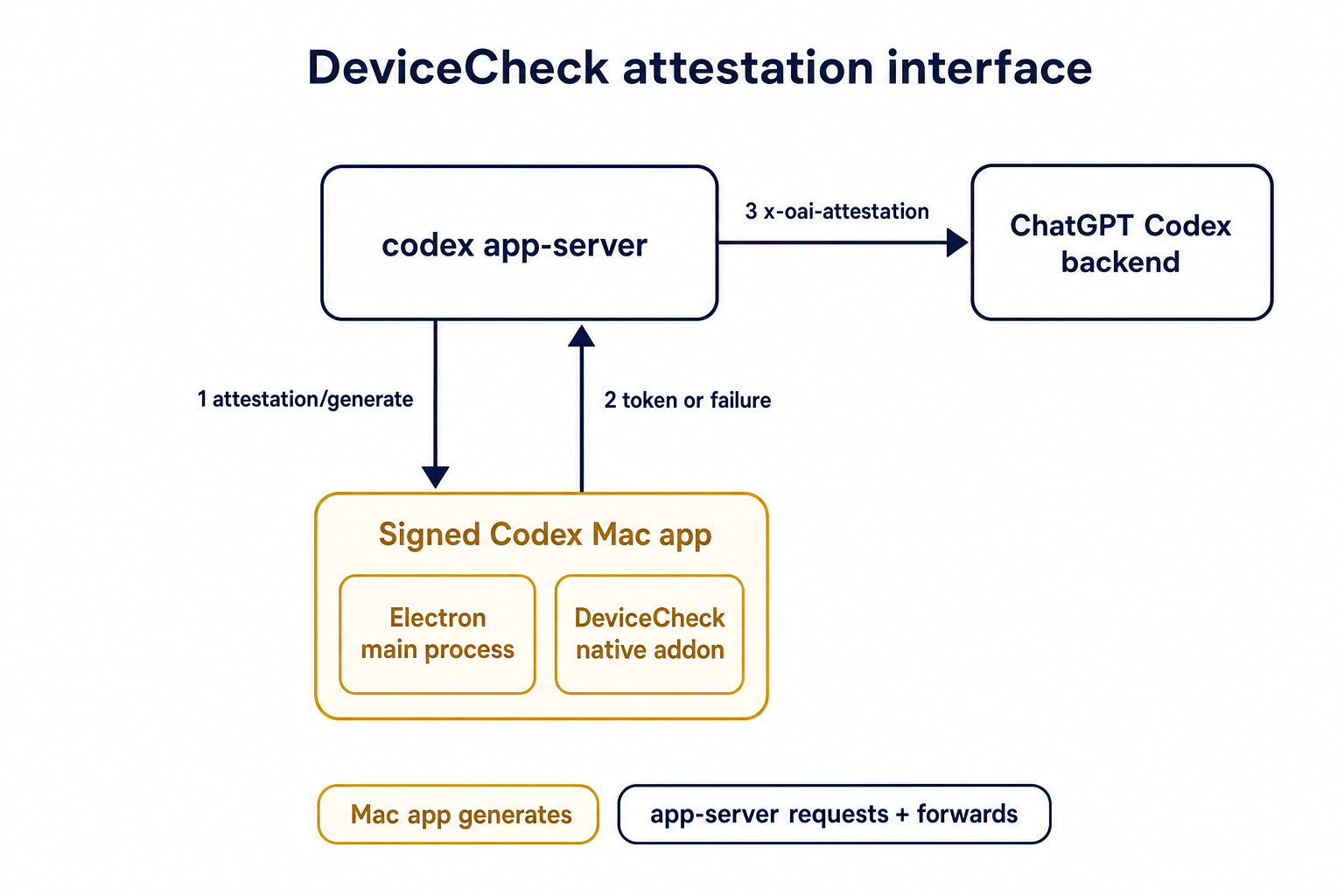
## Details
This PR teaches the Codex app-server runtime how to request and attach
an attestation token. It does not generate DeviceCheck tokens directly;
instead, it relies on the connected desktop app to advertise that it can
generate attestation and then asks that app for a fresh header value
when needed.
The flow is:
1. The Codex desktop app connects to app-server.
2. During `initialize`, the app can advertise that it supports
`requestAttestation`.
3. Before app-server calls selected ChatGPT Codex endpoints, it sends
the internal server request `attestation/generate` to the app.
4. app-server receives a pre-encoded header value back.
5. app-server forwards that value as `x-oai-attestation` on the scoped
outbound requests.
The code in this repo is mostly protocol and runtime plumbing: it adds
the app-server request/response shape, introduces an attestation
provider in core, wires that provider into Responses / compaction /
realtime setup paths, and covers the intended scoping with tests. The
signed macOS DeviceCheck generation remains owned by the desktop app PR.
## Related PR
- Codex desktop app implementation:
https://github.com/openai/openai/pull/878649
## Validation
<details>
<summary>Tests run</summary>
```sh
cargo test -p codex-app-server-protocol
cargo test -p codex-core attestation --lib
cargo test -p codex-app-server --lib attestation
```
Also ran:
```sh
just fix -p codex-core
just fix -p codex-app-server
just fix -p codex-app-server-protocol
just fmt
just write-app-server-schema
```
</details>
<details>
<summary>E2E DeviceCheck validation</summary>
First validated the signed desktop app boundary directly: launched a
packaged signed `Codex.app`, sent `attestation/generate`, decoded the
returned `v1.` attestation header, and validated the extracted
DeviceCheck token with `personal/jm/verify_devicecheck_token.py` using
bundle ID `com.openai.codex`. Apple returned `status_code: 200` and
`is_ok: true`.
Then ran the fuller app + app-server flow. The packaged `Codex.app`
launched a current-branch app-server via `CODEX_CLI_PATH`, and a local
MITM proxy intercepted outbound `chatgpt.com` traffic. The app-server
requested `attestation/generate` from the real Electron app process, and
the intercepted `/backend-api/codex/responses` traffic included
`x-oai-attestation` on both routes:
```text
GET /backend-api/codex/responses Upgrade: websocket x-oai-attestation: present
POST /backend-api/codex/responses Upgrade: none x-oai-attestation: present
```
The captured header decoded to a DeviceCheck token that also validated
with Apple for `com.openai.codex` (`status_code: 200`, `is_ok: true`,
team `2DC432GLL2`).
</details>
---------
Co-authored-by: Codex <noreply@openai.com>
Remove the remote thread-store backend and checked-in protobuf
artifacts. We've moved these into another crate that link against this
one.

Also remove the config settings for thread store backend selection,
since we'll instead pass an instantiated thread store into the core-api
crate's main entrypoint.
- Route ThreadManager rollout-path resume/fork through ThreadStore
history reads.
- Add in-memory store coverage proving path-addressed reads are used.

This isn't strictly necessary for the ThreadStore migration, since these
ThreadManager methods _only_ work for path-based lookups, but I'm trying
to migrate all the rollout recorder callsites to use the threadstore
were possible for consistency.
## Why

Reverts #20689 to restore the previous optional state DB plumbing. The
conflict resolution keeps the newer installation ID and session/thread
identity changes that landed after #20689, while removing the mandatory
state DB and agent graph store dependency from ThreadManager
construction.

## What changed

- Restored `Option<StateDbHandle>` through app-server, MCP server,
prompt debug, and test entry points.
- Removed the `codex-core` dependency on `codex-agent-graph-store` and
reverted descendant lookup back to the existing state DB path when
available.
- Kept newer `installation_id` forwarding by passing it beside the
optional DB handle.
- Kept local thread-name updates working when the optional state DB
handle is absent.

## Validation

- `git diff --check`
- `cargo test -p codex-thread-store`
- `cargo test -p codex-state -p codex-rollout -p
codex-app-server-protocol`
- Attempted `env CARGO_INCREMENTAL=0 cargo test -p codex-core -p
codex-app-server -p codex-app-server-client -p codex-mcp-server -p
codex-thread-manager-sample -p codex-tui`; blocked locally by a rustc
ICE while compiling `v8 v146.4.0` with `rustc 1.93.0 (254b59607
2026-01-19)` on `aarch64-apple-darwin`.
## Why

Skills update notifications are app-server API behavior, but the watcher
lived in `codex-core` and surfaced through
`EventMsg::SkillsUpdateAvailable`. Moving the watcher out keeps core
focused on thread execution and lets app-server own both cache
invalidation and the `skills/changed` notification.

## What changed

- Added an app-server-owned skills watcher that watches local skill
roots, clears the shared skills cache, and emits `skills/changed`
directly.
- Registers skill watches from the common app-server thread listener
attach path, including direct starts, resumes, and app-server-observed
child or forked threads.
- Stores the `WatchRegistration` on `ThreadState`, so listener
replacement, thread teardown, idle unload, and app-server shutdown
deregister by dropping the RAII guard.
- Removed `EventMsg::SkillsUpdateAvailable`, the core watcher, and the
old core live-reload test.
- Extended the app-server skills change test to verify a cached skills
list is refreshed after a filesystem change without forcing reload.

## Validation

- `cargo check -p codex-core -p codex-app-server -p codex-mcp-server -p
codex-rollout -p codex-rollout-trace`
- `cargo test -p codex-app-server
skills_changed_notification_is_emitted_after_skill_change`
## Summary

- resolve or inject the installation ID before core startup and pass it
through `ThreadManager`, `CodexSpawnArgs`, and `Session` as a plain
`String`
- keep child sessions on the parent installation ID instead of
rediscovering it inside core
- propagate installation ID startup failures in `mcp-server` instead of
panicking

## Why

Core was still touching the filesystem on the session startup path to
discover `installation_id`. This moves that work to the outer host
boundary so core no longer depends on `codex_home` reads during session
construction.

---------

Co-authored-by: Codex <noreply@openai.com>
# Overview
MCP refreshes were rebuilding active threads from fresh disk-backed
config only, which dropped thread-start session overlays such as
app-injected MCP servers. This keeps refreshes current with disk config
while preserving the thread-local config that only the active thread
knows about.

# Changes
- Rebuild refreshed config per active thread using that thread's current
`cwd`, rather than fanning out one app-server config to every thread.
- Preserve each thread's `SessionFlags` layer while replacing reloadable
config layers with freshly loaded config, then derive the MCP refresh
payload from the rebuilt result.
- Move MCP refresh orchestration into app-server so manual refreshes
fail loudly while background refreshes remain best-effort, and route
plugin-triggered refreshes through the same per-thread reload path.
- Add regression coverage for session overlays, fresh project config,
plugin-derived MCP config, current requirements, and strict vs
best-effort refresh behavior.

# Verification
- Passed focused Rust coverage for the thread-config rebuild behavior
and deferred MCP refresh flow, plus `cargo test -p codex-app-server
--lib`.
- Verified end to end in the Codex dev app against the locally built
CLI: registered an MCP via thread config, verified that it could be used
successfully before refresh, manually triggered MCP refresh, and
verified that it continued to be available afterward.

